
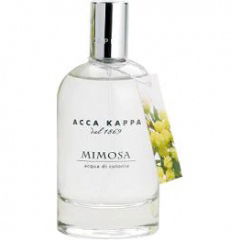
Mimosa Acca Kappa 2004

Top Review
Yes, I am one!!!
Mimosa. If being mimosa-like means being so delicate, so graceful, and so charmingly sunny, yes… then I want to be it! Um… sometimes at least.
A fine silky scent, emotional, a little fairy-like and lovely. Not helplessly girlish and pale in character, but noble and self-assured, almost a bit proud. Very, very beautiful.
It starts with a familiar and irritating note that I do not expect in perfume at all: cut flower stems.
This smell in the flower shop. There, you do not smell roses, irises, gardenias, no, you smell their freshly cut stems. Somewhat floral, but mainly green. Very juicy, a bit prickly. This impression confuses only briefly; quite quickly, through this flower shop scent, comes the one flower that will take the unrivaled leading role in this bouquet: the mimosa.
My scent memory of mimosa was initially quite thin, but as I slowly began to smell it more and more, I recognized it clearly. How does mimosa smell? Greenish, sweet, rounded, very sunny, uplifting, warm.
Christina von Braun writes (in "Stille Post"): "A scent that inevitably evokes a longing for which I have no words."
This mimosa now spreads out in wonderful fullness. And just as it reaches its fullest bloom and radiates a very delicately warm yellow, it is joined by almond. A completely natural almond. Not roasted, salted, sugared, caramelized, no… directly from the tree, freshly lifted from its shell. Even such a young, for our taste quite virgin almond has something green about it. Just like the accompanying, gentle green of the mimosa, the almond green works as well. This is the point where both notes meet and from which they take their departure. Both times into a silky sweetness: with the mimosa it is floral, with the almond it is nutty.
To these two leading, defining notes of mimosa and almond, nothing else is added. They merge after some oscillation into a single scent impression, each retaining its own character. This is supported by warm-sweet sandalwood, which brings an earthiness that underscores the caressing and exceptionally friendly nature of both notes.
The longevity for an EdC is remarkably good.
Mimosas fold their leaves upon touch. Hence their English name "Touch-me-not" and the German usage in the sense of sensitive, wimpy, super-sensitive. However, this beautiful scent has nothing of the little plant "Don’t-touch-me." It does not conceal its delicacy and sunniness but invites irresistible skin closeness.
A fine silky scent, emotional, a little fairy-like and lovely. Not helplessly girlish and pale in character, but noble and self-assured, almost a bit proud. Very, very beautiful.
It starts with a familiar and irritating note that I do not expect in perfume at all: cut flower stems.
This smell in the flower shop. There, you do not smell roses, irises, gardenias, no, you smell their freshly cut stems. Somewhat floral, but mainly green. Very juicy, a bit prickly. This impression confuses only briefly; quite quickly, through this flower shop scent, comes the one flower that will take the unrivaled leading role in this bouquet: the mimosa.
My scent memory of mimosa was initially quite thin, but as I slowly began to smell it more and more, I recognized it clearly. How does mimosa smell? Greenish, sweet, rounded, very sunny, uplifting, warm.
Christina von Braun writes (in "Stille Post"): "A scent that inevitably evokes a longing for which I have no words."
This mimosa now spreads out in wonderful fullness. And just as it reaches its fullest bloom and radiates a very delicately warm yellow, it is joined by almond. A completely natural almond. Not roasted, salted, sugared, caramelized, no… directly from the tree, freshly lifted from its shell. Even such a young, for our taste quite virgin almond has something green about it. Just like the accompanying, gentle green of the mimosa, the almond green works as well. This is the point where both notes meet and from which they take their departure. Both times into a silky sweetness: with the mimosa it is floral, with the almond it is nutty.
To these two leading, defining notes of mimosa and almond, nothing else is added. They merge after some oscillation into a single scent impression, each retaining its own character. This is supported by warm-sweet sandalwood, which brings an earthiness that underscores the caressing and exceptionally friendly nature of both notes.
The longevity for an EdC is remarkably good.
Mimosas fold their leaves upon touch. Hence their English name "Touch-me-not" and the German usage in the sense of sensitive, wimpy, super-sensitive. However, this beautiful scent has nothing of the little plant "Don’t-touch-me." It does not conceal its delicacy and sunniness but invites irresistible skin closeness.
Translated · Show original
8 Comments
 Clover 15 years ago
Beautiful, the comment captures it perfectly. The scent is spring in a bottle!
Translated · Show originalShow translation
 Blanche 15 years ago
*sing* don't touch this, di di di di didi didi
Translated · Show originalShow translation
 Hasi 15 years ago
Great scent, but it's a shame it only lasts a short time on me. I'd have to reapply every half hour :-(
Translated · Show originalShow translation
 Apicius 15 years ago
I need to remember cut flower stems. I think I know this note. From Louban by Montale and from Twill Rose by Parfumerie de Rosine!
Translated · Show originalShow translation
 Eternity 15 years ago
Well, you really have a thing for nuts :-) first pistachio, now almond... what could be next? No, seriously, great comment that makes us all curious about this scent, and we’re all a bit sensitive anyway :-)
Translated · Show originalShow translation
 Kalix 15 years ago
That instantly reminds me of a failed attempt with this extremely demanding plant on my windowsill. It absorbs the water you pour into the pot until it just topples over, without any warning. Very nice description!
Translated · Show originalShow translation
 Woelfin 15 years ago
It encourages you to give it a try...
Translated · Show originalShow translation
Hasi 15 years ago
super super super text!!! :-)
Translated · Show originalShow translation