
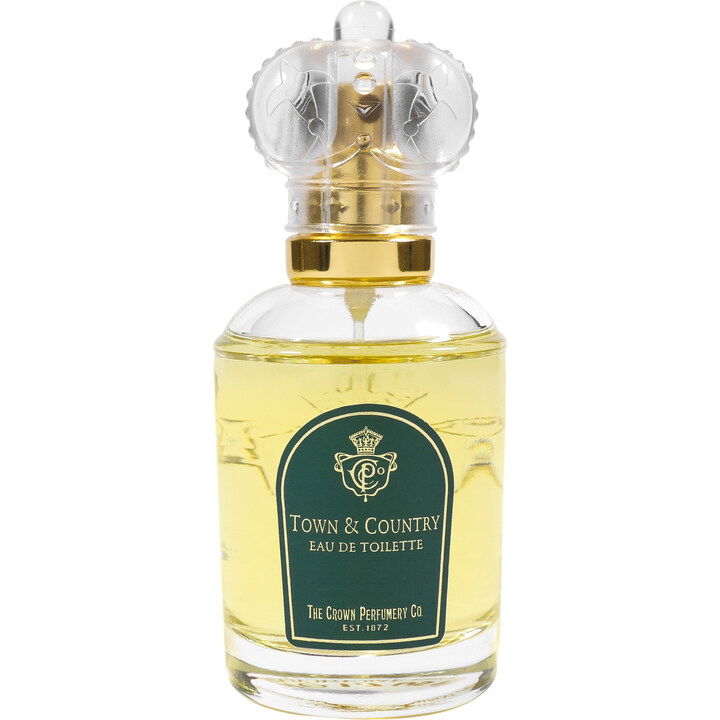
Town & Country Crown Perfumery 1925

55
Top Review
The Extinction of the Aristocrats
Uncommented Fragrances No. 115
I am one of the few lucky owners of a core collection of Crown fragrances, which formed the backbone of British aristocratic colognes for a while after their revival in the 90s. It’s hardly something to admit: Original packaged and sealed remnants of this brand still occasionally surface online, and those who feel inclined to fish, should fish, but leave me the best ones, especially my signature scent (see below).
Caution: The following remarks are primarily of interest to collectors from the parallel universe of traditional English fragrances and are rather a marginal phenomenon even for many connoisseurs here. So you can still decide to exit the reading. I generously forgive that.
The Crown Perfumery's Town & Country belonged at the time to a small family of idiosyncratic light-fresh, almost sharp fragrances that somewhat resemble camphor (Excursus: Does anyone remember that? In the 60s and 70s, it was used to cure almost all diseases, and successfully. This must have been before the hype of homeopathy. Excursus end).
These include in detail:
- Geo F. Trumper Wellington (1876)
- Penhaligon's Blenheim Bouquet (1902)
- The Crown Perfumery Town & Country (1925)
The widely spaced years of release may surprise. In fact, I recently dug out an old catalog lovingly archived by me from Lothar Ruff (The English Scent: english-scent.de / Anglia), perhaps the first to distribute English fragrances on a larger scale in Germany, which mentioned that these three fragrances might go back to a common formula frequently represented around the turn of the century (or even earlier). Lothar Ruff writes: "Imitation occurs everywhere. Who ultimately was the first to introduce this combination of lemon, bergamot, neroli with herbal notes (rosemary, thyme) to the world, I do not know. In any case, the fragrance direction represented by Wellington was a typical scent of the turn of the century. 'Blenheim Bouquet' by Penhaligon's is almost identical, as is 'Town & Country' by The Crown Perfumery." (Lothar Ruff in his catalog "The Art of Grooming. The English Scent", Berlin 2003; to my knowledge, the last printed catalog from The English Scent; after that, the website followed). However, he does not explain why there are decades between the launches of the three mentioned above. He only refers to perhaps an even older variant from another manufacturer. Anyone who knows more about this is kindly invited to contribute enlightening information in the comment section below.
However, what is interesting about this note is also the short list of ingredients, which I believe is more accurate than the currently mentioned ingredients for the fragrance twin Blenheim Bouquet (namely lime, lemon, musk, pine, black pepper; these notes may represent a reformulation) and also better than the too short list above.
Comparing these listings, it is noticeable that Town & Country lacks lemon/lime (which is certainly included in the fragrance), but additionally lavender is mentioned, which I find completely accurate and therefore postulate that the beautiful blue flower (at least originally) should also be contained (or have been) in the sister fragrances Wellington and Blenheim Bouquet.
A small leap to Wellington by Geo F. Trumper, a brand I particularly appreciate: Here we find the lemon mentioned by Lothar Ruff, as well as bergamot, neroli, rosemary, but no thyme and no lavender, instead, however, musk like in Blenheim Bouquet and additionally lily of the valley, which tends to appear in English (also masculine) fragrances and... orange. This, in turn, could indeed be a characteristic of Wellington, which appears a bit softer, juicier, and - yes - more orange-fruity, even if these are marginal details that novices in the club of English fragrances might hardly notice.
All in all, it seems plausible to me that the three fragrances, which are so closely related, all contained the ingredients mentioned by Lothar Ruff as a common denominator (I won’t speak of very recent, reformulated variants), namely: lemon, bergamot, neroli, rosemary, thyme, perhaps musk, perhaps lily of the valley, perhaps lavender - and then in their respective manifestations other accents (Blenheim: lime, Wellington: orange, Town & Country: ?).
By the way: Distant green relatives are Acqua di Selva and Pino Silvestre. They also contain most of the listed ingredients.
What has this brought us now? For most, nothing, for lovers of English fragrances a bit of genealogical research in the realm of extinct English fragrance aristocrats, who have increasingly sold off their silverware (Penhaligon's), are on their way to the auction house (Floris, Truefitt & Hill, Woods of Windsor) or are lurking in niches that normal people (unfortunately) rarely enter (Geo F. Trumper, D.R. Harris, Taylor of Old Bond Street, Czech & Speake, to name a newer representative) or have already died without a male heir (The Crown Perfumery; the fact that the corpse was exhumed by a snob and passably revived as "Clive Christian" at overpriced prices does not count).
To all those who now want to mourn Crown, they should keep their handkerchiefs tucked away and either search the internet or, which is easier, try Anglia Perfumery (initiative Lothar Ruff). There you can find numerous old Crown fragrances (and sometimes also faded fragrance beauties from other houses) as remakes - many of which have turned out quite well. Unfortunately, often with different names, so one has to research a bit painstakingly to find out which original fragrance is hidden behind the new designations. It’s worth it!
I am one of the few lucky owners of a core collection of Crown fragrances, which formed the backbone of British aristocratic colognes for a while after their revival in the 90s. It’s hardly something to admit: Original packaged and sealed remnants of this brand still occasionally surface online, and those who feel inclined to fish, should fish, but leave me the best ones, especially my signature scent (see below).
Caution: The following remarks are primarily of interest to collectors from the parallel universe of traditional English fragrances and are rather a marginal phenomenon even for many connoisseurs here. So you can still decide to exit the reading. I generously forgive that.
The Crown Perfumery's Town & Country belonged at the time to a small family of idiosyncratic light-fresh, almost sharp fragrances that somewhat resemble camphor (Excursus: Does anyone remember that? In the 60s and 70s, it was used to cure almost all diseases, and successfully. This must have been before the hype of homeopathy. Excursus end).
These include in detail:
- Geo F. Trumper Wellington (1876)
- Penhaligon's Blenheim Bouquet (1902)
- The Crown Perfumery Town & Country (1925)
The widely spaced years of release may surprise. In fact, I recently dug out an old catalog lovingly archived by me from Lothar Ruff (The English Scent: english-scent.de / Anglia), perhaps the first to distribute English fragrances on a larger scale in Germany, which mentioned that these three fragrances might go back to a common formula frequently represented around the turn of the century (or even earlier). Lothar Ruff writes: "Imitation occurs everywhere. Who ultimately was the first to introduce this combination of lemon, bergamot, neroli with herbal notes (rosemary, thyme) to the world, I do not know. In any case, the fragrance direction represented by Wellington was a typical scent of the turn of the century. 'Blenheim Bouquet' by Penhaligon's is almost identical, as is 'Town & Country' by The Crown Perfumery." (Lothar Ruff in his catalog "The Art of Grooming. The English Scent", Berlin 2003; to my knowledge, the last printed catalog from The English Scent; after that, the website followed). However, he does not explain why there are decades between the launches of the three mentioned above. He only refers to perhaps an even older variant from another manufacturer. Anyone who knows more about this is kindly invited to contribute enlightening information in the comment section below.
However, what is interesting about this note is also the short list of ingredients, which I believe is more accurate than the currently mentioned ingredients for the fragrance twin Blenheim Bouquet (namely lime, lemon, musk, pine, black pepper; these notes may represent a reformulation) and also better than the too short list above.
Comparing these listings, it is noticeable that Town & Country lacks lemon/lime (which is certainly included in the fragrance), but additionally lavender is mentioned, which I find completely accurate and therefore postulate that the beautiful blue flower (at least originally) should also be contained (or have been) in the sister fragrances Wellington and Blenheim Bouquet.
A small leap to Wellington by Geo F. Trumper, a brand I particularly appreciate: Here we find the lemon mentioned by Lothar Ruff, as well as bergamot, neroli, rosemary, but no thyme and no lavender, instead, however, musk like in Blenheim Bouquet and additionally lily of the valley, which tends to appear in English (also masculine) fragrances and... orange. This, in turn, could indeed be a characteristic of Wellington, which appears a bit softer, juicier, and - yes - more orange-fruity, even if these are marginal details that novices in the club of English fragrances might hardly notice.
All in all, it seems plausible to me that the three fragrances, which are so closely related, all contained the ingredients mentioned by Lothar Ruff as a common denominator (I won’t speak of very recent, reformulated variants), namely: lemon, bergamot, neroli, rosemary, thyme, perhaps musk, perhaps lily of the valley, perhaps lavender - and then in their respective manifestations other accents (Blenheim: lime, Wellington: orange, Town & Country: ?).
By the way: Distant green relatives are Acqua di Selva and Pino Silvestre. They also contain most of the listed ingredients.
What has this brought us now? For most, nothing, for lovers of English fragrances a bit of genealogical research in the realm of extinct English fragrance aristocrats, who have increasingly sold off their silverware (Penhaligon's), are on their way to the auction house (Floris, Truefitt & Hill, Woods of Windsor) or are lurking in niches that normal people (unfortunately) rarely enter (Geo F. Trumper, D.R. Harris, Taylor of Old Bond Street, Czech & Speake, to name a newer representative) or have already died without a male heir (The Crown Perfumery; the fact that the corpse was exhumed by a snob and passably revived as "Clive Christian" at overpriced prices does not count).
To all those who now want to mourn Crown, they should keep their handkerchiefs tucked away and either search the internet or, which is easier, try Anglia Perfumery (initiative Lothar Ruff). There you can find numerous old Crown fragrances (and sometimes also faded fragrance beauties from other houses) as remakes - many of which have turned out quite well. Unfortunately, often with different names, so one has to research a bit painstakingly to find out which original fragrance is hidden behind the new designations. It’s worth it!
Translated · Show original
42 Comments
A true encyclopedia!
I really like the scent after some initial hiccups.
🏆
This was entertaining and, as always, very informative. I'm honestly impressed by the availability of printed catalogs for reference!
It's a shame that so far, I've only liked one women's fragrance from The Crown enough to consider buying it. But even that one, I probably wouldn't find anymore, and Anglia isn't available anymore, right? Or is it?
Thank you for the interesting history lesson!
As always, an interesting comment!
Thank you for that.
"Malabar," the only Crown scent I've had the chance to experience, has convinced me with its British understatement.
And while Franzbranntwein may be old, it really helps with back pain and sore muscles ;-).
Great comment... I learned a lot from it; English fragrances aren't really my specialty. Thanks for that, and a beautiful trophy for you!!