
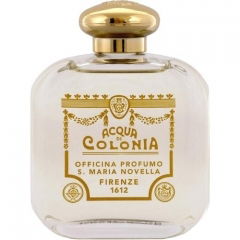
Acqua di Sicilia Santa Maria Novella 1997

33
Top Review
Neukölln 16: Sicilian Vespers
The Sicilian Vespers is, technically speaking, not a cozy evening snack or meal, but rather a massacre of the French occupiers in Palermo in the year 1282. It began on Easter Monday during the time of the Vespers prayer. However, there is no reason for bloody Boadicean concern regarding this commentary. It really only concerns the culinary impressions that this fragrance, which originates from Florence in Tuscany but is named after Sicily, evokes.
In my opinion, Acqua di Sicilia, although it can be recognized as a classic cologne and has a rather traditional fragrance pyramid, is quite a distance from the well-known Farina-4711 standard.
This is primarily because it comes across as very lemony (despite the orange ingredients doubled with neroli and petitgrain). However, this should not lead to the assumption that anything here is sour or would cause one's features to contort. There is also no hint of a pale yellow, almost white, cold, and crystalline sharpness. On the contrary, we are talking about such juicy, dark yellow, meaty lemons that they have become almost sweet in their ripeness. Whether that is botanically possible, I do not know; in any case, it is my olfapoetic impression. If we want to move on less shaky scientific ground, we can also conjure up the image of lavishly candied lemons from a Sicilian confectionery, perhaps to be enjoyed with a glass of cold water and a bitter caffè, or to be baked into a Christmas panettone. It is as if the orange notes are not perceptible on their own (nothing here smells of mandarin or orange), but (probably in conjunction with the Sumatra benzoin, which is attributed a "creamy-sweet" aroma) the bergamot only wondrously transforms into sweetness and fullness.
The second prominent feature of the fragrance is the impression of shadowy, woody, bushy, almost misty coolness, which Yatagan has already perfectly described in his commentary and cannot be further supplemented, no matter how the (business) descendants of the monks of S.M. Novella have managed to evoke this scent impression.
Although I greatly enjoy this midsummer picnic with candied lemons in a shady Sicilian grove, the fragrance ultimately misses out on top ratings for me. Because while I have nothing to remember against the sweet aspect of the benzoin here, I am put off by the slightly vanillic-creamy note that characterizes the fragrance not only in the base. Perhaps it is time for me to come to the realization that I prefer the cool-crystalline variants in colognes.
Additionally, and I hesitate and tremble to say it, there is once again a case where (albeit in an extremely weak variant) my enjoyment of a cologne is marred by a subtly resonating, background sausage note. This is now the fourth or fifth time I have come to this conclusion (always only with citrus colognes), and I cannot explain it. Perhaps it is just a genetically determined individual misperception (like color blindness) regarding some ingredient that is often used in colognes, and not a negative quality characteristic. Therefore, readers should perhaps not be deterred by this aspect. However, since I can only describe the fragrance as I perceive it, I want to give honesty its due and not sweep this Salsiccia misperception under the monastery carpet.
The longevity in the test was about two to three hours. I can remain silent about the highly interesting brand, as many reviewers have already written about SMN fragrances, including myself in my review of Colonia Russa. It should be noted that the packaging in the beautiful bottles is somewhat confusing, as sometimes those labeled "Acqua di Sicilia" are used, while at other times, those marked only "Acqua di Colonia" are used; these are likely universally usable containers (for several colognes from the company).
In my opinion, Acqua di Sicilia, although it can be recognized as a classic cologne and has a rather traditional fragrance pyramid, is quite a distance from the well-known Farina-4711 standard.
This is primarily because it comes across as very lemony (despite the orange ingredients doubled with neroli and petitgrain). However, this should not lead to the assumption that anything here is sour or would cause one's features to contort. There is also no hint of a pale yellow, almost white, cold, and crystalline sharpness. On the contrary, we are talking about such juicy, dark yellow, meaty lemons that they have become almost sweet in their ripeness. Whether that is botanically possible, I do not know; in any case, it is my olfapoetic impression. If we want to move on less shaky scientific ground, we can also conjure up the image of lavishly candied lemons from a Sicilian confectionery, perhaps to be enjoyed with a glass of cold water and a bitter caffè, or to be baked into a Christmas panettone. It is as if the orange notes are not perceptible on their own (nothing here smells of mandarin or orange), but (probably in conjunction with the Sumatra benzoin, which is attributed a "creamy-sweet" aroma) the bergamot only wondrously transforms into sweetness and fullness.
The second prominent feature of the fragrance is the impression of shadowy, woody, bushy, almost misty coolness, which Yatagan has already perfectly described in his commentary and cannot be further supplemented, no matter how the (business) descendants of the monks of S.M. Novella have managed to evoke this scent impression.
Although I greatly enjoy this midsummer picnic with candied lemons in a shady Sicilian grove, the fragrance ultimately misses out on top ratings for me. Because while I have nothing to remember against the sweet aspect of the benzoin here, I am put off by the slightly vanillic-creamy note that characterizes the fragrance not only in the base. Perhaps it is time for me to come to the realization that I prefer the cool-crystalline variants in colognes.
Additionally, and I hesitate and tremble to say it, there is once again a case where (albeit in an extremely weak variant) my enjoyment of a cologne is marred by a subtly resonating, background sausage note. This is now the fourth or fifth time I have come to this conclusion (always only with citrus colognes), and I cannot explain it. Perhaps it is just a genetically determined individual misperception (like color blindness) regarding some ingredient that is often used in colognes, and not a negative quality characteristic. Therefore, readers should perhaps not be deterred by this aspect. However, since I can only describe the fragrance as I perceive it, I want to give honesty its due and not sweep this Salsiccia misperception under the monastery carpet.
The longevity in the test was about two to three hours. I can remain silent about the highly interesting brand, as many reviewers have already written about SMN fragrances, including myself in my review of Colonia Russa. It should be noted that the packaging in the beautiful bottles is somewhat confusing, as sometimes those labeled "Acqua di Sicilia" are used, while at other times, those marked only "Acqua di Colonia" are used; these are likely universally usable containers (for several colognes from the company).
Translated · Show original
25 Comments
By the way, have you ever been to l’Officine Universelle Buly 1803 in Paris? You might like it.
To delve deeper into other aspects of the sausage water, I recommend to you and the esteemed readership the brilliantly funny work by your Charlottenburg/Neukölln compatriot Thomas Kapielski: 'Aqua Botulus'.
:))
I wish there were so many fragrances I’d love to write about... You're super productive right now, hats off!
If the broth sausage note could be intensified, it might create a whole new perfume experience. I’d also be interested in a liver sausage scent and a smoked sausage perfume. But no one dares to try, and maybe the market for it is limited.
Still, an eight...