
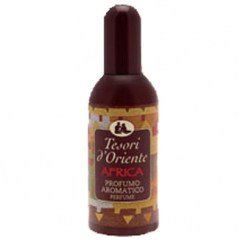
Africa Tesori d'Oriente

20
Top Review
Elsewhere
A mysterious brew. Right after application, I am hit by a piercing, musty artificiality, reminiscent of many (and unfortunately not exclusively bad) lavender scents that develop on my skin. It only dawns on me over the course of the next hour that this must be the harbinger of a heliotrope synthetic.
The possibly most well-known type of heliotrope, the vanilla flower, certainly lives up to its name in terms of scent, but it also offers a prickly-sweet nuance that always strikes me as rather artificial. That is exactly what comes to mind. Now, heliotrope in fragrances as a source of vanilla scent is by no means unusual (or even standard - at least that’s what I’ve read somewhere), but I think it could be a bit rounder.
Additionally, cinnamon could be involved in the scent impression, which would fit the prickliness quite well. From a distance - quite a distance - orange blossom might play a role. According to Angua (see below), it is mentioned on the bottle, but I wouldn’t have thought of it on my own initially. Be that as it may, with a bit of imagination, orange blossom honey is fine with me - from a very, very far distance. Dry cedar dusts around in the background. On the side. As if the two have nothing to do with each other, each doing its own thing.
In the fourth hour, the mustiness breaks through again, this time, I must admit, woodier than before. The slightly prickly-stinky white flower note comes a little closer. From the fifth hour on - variatio delectat - the mustiness seems more like that of patchouli. Along with the well-known synthetic sweetness. I find this combination quite unpleasant. Dusty must and cheap vanilla. Unfortunately, this continues for hours until, by evening, only…dusty must remains.
If I had to name a fragrance that Africa reminds me of the most, it would be (the certainly better) Nightflight by Joop, due to the dominant artificial heliotrope note on dry wood. Although the night flight in this case may lead elsewhere - certainly not to Africa.
What remains is my realization that according to Duden, a “sonst” is always separated from the following word. Aha. At least something.
I thank ChaiTee for the sample.
The possibly most well-known type of heliotrope, the vanilla flower, certainly lives up to its name in terms of scent, but it also offers a prickly-sweet nuance that always strikes me as rather artificial. That is exactly what comes to mind. Now, heliotrope in fragrances as a source of vanilla scent is by no means unusual (or even standard - at least that’s what I’ve read somewhere), but I think it could be a bit rounder.
Additionally, cinnamon could be involved in the scent impression, which would fit the prickliness quite well. From a distance - quite a distance - orange blossom might play a role. According to Angua (see below), it is mentioned on the bottle, but I wouldn’t have thought of it on my own initially. Be that as it may, with a bit of imagination, orange blossom honey is fine with me - from a very, very far distance. Dry cedar dusts around in the background. On the side. As if the two have nothing to do with each other, each doing its own thing.
In the fourth hour, the mustiness breaks through again, this time, I must admit, woodier than before. The slightly prickly-stinky white flower note comes a little closer. From the fifth hour on - variatio delectat - the mustiness seems more like that of patchouli. Along with the well-known synthetic sweetness. I find this combination quite unpleasant. Dusty must and cheap vanilla. Unfortunately, this continues for hours until, by evening, only…dusty must remains.
If I had to name a fragrance that Africa reminds me of the most, it would be (the certainly better) Nightflight by Joop, due to the dominant artificial heliotrope note on dry wood. Although the night flight in this case may lead elsewhere - certainly not to Africa.
What remains is my realization that according to Duden, a “sonst” is always separated from the following word. Aha. At least something.
I thank ChaiTee for the sample.
Translated · Show original
17 Comments
To the point, informative, rich in metaphors.
And it hits my perception spot on.
🏆