
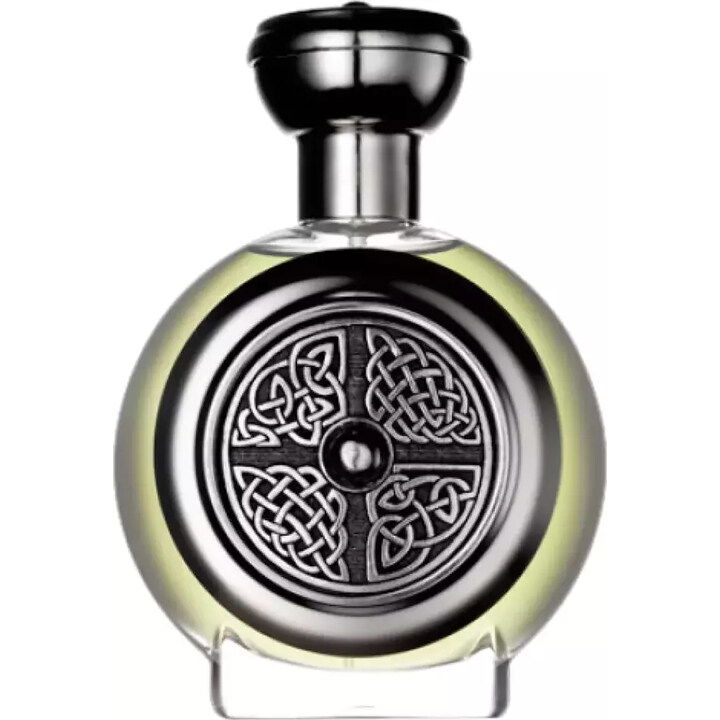
Explorer Boadicea the Victorious 2008

6
Helpful Review
Boadi-Controversy - an explorative reanalysis
An explorer sets out to discover new things - or to rediscover forgotten ones. The perfumer who calls his creation "Explorer" may have just wanted to try something fun.
The Boadicea Explorer has sparked quite a controversial discussion here in the forum, which, from my current perspective, has stretched from the ancient times of Parfumo to the High Middle Ages. The average rating is just 6.5, and the entire spectrum of evaluations has been given, from catastrophic to phenomenal. At least half of the stock must have long been used up in the sanitary sector. As a 3-year perfume veteran - someone from the middle Parfumo modern era - I will now analyze this fragrance work once again. In doing so, I will attempt to translate the now somewhat archaic texts from the context of their time into modern perfume German and incorporate the judgments of our ancestors into my analysis. References to living persons are intentional, as are plagiarisms! DonTheBoss was reminded of "polishing" while exploring (note for modern Parfumo users: the act of rubbing a floor with a protective wax layer - something grandma used to do). Patchouli or not, DeGirlof53 found it cedar-like but was put in the cleaning product corner by everyone else (note: back then, emancipation still had to be fought for, so I suspect that the mentioned prejudices came from male "others"). In the early modern period, someone associated this scent with tractor (gear) differential oil and stated it was perfectly wearable for gold chain-wearing gentlemen (note: correctly "gendered" thus gold chain-wearing gentlemen/*inas) starting from 85. It remains unclear at this point whether the enthusiastic author himself falls into this category.
From all these cultural-historical impressions, however, a picture emerges with today's perspective that - quite contemporarily - is somewhat top-note heavy. Why? Of course, because of the almost mega-fruit in it. Naturally, one can assume that the work has been reformulated. However, I was able to experimentally reconstruct how the reformulation was most likely carried out. Frog wood cleaner (with natural ingredients from pine) provides the green-bitter base tone (note: from today's perspective, rather mild than bitter). A portion of SOFIX parquet adds the somewhat soapy wax note. Plenty of grated orange peels stirred in, and applied to an oak floor. The "sun rose" is, in my opinion, an overzealous translation error for a few floral sprinkles. After absorption, one extracts an "absolute" from it. It then smells like a cedar wood log rubbed with orange peel butter.
The verdict: The scent clearly belongs in the "phenomenal" category today. No twin is known, not even in the slightest. The minimum age for wearability starts significantly lower due to the fruity note in modern times, but due to the slight soapiness and less pronounced sweetness, perhaps at 45 ± 16.3.
{preprint from Parf. Phil. Trans., vol 733, 34pp, 2021.}
The Boadicea Explorer has sparked quite a controversial discussion here in the forum, which, from my current perspective, has stretched from the ancient times of Parfumo to the High Middle Ages. The average rating is just 6.5, and the entire spectrum of evaluations has been given, from catastrophic to phenomenal. At least half of the stock must have long been used up in the sanitary sector. As a 3-year perfume veteran - someone from the middle Parfumo modern era - I will now analyze this fragrance work once again. In doing so, I will attempt to translate the now somewhat archaic texts from the context of their time into modern perfume German and incorporate the judgments of our ancestors into my analysis. References to living persons are intentional, as are plagiarisms! DonTheBoss was reminded of "polishing" while exploring (note for modern Parfumo users: the act of rubbing a floor with a protective wax layer - something grandma used to do). Patchouli or not, DeGirlof53 found it cedar-like but was put in the cleaning product corner by everyone else (note: back then, emancipation still had to be fought for, so I suspect that the mentioned prejudices came from male "others"). In the early modern period, someone associated this scent with tractor (gear) differential oil and stated it was perfectly wearable for gold chain-wearing gentlemen (note: correctly "gendered" thus gold chain-wearing gentlemen/*inas) starting from 85. It remains unclear at this point whether the enthusiastic author himself falls into this category.
From all these cultural-historical impressions, however, a picture emerges with today's perspective that - quite contemporarily - is somewhat top-note heavy. Why? Of course, because of the almost mega-fruit in it. Naturally, one can assume that the work has been reformulated. However, I was able to experimentally reconstruct how the reformulation was most likely carried out. Frog wood cleaner (with natural ingredients from pine) provides the green-bitter base tone (note: from today's perspective, rather mild than bitter). A portion of SOFIX parquet adds the somewhat soapy wax note. Plenty of grated orange peels stirred in, and applied to an oak floor. The "sun rose" is, in my opinion, an overzealous translation error for a few floral sprinkles. After absorption, one extracts an "absolute" from it. It then smells like a cedar wood log rubbed with orange peel butter.
The verdict: The scent clearly belongs in the "phenomenal" category today. No twin is known, not even in the slightest. The minimum age for wearability starts significantly lower due to the fruity note in modern times, but due to the slight soapiness and less pronounced sweetness, perhaps at 45 ± 16.3.
{preprint from Parf. Phil. Trans., vol 733, 34pp, 2021.}
Updated on 12/14/2021
Translated · Show original
1 Comment
 Floyd 4 years ago
Great retrospective! Really enjoyed studying it!
Translated · Show originalShow translation