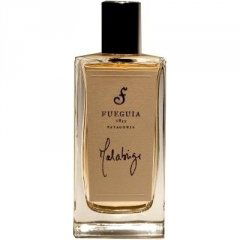
Anyone who has always had the urgent desire to smell like warm llama neck can now breathe a sigh of relief. On the other hand, if the thought of fur makes you wrinkle your nose, rest assured: Malabrigo does not smell like a stable, but rather like the alpine sun of Patagonia. It is a cozy scent that breathes expansiveness. For me, it embodies the fur skirts of a shamaness and awakens a longing for a relationship with animals that is characterized not by exploitation, but by respect and gratitude.
I discovered Malabrigo in an excellent little perfumery on via settembre XX in Alassio. Well, to be honest, I didn’t discover it; Harlekino did. As a die-hard Bordeaux box fetishist, he immediately fell for the charming wooden boxes in which the Fueguias are sold. Additionally, according to the brochure, only wood from trees that naturally fall is used to make these boxes. A lovely idea.
Talented knitters might know Malabrigo as a name for a yarn that, according to the internet, is produced by a women’s cooperative in Uruguay. It is said to be characterized by a very special softness. However, the perfume clearly smells to me like a wool that is attached to a living animal. I can also perceive plenty of dark, woody components and a hint of smoke. Malabrigo contains guaiac wood and copaiba balsam, a balsam unknown to me until now, which vaguely reminds me of oud. Copa means resin juice in the Tupi language (a language spoken in Brazil before the Conquista). This resin juice is obtained by making deep cavities in the trunks of the Copaifera trees. A tree can yield up to 50 liters in a short time this way. 10 ml costs about 1.70 euros, making it relatively affordable. Copaiba balsam is still used today in medicine, as well as for making varnish and lacquer. It is golden yellow, thick, and its smell is described as peculiar, scratchy, and bitter. I do not find Malabrigo scratchy at all, which is likely due to the cashmeran. A bit scruffy and peculiar, yes, but not scratchy. Bitter, yes, but perfectly balanced by a sweetness that I attribute to the guaiac wood, from which I believe I can detect a hint of licorice, just enough that those who dislike licorice should be fine with it. When I first sprayed it, I had my doubts about whether Malabrigo and I could become friends. But Malabrigo turned out to be much more bearable than I had assumed. It has a strong presence but makes no noise on the skin. My surroundings reacted overwhelmingly positively to the scent, even though I openly declared that I would be smelling like vicuña llama for a change today. The scent progression is stable, longevity and sillage are very good, though not outstanding. The truly remarkable thing about this perfume is the way it adapts to the individual personality. What I also like is its bold closeness to wood and animal, which I see as absolutely not coarse. I could very well imagine wearing Malabrigo to social occasions. And although my first impression was different, I find it to be distinctly unisex. Sun and sport do not detract from Malabrigo at all; on the contrary, they really bring it to life, so I would consider it a criminal waste to assign it solely to the colder seasons.


It's going on my list, I have to try it!