“Legends of Classical Antiquity,” specifically: the Greek mythological world - presented in a series of 80 episodes, each lasting a quarter of an hour. This may sound like hours, days, or even weeks of torment to some. However, it is by no means so when the Austrian writer Michael Köhlmeier takes on the role of the narrator (www.br.de/fernsehen/ard-alpha/sendungen/mythen/index.html). With him, the figures come to life in the present, seemingly as if what he says occurs to him only at that very moment - and perhaps that is exactly what happens. To be able to weave such tales is an impressive gift.
In passing, one can also catch a glimpse of what a refined Austrian accent sounds like (’tschuldigung…).
Well, what I really want to get at is that the Greek myths are filled to the brim with (active or passive) transformations of various beings - which is, in fact, an ancient tradition that continues seamlessly in Ovid’s (for us: Eauvied’s) Metamorphoses. However, most of the time, all this effort is of no use to the people, and they still end up getting killed or are popped by Zeus. Or the situation is simply annoying: who wants to be transformed into a spider or to hang around as a constellation at a chilly zero degrees Kelvin for eternity?
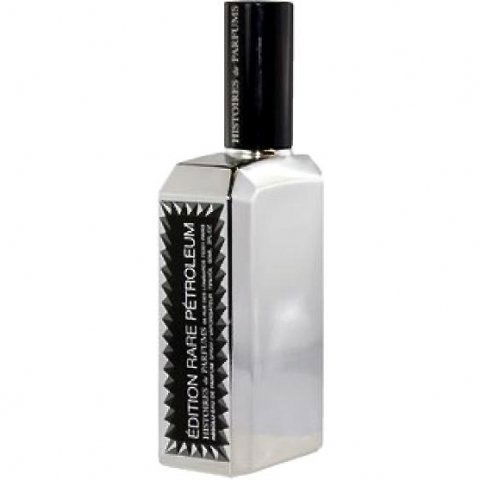
‘Petroleum’ also performs a masquerade. At first, it disguises itself by throwing on a leather rag soaked with plenty of workshop grease and solvents, later it hides, rather poorly, behind a gradually emerging floral fruitiness that embodies more the “principle of rose” than “rose” itself. Leather and rose are sometimes very close together - especially when the leather is first created from oily rose. Today, however, we seemingly have two different things at hand.
Yesss, and there’s also a bit more from the AmbER corner. But I’ve still detected an (for me) old acquaintance. Underneath lies a good piece of the DNA of ‘Ambrarem’ from the same house. The kinship of the inner workings, the base of ‘Petroleum’ to the animalistic-creamy, banana-touched sibling, which also partially approaches the leather side through castoreum, is unmistakable, although not as drastically as in this case, and from a different direction.
The pyramidical notes do not suggest the relationship, yet I am confident in my assertion, as I own ‘Ambrarem’ and was therefore able to test them side by side. The visual similarity and the same year of release may also be no coincidence. And, what a surprise, I also like ‘Petroleum’. The brutal opening should not deter anyone; it softens a little(!) over time.
In any case, I do not want the above to be understood as a reproach; the Histoire people would not try to sell us something too similar twice. No, ‘Petroleum’ is primarily a completely independent fragrance due to its hours-long focus on “floral leatheriness,” which moreover does not stomp over the vanilla path at the end, as ‘Ambrarem’ does.
Conclusion: It’s things like this that excite me about the topic of perfume.
While reading, I thought, oh no, I won't like this scent. The last sentence puzzled me, and look at that, I rated it super well too, just that you discovered different facets.
Could definitely appeal to me, but the topic of liquid fuels has just been taken over by /L again. Also, Royal Mayfair with its petroleum opening is waiting for a comeback. Great headline, by the way!
It seems to me that you enjoyed not only testing but also writing about it :)
For me, though, this one isn't it; the historians offer nicer options for my nose.
How great that there are things like this and that you bring them closer to us! I enjoyed reading it again, but with leather AND animalistic notes, I start to get a bit uneasy :-D


That's why we're exploring here!
For me, though, this one isn't it; the historians offer nicer options for my nose.
I really enjoy your thought processes.
Thank you!