
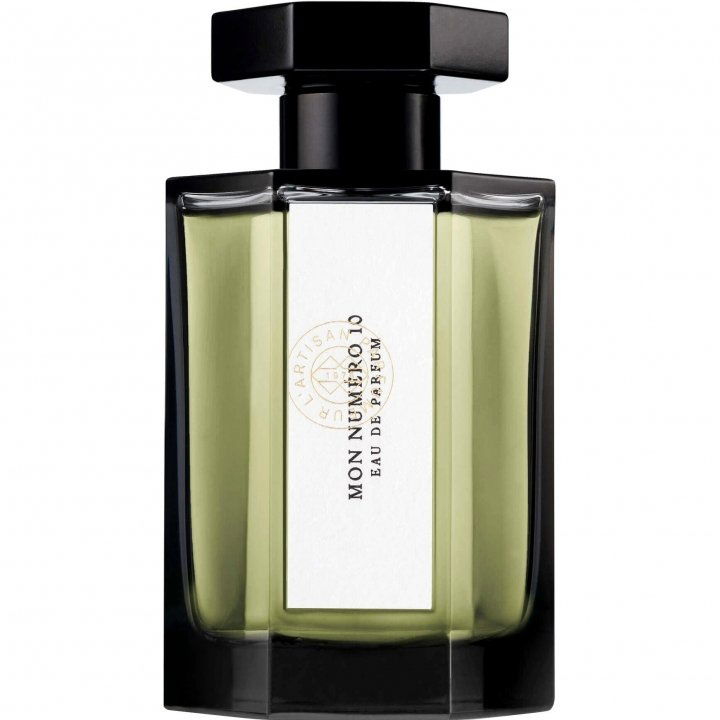
Mon Numéro 10 L'Artisan Parfumeur 2009
37
Top Review
serial killer
Bertrand Duchaufour is a busy man; I believe there is no other major perfumer with such a conveyor-belt-like output. In this respect, his "Numéro" fragrances for L'Artisan are fundamentally honest in their naming: they are, viewed kindly, études in which he plays with his fragrance toolkit. Less kindly, one might ask why someone of Renzo Piano's caliber is dealing with prefabricated modules instead of occasionally presenting a truly great creation. Consider that the great Edmond Roudnitska spent over two years tinkering with Eau Sauvage - what emerged was a classic Eau de Cologne with an overdose of Hedione, a simple but brilliant idea, a fragrance of the century. But those were different, clearly better times, because ironically, the massification of the fragrance market is not a truly successful strategy; it poses not only an aesthetic but also an economic problem, as the multinationals are now realizing. Unfortunately, no one has dared to break free from the spiral of mediocrity, and thus haute perfumery has largely settled at the level of air fresheners, with all competitors hoping their clone of Million will be the next big seller.
Against this backdrop, I find it unconstructive to view a product like Mon Numéro 10 as an independent work of art and Duchaufour as an artistic genius in the 19th-century sense. He is a technically skilled constructor of a series, working under time pressure and with a very limited budget, in an industry that, thanks to brilliant marketing, successfully offers Dacias at Ferrari prices. The ironic break lies in the fact that the numbered line began as a series of bespoke fragrances, with a single bottle priced at $20,000. In a second step, the fragrances were assigned to cities and offered only through an exclusive outlet - in the case of Numéro 10, Barney's New York. Then the series became available online, and eventually, this fragrance ended up in the TK Maxx bargain bin - the story of an artificially generated exclusivity cycle that essentially reveals everything essential about the nature of today's (pseudo) luxury market. Naturally, such a gradual downgrading with a truly limited product, like 150-year-old Oud, would be completely unthinkable.
Michael Edwards classifies Mon Numéro 10 as "dry wood" - this is very accurate, as the fragrance is almost nose-burning with Norlimbanol or similar dry wood synthetics, harking back to a classic Duchaufour theme, which he perfected in Timbuktu according to Luca Turin (the current Timbuktu, however, has as much in common with the original as the single bottle No. 10 likely does with the mass-market version). Alongside the dry wood, there is dry leather and woody-synthetic incense (Bertrand's Comme des Garçons period beckons from afar). So far, so conventional. What distinguishes this fragrance is the unusual spice accord layered over it - pink peppery, nutmeg-cardamom-like, cinnamon. Together, this results in a note for most Americans somewhere between Dr. Pepper and Cherry Coke - not something one would want to pay $200 for the "can," which is why the fragrance has rarely been positively reviewed west of the Atlantic. As a transatlantic hybrid, I share this association, but I do not find it compelling. No. 10 immediately reminded me of classic sharp shaving soap with spice and typical rose geranium notes, and I thought immediately of Penhaligon's Sartorial, Duchaufour's cheeky homage to the classic, cheap barbershop fougères of the last century - different context, different marketing, but there are definite connections. The amber base that emerges after a few hours, composed of musk and tonka notes, is disappointingly cheap, but in this respect, L'Artisan has never been an alternative for Lutens enthusiasts like me. Thanks to the super-adhering synthetics, No. 10 simply lasts forever and withstands even washing attempts, and for a fragrance from this house, it is unusually penetrating. It irritates my sinuses so much that I will certainly not wear it again and will promptly dispose of the scent strip in front of me outside the apartment.
This analytical-contextual review already reveals that Mon Numéro 10 does not move me; rather, it interests me at best as a case study of the state of the perfume industry. The overly obvious plug modules and routines prevent that "suspension of disbelief" necessary for a fragrance to transport me to a special memory or emotional place - just as the stereotypical nature of serial mainstream pop leaves me cold or cliché-driven literature like Dan Brown. Even if that were not the case, the synthetics here are simply too harsh for me - which says something given Duchaufour's blending talent. I have little hope that his future works will appeal to me, especially since he mentioned in an interview that he wants to turn to the Ellena school of synthetic minimalism, which I consider a creative dead end (see Monsieur Li). I would prefer he spend two years in a Buddhist monastery and absorb the soul of Jacques Guerlain.
Against this backdrop, I find it unconstructive to view a product like Mon Numéro 10 as an independent work of art and Duchaufour as an artistic genius in the 19th-century sense. He is a technically skilled constructor of a series, working under time pressure and with a very limited budget, in an industry that, thanks to brilliant marketing, successfully offers Dacias at Ferrari prices. The ironic break lies in the fact that the numbered line began as a series of bespoke fragrances, with a single bottle priced at $20,000. In a second step, the fragrances were assigned to cities and offered only through an exclusive outlet - in the case of Numéro 10, Barney's New York. Then the series became available online, and eventually, this fragrance ended up in the TK Maxx bargain bin - the story of an artificially generated exclusivity cycle that essentially reveals everything essential about the nature of today's (pseudo) luxury market. Naturally, such a gradual downgrading with a truly limited product, like 150-year-old Oud, would be completely unthinkable.
Michael Edwards classifies Mon Numéro 10 as "dry wood" - this is very accurate, as the fragrance is almost nose-burning with Norlimbanol or similar dry wood synthetics, harking back to a classic Duchaufour theme, which he perfected in Timbuktu according to Luca Turin (the current Timbuktu, however, has as much in common with the original as the single bottle No. 10 likely does with the mass-market version). Alongside the dry wood, there is dry leather and woody-synthetic incense (Bertrand's Comme des Garçons period beckons from afar). So far, so conventional. What distinguishes this fragrance is the unusual spice accord layered over it - pink peppery, nutmeg-cardamom-like, cinnamon. Together, this results in a note for most Americans somewhere between Dr. Pepper and Cherry Coke - not something one would want to pay $200 for the "can," which is why the fragrance has rarely been positively reviewed west of the Atlantic. As a transatlantic hybrid, I share this association, but I do not find it compelling. No. 10 immediately reminded me of classic sharp shaving soap with spice and typical rose geranium notes, and I thought immediately of Penhaligon's Sartorial, Duchaufour's cheeky homage to the classic, cheap barbershop fougères of the last century - different context, different marketing, but there are definite connections. The amber base that emerges after a few hours, composed of musk and tonka notes, is disappointingly cheap, but in this respect, L'Artisan has never been an alternative for Lutens enthusiasts like me. Thanks to the super-adhering synthetics, No. 10 simply lasts forever and withstands even washing attempts, and for a fragrance from this house, it is unusually penetrating. It irritates my sinuses so much that I will certainly not wear it again and will promptly dispose of the scent strip in front of me outside the apartment.
This analytical-contextual review already reveals that Mon Numéro 10 does not move me; rather, it interests me at best as a case study of the state of the perfume industry. The overly obvious plug modules and routines prevent that "suspension of disbelief" necessary for a fragrance to transport me to a special memory or emotional place - just as the stereotypical nature of serial mainstream pop leaves me cold or cliché-driven literature like Dan Brown. Even if that were not the case, the synthetics here are simply too harsh for me - which says something given Duchaufour's blending talent. I have little hope that his future works will appeal to me, especially since he mentioned in an interview that he wants to turn to the Ellena school of synthetic minimalism, which I consider a creative dead end (see Monsieur Li). I would prefer he spend two years in a Buddhist monastery and absorb the soul of Jacques Guerlain.
Translated · Show original
12 Comments
 Knopfnase 2 years ago
What a review! Thanks for that. I'm currently researching cinnamon scents and ended up here. What a stroke of luck to have found your words, as I’m getting a sense of the fragrance and will pass.
Translated · Show originalShow translation
 DasguteLeben 10 months ago
It's been a while since all this, but thank you! As for cinnamon, I can immediately recommend Villoresi Incensi and Spezie, and for a classic budget men's fragrance, Jacques Bogart Witness.
Translated · Show originalShow translation
 Felini 9 years ago
Really great, extremely informative comment-I tested the scent today and my first impression was spicy soap, soap with cinnamon, later it turned into wood soap. And since soapy isn't my thing, I jumped in the shower-and yes, it holds up well, you really have to scrub if you want to wear something else.
Translated · Show originalShow translation
 Precious 9 years ago
1
A thought-provoking comment. I can't judge fragrances so analytically. But I read a book by Edmond Roudnitska and thus know about his seriousness and passion for creating a good perfume and viewing it as art. Even back then, he felt that the "perfume industry" didn't treat the subject of scent artistically and respectfully enough... It's mainly about sales and not about art. Just like most things in life.
Translated · Show originalShow translation
 Gold 9 years ago
Stunning analysis, hats off. A true pleasure to read this comment.
Translated · Show originalShow translation
Gold 9 years ago
Weren't you active on Basenotes at one point? I really appreciated your comments there. This one is great too.
Translated · Show originalShow translation
DasguteLeben 9 years ago
It's not bad at all - but personally, I'm just not interested in things like that anymore - meaning monomolecular dominant modular niche perfumery - it just leaves me shrugging instead of feeling moved.
Translated · Show originalShow translation
 Yatagan 9 years ago
1
It's a pity I don't know this one, purely out of encyclopedic interest, since I'm familiar with almost all L'A.P.s, including those from the Numero-whatever series. But not this one.
Translated · Show originalShow translation
 Sensual 9 years ago
Well written, trophy for that - I don't know the scent, but I've always been curious about it... now I feel like I can skip the test, even though I like quite a bit of Duchaufour's work.
Translated · Show originalShow translation
 Troemmer 9 years ago
Very good, renaming to House of Pareto - the tagline: Fill level varies!
Translated · Show originalShow translation
DasguteLeben 9 years ago
1
He will then be an in-house perfumer at House of Matriarch and explain the 80:20 philosophy to them ;-).
Translated · Show originalShow translation
Troemmer 9 years ago
Nice idea, but what did he do after completing his stay at the monastery? Especially on whose behalf? And where and for how long would the result be available, and at what price? Not so easy...
Translated · Show originalShow translation