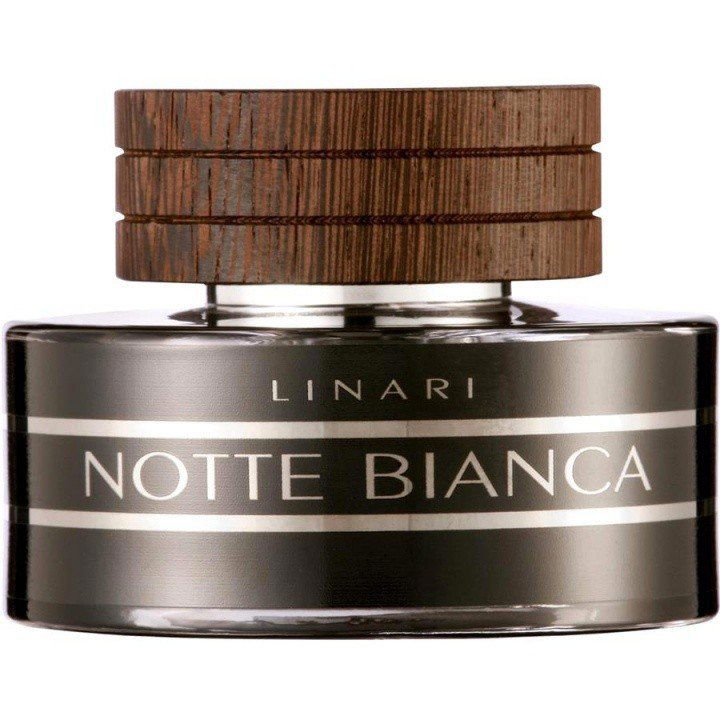
There are those perfumes that immediately remind you of other, equally rare ones. And when this rarity is also really good, you don't judge this perfume as a copy, but rather appreciate it as an enhancement of an unusual fragrance direction. One such perfume is Notte Bianca by Linari.
Notte Bianca fascinates with a skillful interpretation of the theme "white musk," and that is a very challenging theme! In most fragrance pyramids, the term "white musk" stands for breadth and creaminess, if not even for soapy nuances. This is different for those who approach this fragrance ingredient in a special way: the brand Acca Kappa with perfumes like Muschio Bianco and especially Cedro. Mr. Kormann from 1000&1 Seifen allowed me to recognize the heart of this matter some time ago, through his beautiful scent "August," which we compared with Acca Kappa's Cedro. In addition to the white musk, a good portion of Iso E Super seems to be involved in this direction. This mundane term, of course, does not appear in most fragrance pyramids.
Well then, white musk can also be different, and Notte Bianca is a good example: crisp, spicy, and very slender, it refuses any opulence - in a way, an anti-perfume. How should one describe this style? Notte Bianca - white night - this name is already a clue. We think of the famous white nights of St. Petersburg, as well as wide snow-covered fields under a full moon. But that is just an image. Here, I can only recommend getting to know at least one successful representative of this direction.
In the initial perception, Notte Bianca immediately reminded me of Acca Kappa's Cedro, which I also sprayed on my other hand today for a direct comparison. Both share this crisp-spicy white musk style. Cedro immediately goes in a clove-like direction, framed by woody undertones, while Notte Bianca experiences a wonderfully slender spiciness of a very piquant kind - wormwood, anise, star anise, basil, and a touch of clove. It tickles nicely in the nose.
In contrast to Cedro, the spiciness is much less overwhelming. In Cedro, the clove remains very present for a long time, which eventually becomes too much for me. Here, Notte Bianca is clearly more restrained and wearable.
And there is another reason: before it could become too much, Notte Bianca changes and takes on a different, but still similar hue. After just half an hour, the spiciness fades in favor of an ever more prominent vetiver note. This completely dominates the base after a full hour.
And it is a slender, dry vetiver that unfolds here. The heart and base notes have passed on their style, and the white musk is present in the background. This vetiver has little in common with that of Guerlain or Lubin, but a lot with the slender, powdery one from Carven. Notte Bianca was created by Mark Buxton, and it reminds me a lot of his rather modern vetiver perfume "Wood and Absinth" from his own brand.
However, there is one thing to criticize: the fragrance development progresses much too quickly within an hour. I would have liked to have had the spicy notes on the musk bed for a bit longer. Perhaps this is the necessary compromise. The use of fixatives is likely subject to certain limits, and a refined note probably does not become more beautiful through these substances.
So, for me, the use of Notte Bianca might be limited to special occasions. I think it is an ideal perfume for a theater evening. The piquant spiciness is a pick-me-up that keeps your eyes open even during boring performances. As a well-rested perfume, Notte Bianca is of course also an excellent, modern office scent, but then as a slender vetiver.
I think a bit of modern Mark Buxton style is contained here. Mark Buxton has particularly shown with his own line that he is less attached to tradition, but rather strives for an appropriate expression of modern life feelings. So too with Notte Bianca: it fits into a modern, urban environment, not to country houses and rustic oak!
One more piece of information about the brand: I met the owner of Linari - apparently a German - at the Global Arts of Perfumery. Linari started with room fragrances, and only gradually is it being recognized that they also produce "real" perfumes. So there is nothing Italian here except for the typically German fondness for everything Italian. Fortunately, the owner's Tuscan complex seems to be limited to the naming of the fragrances and a kind of upscale Italian design for the bottles.
My recommendation for this unusual, yet harmonious scent!


 Clover 14 years ago
 Blanche 14 years ago
 Duftstick 14 years ago
 Fantaghiro77 14 years ago
 Fran 14 years ago