

17
Top Review
Love strikes like cold steel
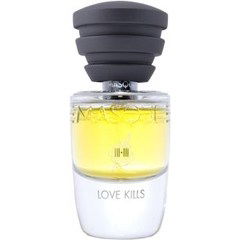
The curtain rises. Enter Rose. It’s a grand entrance. The rose is immediately present, almost kitschily sweet and heavy like in some oriental perfumes. I am a fan of rose scents. But this is too intense for me. If you sniff closer and let the scent of this overdose of ripe rose develop, it soon comes across surprisingly fresh and green, almost citrusy - and makes you sit up and take notice. At least me. Because I like this modern kind of rose. But just as I begin to enjoy the unexpected freshness, a dark cloud in the form of an equally unexpected metallic sharpness rolls in. Where does that come from? No idea. But it’s there. Perhaps it’s the geranium breaking into the rosy idyll.
Even if no geranium appears in the fragrance pyramid on Parfumo, it is mentioned in most other sources. For me, it is clearly noticeable.
Geranium and rose often meet in perfumes. On one hand, to stretch the expensive rose oil, on the other hand, to make the scent more lasting. Nothing against the delicate, white flower, but I am not a fan of its floral sweetness. I may be unfair, but I always see geranium as the cheap "substitute rose" of lesser quality that ruins every rose scent for me.
Here it’s a bit different. I recognize the concept. Love Kills is a parable about the transience of love. One could also say: the life of a rose as an allegory for the brevity of romantic relationships.
Okay, one doesn’t have to read too much into everything. What bothers me about such metaphors is also the rigorous apodicticity. Because not all love stories end in drama or are shorter than a rose's life. Right? But here it’s about the finiteness of love relationships - whether through the everyday life that kills the passionate feelings, betrayal, disappointment, jealousy, stranded hopes, or whatever - and the melancholy that inherently comes with it.
For me, the message is clear: At the beginning is the still green rose with its promising freshness. Then it blooms into a beautiful, velvety flower and develops such a heavy, dark-sweet scent that it’s almost too intense to enjoy it as pleasant. But while one wonders whether so much rose is allowed in a scent or in a person, the geranium takes over the scene. Its citrusy spiciness makes the unisex scent wearable for men, but it also brings this almost painful metallic sharpness into play, as if a sword were cutting the wonderful rose in two.
So the geranium is a consciously employed player here, meant to olfactorily show how the innocent-heavenly love relationship begins to crack. And the early tragedy remains. At this point, the scent develops a certain cleanliness and neatness that cannot be interpreted unambiguously in the play of this allegory. I would say: The passion is now out of the relationship. They still stay together, but under different conditions.
The association with the song “Love Kills” by Freddie Mercury from 1984 is compelling. It’s not one of his best, even though it’s his first solo track. But there’s this line: “Love strikes like cold steel, scars you from the start. Love kills.”
Freddie also seems to have had not too good experiences with love.
Did Caroline Dumur, who created this scent, think of Freddie and his song when she mixed “Love Kills”? I don’t know. It doesn’t matter. The message is - whether by coincidence or not - the same.
Even if this scent hasn’t exactly captured my heart in a storm, it deserves respect. Here, they didn’t want to create a pleasing floral array. The scent tells a - extremely dramatic - story and is an interesting, varied composition with an exciting scent progression that stays in memory. But it plays very much in the foreground. You have to like it, share its mood. Then it fits. It won’t adapt to you or “enhance your personality,” as one often expects from perfumes. It is itself far too strong for that. A “all or nothing” affair. No compromises, no tolerance, no harmony. It’s more about power and dominance. If you are ready to accept this strength, you will find yourself in the scent. For me, it is too intense and ultimately too overt in its message. Program music, as one calls it in musical compositions. Besides, I am not willing to have the destructive scent progression from the rosebud to the toxic relationship imposed on me. Even if the story may be true - I don’t want to be constantly reminded of the potentially deadly power of love.
Those who can endure the dark rose-patchouli mixture will be rewarded with a scent that has a literary quality, shows a varied progression, possesses a remarkably strong sillage and longevity, and is very extreme. Not for the superficial, not for wallflowers, office people, or status seekers. More for existentialists, the brave, the curious, and the depressed.
The strange name "III-III Love Kills," which somehow reminds me of X Æ A-XII Musk,
is supposed to mean something like III. Act, III. Scene, I read somewhere, which underscores the dramatic character of this perfume.
(With thanks to NatRocks)
Even if no geranium appears in the fragrance pyramid on Parfumo, it is mentioned in most other sources. For me, it is clearly noticeable.
Geranium and rose often meet in perfumes. On one hand, to stretch the expensive rose oil, on the other hand, to make the scent more lasting. Nothing against the delicate, white flower, but I am not a fan of its floral sweetness. I may be unfair, but I always see geranium as the cheap "substitute rose" of lesser quality that ruins every rose scent for me.
Here it’s a bit different. I recognize the concept. Love Kills is a parable about the transience of love. One could also say: the life of a rose as an allegory for the brevity of romantic relationships.
Okay, one doesn’t have to read too much into everything. What bothers me about such metaphors is also the rigorous apodicticity. Because not all love stories end in drama or are shorter than a rose's life. Right? But here it’s about the finiteness of love relationships - whether through the everyday life that kills the passionate feelings, betrayal, disappointment, jealousy, stranded hopes, or whatever - and the melancholy that inherently comes with it.
For me, the message is clear: At the beginning is the still green rose with its promising freshness. Then it blooms into a beautiful, velvety flower and develops such a heavy, dark-sweet scent that it’s almost too intense to enjoy it as pleasant. But while one wonders whether so much rose is allowed in a scent or in a person, the geranium takes over the scene. Its citrusy spiciness makes the unisex scent wearable for men, but it also brings this almost painful metallic sharpness into play, as if a sword were cutting the wonderful rose in two.
So the geranium is a consciously employed player here, meant to olfactorily show how the innocent-heavenly love relationship begins to crack. And the early tragedy remains. At this point, the scent develops a certain cleanliness and neatness that cannot be interpreted unambiguously in the play of this allegory. I would say: The passion is now out of the relationship. They still stay together, but under different conditions.
The association with the song “Love Kills” by Freddie Mercury from 1984 is compelling. It’s not one of his best, even though it’s his first solo track. But there’s this line: “Love strikes like cold steel, scars you from the start. Love kills.”
Freddie also seems to have had not too good experiences with love.
Did Caroline Dumur, who created this scent, think of Freddie and his song when she mixed “Love Kills”? I don’t know. It doesn’t matter. The message is - whether by coincidence or not - the same.
Even if this scent hasn’t exactly captured my heart in a storm, it deserves respect. Here, they didn’t want to create a pleasing floral array. The scent tells a - extremely dramatic - story and is an interesting, varied composition with an exciting scent progression that stays in memory. But it plays very much in the foreground. You have to like it, share its mood. Then it fits. It won’t adapt to you or “enhance your personality,” as one often expects from perfumes. It is itself far too strong for that. A “all or nothing” affair. No compromises, no tolerance, no harmony. It’s more about power and dominance. If you are ready to accept this strength, you will find yourself in the scent. For me, it is too intense and ultimately too overt in its message. Program music, as one calls it in musical compositions. Besides, I am not willing to have the destructive scent progression from the rosebud to the toxic relationship imposed on me. Even if the story may be true - I don’t want to be constantly reminded of the potentially deadly power of love.
Those who can endure the dark rose-patchouli mixture will be rewarded with a scent that has a literary quality, shows a varied progression, possesses a remarkably strong sillage and longevity, and is very extreme. Not for the superficial, not for wallflowers, office people, or status seekers. More for existentialists, the brave, the curious, and the depressed.
The strange name "III-III Love Kills," which somehow reminds me of X Æ A-XII Musk,
is supposed to mean something like III. Act, III. Scene, I read somewhere, which underscores the dramatic character of this perfume.
(With thanks to NatRocks)
Translated · Show original
8 Comments
The unwanted love of Romeo and Juliet
But I really like your beautiful scent description and the extensive classification of III-III Love Kills in your review!