…this is the impression one gets after the first spray. Leather (Cuir) does not want to reveal itself at all. No, rather it is a voluminous, slightly herbal floral bouquet that hits you. The top notes are clearly dominated by lavender and coriander, with styrax already providing the balsamic resinous quality that is present in all phases of the fragrance.
In the heart note, the initial herbaceousness subsides, and the fragrance takes a turn more towards the floral-oriental, with no trace of leather here either. Geranium, cardamom, and patchouli clearly set the tone, without any one of them stepping too loudly into the foreground.
In the base, the fragrance is clearly assigned to the oriental scent genre, with amber and especially benzoin providing depth and weight. Sandalwood, vetiver, and labdanum add a resinous-woody touch. Here, a slight leather note can also be perceived from a distance, which then does justice to the name a little.
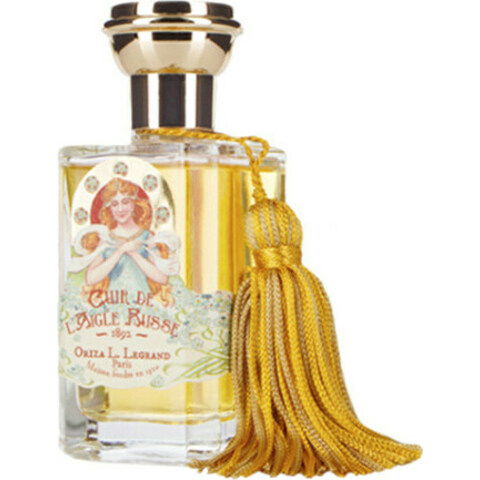
On the homepage of Oriza L. Legrand, Cuir de l'Aigle Russe is listed in the "Collection Second Empire" with the year 1892; whether the old formulation has been retained in the new edition, I cannot say, but the fragrance would fit well in that era. It reminds me a bit of Pompeia by L.T. Piver, but unlike that, it is a fragrance that can definitely be used as unisex.
The longevity is very good, lasting almost ten hours on me, and the sillage is rather discreet and unobtrusive, making it a lovely companion through the cooler days, but also suitable as an evening fragrance in summer.
The only question I still have is, what were they thinking with this name?
At the Russian imperial court, this fragrance would certainly not have been opulent enough; the Romanovs would probably have preferred more "punch" :-) This Aigle Russe (the Romanovs had a double-headed eagle as their emblem) is more of a Faucon (falcon), but a very graceful and beautiful one, so I give it a full 100%.


 Flakon11e 2 years ago
 Yatagan 10 years ago
 Ergoproxy 10 years ago