
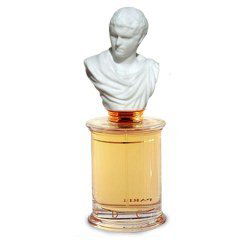
Invasion Barbare Parfums MDCI 2005

27
Top Review
Caracalla...
...was perhaps the last of the great Roman emperors before the onset of late antiquity and the crisis of the 3rd century. He was reviled by his contemporaries, and (only partially) untrue legends from senatorial historiography have shaped our negative image of him. Nevertheless, he remains the only resonant name on the Roman imperial throne for many years until Diocletian ascends it in Nicomedia. At least he seems well-known enough to adorn the bottle of this MDCI fragrance - at least that is the majority opinion from a survey among those knowledgeable in ancient art history. I do find the bust quite stylish, but that is a matter of taste. However, whether the almost double price for the bottle with the resin bust or even a four-digit amount for the bottle version with Limoges porcelain is truly justified, one must decide for themselves.
Even without Caracalla on top, the scent is certainly not a cheapie, but for me, it is worth the money. So much I can reveal in advance. Here follows my first detailed comment, and I hope to perhaps even inspire some with this scent.
Caracalla's foreign policy was more characterized by his expansionist policies in the east of the empire than by defense against barbarian invasions. So why does this emperor adorn the bottle of "Invasion Barbare"? Perhaps we will never know.
Herb would certainly be an understatement for the emperor, who, out of sheer paranoia, had a five-digit number of people murdered. However, for the start of IB, it is quite a good description. At the same time, it is also fresh, and I believe I have detected a few small aquatic notes - perhaps it is just the waters of the Tiber flowing towards the imperial palace. The wind seems to be shifting, as I only had that note in my nose for a very brief moment.
The heavy hooded cloak, which the emperor had tailored according to a self-designed pattern, is deeply soaked with the scent of lavender from Caracalla's Gallic homeland. The lavender is absolutely present in this fragrance, and I am amazed at how much I still like it. As a confessed lavender skeptic, IB still manages to excite me. Because the lavender is very well integrated into the overall composition and only emerges as a standalone scent part at the very end of the drydown.
From the Germanic campaign (should those be the barbarians referred to in Invasion Barbare?) at the beginning of his reign, Caracalla brings hints of moss, as well as juniper and various other herbs. At this point, the scent also becomes very masculine - which it has been all along, but at this juncture, this accent becomes particularly pronounced.
As described, the defining aspect of his foreign policy should rather be the eastern policy in the empire. One can also detect intensely aromatic woods from the eastern Mediterranean here, as well as a pepper note. Through the already flourishing trade with India at that time, the emperor surely found a good source here in Asia Minor.
As time draws to a close, a certain mellowing is always said to set in. With Caracalla, that was hardly the case: At just 29, he fell victim to an assassination attempt made possible by his own paranoia and reign of terror. The scent, however, becomes creamier towards the end. I can distinctly smell vanilla and tonka. Caracalla would have known neither of these scents, just as his barbarian contemporaries would not have, as both plants are native to North and South America and only began their journey across the world several centuries later.
Lavender, oak moss, tonka - essentially everything one needs for a classic barbershop scent. And perhaps here lies the connection to Caracalla: For he had a huge, free-entry thermal complex built in the city to win the Roman people over to his side.
Despite all the inconsistencies in naming and bust selection: The complex scent development is definitely worthy of an emperor - whether Caracalla, with his extremely questionable methods of governance that did not even spare his own immediate family, is the right emperor for that? I do not know. Unlike ancient and modern historiography regarding Caracalla's qualities as an emperor, this scent is indeed a great one. For me, IB is a wonderful fragrance with one of the most complex and interesting scent developments I have had the pleasure of experiencing. The various components can be detected quite well, but above all, they merge into an overall scent that can simply be described as interesting, stimulating, and pleasant. Perhaps not suitable for the midsummer of central Italy; but on special occasions, I can imagine it both on the campaign, after a visit to the baths, or during the celebrations of the great games!
Even without Caracalla on top, the scent is certainly not a cheapie, but for me, it is worth the money. So much I can reveal in advance. Here follows my first detailed comment, and I hope to perhaps even inspire some with this scent.
Caracalla's foreign policy was more characterized by his expansionist policies in the east of the empire than by defense against barbarian invasions. So why does this emperor adorn the bottle of "Invasion Barbare"? Perhaps we will never know.
Herb would certainly be an understatement for the emperor, who, out of sheer paranoia, had a five-digit number of people murdered. However, for the start of IB, it is quite a good description. At the same time, it is also fresh, and I believe I have detected a few small aquatic notes - perhaps it is just the waters of the Tiber flowing towards the imperial palace. The wind seems to be shifting, as I only had that note in my nose for a very brief moment.
The heavy hooded cloak, which the emperor had tailored according to a self-designed pattern, is deeply soaked with the scent of lavender from Caracalla's Gallic homeland. The lavender is absolutely present in this fragrance, and I am amazed at how much I still like it. As a confessed lavender skeptic, IB still manages to excite me. Because the lavender is very well integrated into the overall composition and only emerges as a standalone scent part at the very end of the drydown.
From the Germanic campaign (should those be the barbarians referred to in Invasion Barbare?) at the beginning of his reign, Caracalla brings hints of moss, as well as juniper and various other herbs. At this point, the scent also becomes very masculine - which it has been all along, but at this juncture, this accent becomes particularly pronounced.
As described, the defining aspect of his foreign policy should rather be the eastern policy in the empire. One can also detect intensely aromatic woods from the eastern Mediterranean here, as well as a pepper note. Through the already flourishing trade with India at that time, the emperor surely found a good source here in Asia Minor.
As time draws to a close, a certain mellowing is always said to set in. With Caracalla, that was hardly the case: At just 29, he fell victim to an assassination attempt made possible by his own paranoia and reign of terror. The scent, however, becomes creamier towards the end. I can distinctly smell vanilla and tonka. Caracalla would have known neither of these scents, just as his barbarian contemporaries would not have, as both plants are native to North and South America and only began their journey across the world several centuries later.
Lavender, oak moss, tonka - essentially everything one needs for a classic barbershop scent. And perhaps here lies the connection to Caracalla: For he had a huge, free-entry thermal complex built in the city to win the Roman people over to his side.
Despite all the inconsistencies in naming and bust selection: The complex scent development is definitely worthy of an emperor - whether Caracalla, with his extremely questionable methods of governance that did not even spare his own immediate family, is the right emperor for that? I do not know. Unlike ancient and modern historiography regarding Caracalla's qualities as an emperor, this scent is indeed a great one. For me, IB is a wonderful fragrance with one of the most complex and interesting scent developments I have had the pleasure of experiencing. The various components can be detected quite well, but above all, they merge into an overall scent that can simply be described as interesting, stimulating, and pleasant. Perhaps not suitable for the midsummer of central Italy; but on special occasions, I can imagine it both on the campaign, after a visit to the baths, or during the celebrations of the great games!
Translated · Show original
11 Comments
Please write more reviews like this and you'll get a thousand laurel wreaths - uh - trophies from me!
Really enjoyed reading it.