
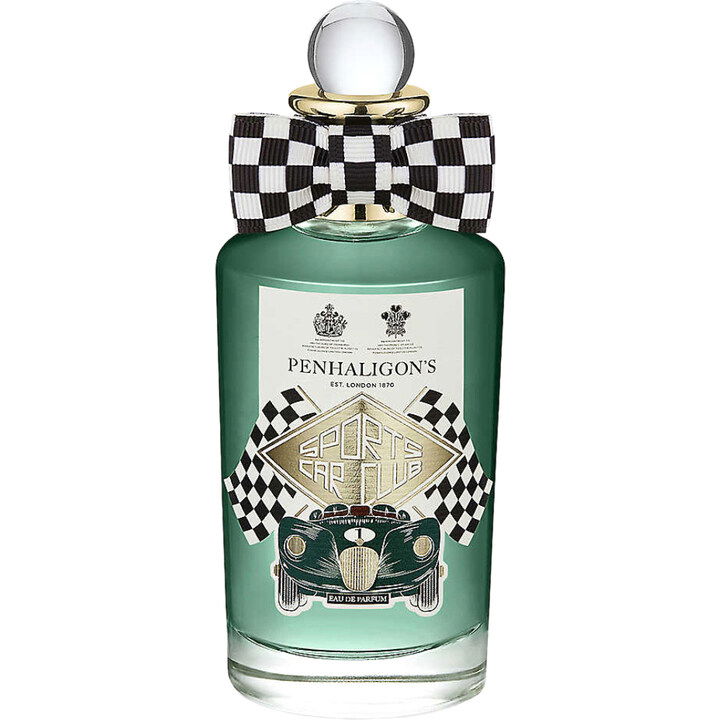
Sports Car Club Penhaligon's 2022

28
Top Review
Murder Bee Bait
My regular readers know about my ambivalent relationship with Penhaligon's; for everyone else, just this much: we have a history. In any case, I drown my frustration over the majority of new releases since 2016 with my rapidly dwindling stocks of the classic scents that have been discontinued.
But the marketing people at Penhaligon's wouldn't be the marketing people at Penhaligon's if they didn't know how to reel in a disgruntled and disappointed bee once again - The bait: an old car on the bottle.
Although Sir William Lyons - the founder of Jaguar - was not a fan of motorsport, he recognized the advertising effectiveness and initially tolerated the secretly initiated project by employees to develop a factory racing car. This decision would prove to be spot on. The Jaguar XK-C (also known as C-Type), first deployed in 1951, benefited from the pairing of the proven engine of the XK120 with a newly developed tubular frame covered in thin aluminum skin. The initially 200 hp faced a weight of less than 1,000 kg, and later even another 100 kg was trimmed off while the power was increased to about 230 hp. A chassis with double wishbones and torsion bars at the front and rear ensured excellent road handling. In combination with the good brakes, it allowed drivers to play cat and mouse with the more powerful Ferraris. The 24 Hours of Le Mans was won in 1951, 1953, 1955, 1956, and 1957, and in Grand Prix racing, the later Formula 1, Jaguar secured pole position with the C-Type at the legendary race in Monaco in 1952. Thus, the C-Type became not only a notable success for Jaguar but one of the great icons of motorsport. One of the few surviving examples (of originally 53) changed hands for twelve million dollars at an auction in 2015.
So what does the Jaguar C-Type have to do with the new fragrance from Penhaligon's? Well, it prominently features its likeness, and both are certainly not among the most affordable of their kind - furthermore, they also share their color.
The new one from Penhaligon's is green: cypress green, mint green, eucalyptus green, pepper green, maybe a bit of British racing green.
The sharpness of the pepper and the musky soft eucalyptus contrast pleasantly with each other; the poles are not too far apart. Sports Car Club remains consistently fresh; the menthol note is noticeable but subtle and well woven, with a slight hint of sweetness running through the fragrance in the background.
In the base, the green fades quietly, and fortunately, I don't notice much of an artificial long finish.
Conclusion: the price could perhaps be debated, but the scent is quite well done - a nice green for the green fragrance lovers.
So, dear marketing people at Penhaligon's: until the next old car!
But the marketing people at Penhaligon's wouldn't be the marketing people at Penhaligon's if they didn't know how to reel in a disgruntled and disappointed bee once again - The bait: an old car on the bottle.
Although Sir William Lyons - the founder of Jaguar - was not a fan of motorsport, he recognized the advertising effectiveness and initially tolerated the secretly initiated project by employees to develop a factory racing car. This decision would prove to be spot on. The Jaguar XK-C (also known as C-Type), first deployed in 1951, benefited from the pairing of the proven engine of the XK120 with a newly developed tubular frame covered in thin aluminum skin. The initially 200 hp faced a weight of less than 1,000 kg, and later even another 100 kg was trimmed off while the power was increased to about 230 hp. A chassis with double wishbones and torsion bars at the front and rear ensured excellent road handling. In combination with the good brakes, it allowed drivers to play cat and mouse with the more powerful Ferraris. The 24 Hours of Le Mans was won in 1951, 1953, 1955, 1956, and 1957, and in Grand Prix racing, the later Formula 1, Jaguar secured pole position with the C-Type at the legendary race in Monaco in 1952. Thus, the C-Type became not only a notable success for Jaguar but one of the great icons of motorsport. One of the few surviving examples (of originally 53) changed hands for twelve million dollars at an auction in 2015.
So what does the Jaguar C-Type have to do with the new fragrance from Penhaligon's? Well, it prominently features its likeness, and both are certainly not among the most affordable of their kind - furthermore, they also share their color.
The new one from Penhaligon's is green: cypress green, mint green, eucalyptus green, pepper green, maybe a bit of British racing green.
The sharpness of the pepper and the musky soft eucalyptus contrast pleasantly with each other; the poles are not too far apart. Sports Car Club remains consistently fresh; the menthol note is noticeable but subtle and well woven, with a slight hint of sweetness running through the fragrance in the background.
In the base, the green fades quietly, and fortunately, I don't notice much of an artificial long finish.
Conclusion: the price could perhaps be debated, but the scent is quite well done - a nice green for the green fragrance lovers.
So, dear marketing people at Penhaligon's: until the next old car!
Translated · Show original
19 Comments
LeMans Winner Trophy for the connoisseur!
For green and motorized growling, I stick with my Thierry Wasser early work, the first Jaguar scent... It still smells great even when newly bought... and my old minis have nice grippy wooden caps :)).
Unfortunately, I've lost interest in Penhaligon's since they discontinued Racquets Formula.
But who knows, maybe a lovely, cool composition will come along someday...