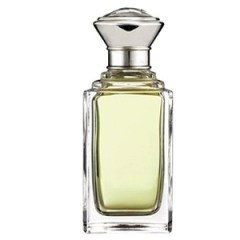
The Scent of a Gentleman is unappealing to me, and therefore I may be a bit harsh on it.
In the opening, I perceive a moderately citrusy freshness (the occasionally felt Neroli hammer did not hit me), which clashes with a herby severity that occasionally brushes against the unpleasant. This is actually the Habit-Rouge overture, but the equally ugly counterpoint here lacks the touch of dark-threatening, powerful to almost violent allure that is so appealing in Habit Rouge; instead, it comes off as somewhat maliciously sly. If you know the ending, you can already sense a certain characteristic soapy quality here that gains prominence by the end.
I find the middle phase to be very original in one sense; the rather pleasant coriander stinkiness combines here in a very peculiar way with eucalyptus and floral notes; I have never smelled anything like this before. However, whether this originality is also successful, I do not know; it occasionally feels a bit off, uneven, like a sketch that has remained unfinished, and even before I researched the perfumer, I noticed a synthetic detergent note of some persistence embedded in the whole affair. I do not perceive it as peppery at all.
The final phase again evokes reminiscences of beloved classics, namely the tonka sweetness of Tabac Original ("real" tobacco I cannot recognize) and the beautiful, long, continental-masculine base of Bel-Ami. One can also think of some chypres here. But these are just reminiscences; once again, the whole thing does not feel rounded and, above all, not alive. Despite the enormous, almost murderously concrete longevity, there is a glaring lack of charm, development, and warmth to be noted here. To me, the "von" in its linear sweet-spicy soapiness appears relentlessly smooth, synthetic, and dead.
Alexander von Schönburg has written a book titled "The Art of Stylish Impoverishment," in which - among other things - examples are given of how the nobility has been impoverished for centuries because one can no longer make a fortune with estates, yet still manages to go through life with a certain dignity and good humor thanks to tradition and the style learned over generations. When I look at the website of the House of Sierstorpff (which is linked here at Parfumo), I get the impression that - just like in the times of the robber knights, only with different means - the opposite path has been taken: Wealth preservation at any cost, we make money and do not let the slyest petty bourgeois businessmen take the butter off our bread. Almost everything is offered by the count's enterprise, often in a market-crier manner (constantly emphasizing the noble aspect, which gives it a special commercial appeal), with which one can make money: wellness, food, clothing, and of course fragrances. All that’s missing is bungee jumping with a noble crown on one’s head.
Well, I do not expect that just because one has a "von," one is particularly stylish; perhaps one must howl with the wolves today. But must one really advertise their fragrances with the painfully embarrassing phrase "Dyfte für wahrliche Herrschaften," which mutilates the German language multiple times? "Wahrliche"??? "Wahrlich" is an adverb and only an adverb; "wahrliche Herrschaften" are just as sick as "vielleichte Ereignisse" or "möglicherweise Nachfolger." And anyway, "Herrschaften"! This word conjures up images of servants speaking of "their lords," of "lordly times!" and "for heaven's sake!", but certainly not of "gentlemen," who are presumably meant here. And must one spread the (evident to me) fake news that an ancient "family recipe" has been unearthed here (presumably smeared with red sealing wax on parchment in the attic of the old castle), when Frank Rittler is listed as the perfumer, who presents himself on his (not-so-modestly named) private homepage "thenose.de" as follows: "Frank Rittler works as one of seven perfumers at the Henkel Fragrance Center in Krefeld and creates fragrances for Henkel products in the area of cosmetics/personal care as well as washing and cleaning agents." Must it be like this?
It does not have to be. To me, this Torpff is a Talmi fragrance for pseudo-nobles with plastic signet rings.
It's a shame, the website seems to no longer exist. I would have loved to see the marketing you described in person.
I only found one article from the "Welt" newspaper. It just touches on the concept.
When I read the phrase: "Scents for true gentlemen," I thought of the old form of the German language that used to be quite common.
That didn't put me off at all, as it's not unusual.
However, the way of distinguishing and the deliberate exclusion, the artificial exclusivity, came across as presumptuous. It feels rather tasteless and vulgar, not elegant at all and far from what a gentleman would embody.
I thoroughly enjoyed your review!
Brilliant fragrance description topped with a thoroughly convincing social critique!
A trophy and (inheritance-worthy) honorary membership in the Adverb Defenders' Guard.
Both linguistically and in content, a superbly crafted analysis. It seems to me that someone needed to let off some steam here. Show-off and arrogance!
Perfectly dissected! ;) If only the fragrance were good amidst all that marketing fuss (that's what really matters to me in the end). Apparently, it's nothing special either :/ It reminds me of a former "noble" client of our office who insisted on being addressed only as "Your Highness Prince of...". When letters went out with the standard "Dear Sir...", the hysteria was enormous.
You've nicely exposed the marketing nonsense. It should also be added that the ancestor claimed as the forefather of the perfume was just as business-savvy and, according to Wikipedia, made a name for himself with a treatise "On some insect species that are particularly harmful to spruce forests, and on the dry rot of the spruce forests of the Harz." Almost as stimulating as the ramblings of senior perfumer Rittler. Noble patent trophy!
This, found on a website dedicated to the fragrance, leaves me speechless: "The buyers of this scent clearly set themselves apart: True connoisseurs are not found just anywhere, but primarily in the context of classic car events, model parties, polo tournaments, in yacht harbors, at horse races, or at private airfields. They can be seen at art fairs, festivals, or theater premieres - often unrecognized, yet striking with their natural elegance."
Great comment! I once came across the term "the better pack." That seems to fit in some ways.
I've never heard of the scent before, and after your brilliant description of it as "maliciously sly," my wish list isn't getting any longer. Thanks for this informative and fantastic comment, which deserves a blue-blood trophy!
Reminds me of an acquaintance who unsuccessfully tried to emulate Wolf von Niebelschütz as a writer. Or the pseudo-early modern High German of people at so-called "medieval markets." Terrible pain and secondhand embarrassment. Blue Chamberlain Goblet!
Haha, a fine takedown, very stylish by the way. I wasn't even aware of the existence of this goth guy until now, let alone his fragrance offspring. How do you come across such unique finds?


I only found one article from the "Welt" newspaper. It just touches on the concept.
When I read the phrase: "Scents for true gentlemen," I thought of the old form of the German language that used to be quite common.
That didn't put me off at all, as it's not unusual.
However, the way of distinguishing and the deliberate exclusion, the artificial exclusivity, came across as presumptuous. It feels rather tasteless and vulgar, not elegant at all and far from what a gentleman would embody.
I thoroughly enjoyed your review!
A trophy and (inheritance-worthy) honorary membership in the Adverb Defenders' Guard.
I enjoyed reading your comment and a prestigious trophy for you *g*
I've never heard of the scent before, and after your brilliant description of it as "maliciously sly," my wish list isn't getting any longer. Thanks for this informative and fantastic comment, which deserves a blue-blood trophy!