



Pimm
5 Reviews
Translated · Show original

Pimm
Helpful Review
6
Natural Mediterranean Citrus Cologne Anno 1819
A lot of lemon and clove oil, is my impression. These materials are also mentioned by the label, along with rosemary. I think I can also smell orange oil. So quite culinary, which is why it doesn’t remind me of cleaning products, and I don’t perceive any bitter orange oils, making it not similar enough to 4711 to seem outdated. The combination of citrus oils with kitchen herbs seems to never have gone out of style. The top note of the Saint Helena Cologne is zesty, cheerful, and delicious. However, the essential oils are so volatile that the scent - on skin as well as on clothing - can only be perceived from close proximity after just a few minutes, and after an hour, hardly even that. This heart/base phase smells not only sour and spicy but also oily, perhaps due to the rosemary.
Regarding the historical background, the information on napoleon-cologne.fr is a bit confusing for me; I have laid out the following sequence: Napoleon arrived in his exile on Saint Helena in 1815 and used a Cologne imported from Europe, though it is unknown which one. In 1819, there was a supply gap - unclear why - and Napoleon's entourage, specifically his chamberlain and librarian Louis-Étienne Saint-Denis (known as Mamelouk Ali), created a Cologne on Saint Helena that was supposed to resemble the one imported until then. In the English text (usa.napoleon-cologne.com), it sounds as if local plants were used:
“Mameluke Ali pieced together the Eau de Cologne in a traditional way according to the local resources available on the island. Nearby, he mainly had access to citrus trees from which he extracted and collected the essences contained in the fruit peel, using compression with a natural sponge. He also harvested rosemary and cloves, which he distilled to extract their essence. These oils and some others were then mixed with wine spirit in good proportions.”
For practical reasons, I suspect that imported supplies of fruits and spices were used - the French text leaves this possibility open, as it speaks of “des citrus” instead of “citrus trees” and uses the more general “récolter” instead of “harvest.” It would be interesting to know, at least for me, which oils besides the explicitly mentioned ones were used. In any case, probably no special perfume ingredients like bergamot oil. The improvised distillation of any flower oils also seems unlikely to me. More conceivable are other herbs, perhaps in small quantities and therefore not easily identifiable by scent, which could also explain the Farnesol in the allergen list. The citrus fruits were probably simply lemons and oranges.
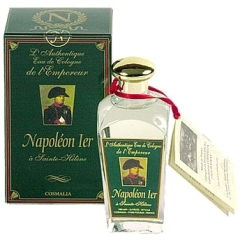
Napoleon died in 1821, so the Saint Helena Cologne was in use for a maximum of two years. The text mentions a temporary shortage (“disette momentanée,” “disette qui régnait à certains moments”) - so it is conceivable that even only a single batch was produced. The recipe eventually reached Jean Kerléo, co-founder of the Osmothèque in Versailles, from the estate of Saint-Denis, no earlier than 1991. What exact contribution he made is unclear to me. He must have interpreted the information on materials and quantities, and perhaps he also thought about the growing areas and extraction methods of that time. Soon after, marketing began as an olfactory reminiscence of Napoleon, possibly already in the square bottle that is currently shown in the Parfumo photo. “Les parfums historiques” assures, citing the Osmothèque, that the formula corresponds to the original and is “100% natural”; however, no information is provided regarding geographical origin and processing.
The cylindrical bottle advertised on napoleon-cologne.fr has apparently been available since 2020. The formula must have remained the same, but the price per milliliter has increased. The old bottle is still available in some French online shops, which is how I got my current 100-ml bottle in 2021 (for €54 with free shipping). A 25-ml size seems to have recently been added.
These are not prices at which one can spray oneself all over every hour with a clear conscience to survive hot weekends. For this purpose, one would also need to find more refreshing scents, perhaps more with bergamot or bitter orange and fresher spices. Well, spraying once to put oneself in the mindset of the exiled emperor is certainly justifiable. Otherwise, for me, it is a scent that one enjoys a little, briefly, from time to time. However, citrus oils are said not to last too long even in the -opened- bottle. As I understand it, these oils in modern perfumes are usually concentrated and thus more durable; in comparison, this historical Cologne could therefore age particularly quickly. On the skin, however, even modern fixatives seem not to make the most beautiful citrus aromas significantly longer-lasting. Since the suspected ingredients are all easily available as pure essential oils, a diffuser could be a cost-effective alternative with a longer duration of effect; I have no experience with that.
Personal background (for particularly leisurely readers): My parents brought back a bottle as a souvenir from France, probably in the late 90s, possibly with thoughts of our house cat Napoleon. In any case, the still-packaged bottle was displayed on a shelf near the cat litter for years before I had the idea to try the scent. At that time, I only knew various soapy men's fragrances, which I found unpleasant, but whose social function I understood. The Saint Helena Cologne, without a clear reference to gender, age, or social status and already through its very short-term external effect decidedly non-functional, offered me a completely different perspective. (To engage further with perfumes at that time, the Cologne perhaps seemed too much of an exception, and I lacked an idea of how such a hobby could be affordable.)
Regarding the historical background, the information on napoleon-cologne.fr is a bit confusing for me; I have laid out the following sequence: Napoleon arrived in his exile on Saint Helena in 1815 and used a Cologne imported from Europe, though it is unknown which one. In 1819, there was a supply gap - unclear why - and Napoleon's entourage, specifically his chamberlain and librarian Louis-Étienne Saint-Denis (known as Mamelouk Ali), created a Cologne on Saint Helena that was supposed to resemble the one imported until then. In the English text (usa.napoleon-cologne.com), it sounds as if local plants were used:
“Mameluke Ali pieced together the Eau de Cologne in a traditional way according to the local resources available on the island. Nearby, he mainly had access to citrus trees from which he extracted and collected the essences contained in the fruit peel, using compression with a natural sponge. He also harvested rosemary and cloves, which he distilled to extract their essence. These oils and some others were then mixed with wine spirit in good proportions.”
For practical reasons, I suspect that imported supplies of fruits and spices were used - the French text leaves this possibility open, as it speaks of “des citrus” instead of “citrus trees” and uses the more general “récolter” instead of “harvest.” It would be interesting to know, at least for me, which oils besides the explicitly mentioned ones were used. In any case, probably no special perfume ingredients like bergamot oil. The improvised distillation of any flower oils also seems unlikely to me. More conceivable are other herbs, perhaps in small quantities and therefore not easily identifiable by scent, which could also explain the Farnesol in the allergen list. The citrus fruits were probably simply lemons and oranges.
Napoleon died in 1821, so the Saint Helena Cologne was in use for a maximum of two years. The text mentions a temporary shortage (“disette momentanée,” “disette qui régnait à certains moments”) - so it is conceivable that even only a single batch was produced. The recipe eventually reached Jean Kerléo, co-founder of the Osmothèque in Versailles, from the estate of Saint-Denis, no earlier than 1991. What exact contribution he made is unclear to me. He must have interpreted the information on materials and quantities, and perhaps he also thought about the growing areas and extraction methods of that time. Soon after, marketing began as an olfactory reminiscence of Napoleon, possibly already in the square bottle that is currently shown in the Parfumo photo. “Les parfums historiques” assures, citing the Osmothèque, that the formula corresponds to the original and is “100% natural”; however, no information is provided regarding geographical origin and processing.
The cylindrical bottle advertised on napoleon-cologne.fr has apparently been available since 2020. The formula must have remained the same, but the price per milliliter has increased. The old bottle is still available in some French online shops, which is how I got my current 100-ml bottle in 2021 (for €54 with free shipping). A 25-ml size seems to have recently been added.
These are not prices at which one can spray oneself all over every hour with a clear conscience to survive hot weekends. For this purpose, one would also need to find more refreshing scents, perhaps more with bergamot or bitter orange and fresher spices. Well, spraying once to put oneself in the mindset of the exiled emperor is certainly justifiable. Otherwise, for me, it is a scent that one enjoys a little, briefly, from time to time. However, citrus oils are said not to last too long even in the -opened- bottle. As I understand it, these oils in modern perfumes are usually concentrated and thus more durable; in comparison, this historical Cologne could therefore age particularly quickly. On the skin, however, even modern fixatives seem not to make the most beautiful citrus aromas significantly longer-lasting. Since the suspected ingredients are all easily available as pure essential oils, a diffuser could be a cost-effective alternative with a longer duration of effect; I have no experience with that.
Personal background (for particularly leisurely readers): My parents brought back a bottle as a souvenir from France, probably in the late 90s, possibly with thoughts of our house cat Napoleon. In any case, the still-packaged bottle was displayed on a shelf near the cat litter for years before I had the idea to try the scent. At that time, I only knew various soapy men's fragrances, which I found unpleasant, but whose social function I understood. The Saint Helena Cologne, without a clear reference to gender, age, or social status and already through its very short-term external effect decidedly non-functional, offered me a completely different perspective. (To engage further with perfumes at that time, the Cologne perhaps seemed too much of an exception, and I lacked an idea of how such a hobby could be affordable.)
5 Comments
 Marieposa
 Fittleworth