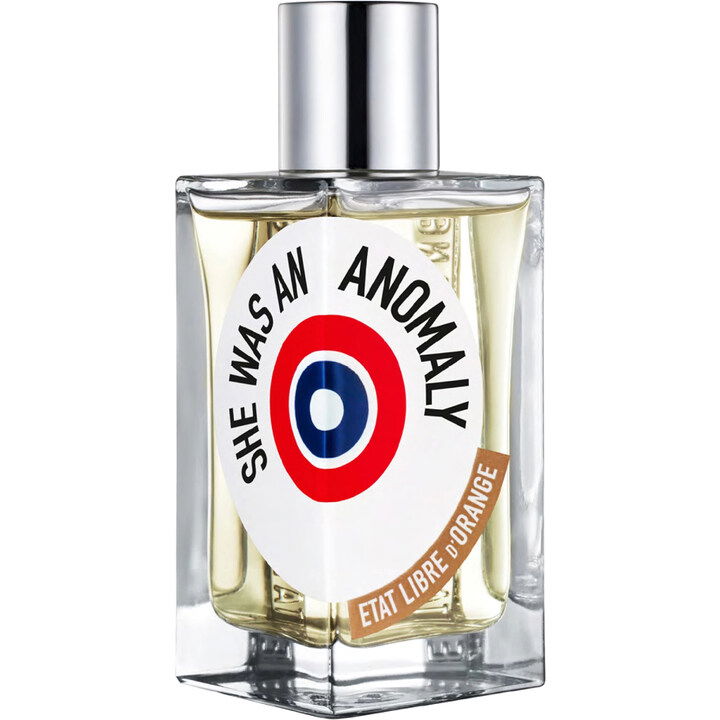
“My mother, she was an anomaly, she was brilliant, she was loved but she paid a huge price.”
A quote from Lisa Simone about her mother Nina. Nina Simone, the great jazz diva, called the "High Priestess of Soul," was considered difficult in the music industry, was erratic, a driven person. Her outbursts of anger were legendary. Part of this can be explained by a bipolar disorder that was diagnosed only at the age of 60. Lisa Simone felt she had a mother who was incapable of loving her unconditionally. Nevertheless, she says with her quote: it belongs together. What we love and admire about Nina Simone, her art, cannot be separated from what her daughter refers to as an “anomaly.”
Perfume names rarely attract attention. However, with Etat Libre d'Orange, it can be rewarding: they often mislead and the perfumes are different from what we would have expected. Still, when thought about from a different angle, the names fit perfectly. We are held up a mirror to how much bias can stand in our way here.
Now, when Lisa Simone searches for words to describe her mother and summarizes all the facets and conflicting feelings under the term "anomaly," it is far too large, far too significant to describe merely one perfume. Here, "anomaly" seems to mean: deviating from the standard, away from the ordinary.
So: is "She Was an Anomaly" a perfume never smelled before? Are conventions being broken? No. It is a calm, elegantly reduced iris scent. Not the buttery, creamy side of iris is emphasized, but the powdery one. This suggests that (as almost always) synthetic, not natural iris was used: the latter brings significant creaminess, while in the synthetic reproduction, the powdery aspect is in the foreground. From this perspective, with a suitable staging, the iris can appear very cool, almost metallic - as it does here in "She Was an Anomaly." This type of staging has become increasingly popular in the last 20 years: Yann Vasnier might have been the first to tease out this metallic-cool aspect of iris in "L'Homme de Cœur" with a combination of angelica, cypress, and vetiver. Annick Ménardo achieved a similar effect in "Bois d’Argent" by pairing iris with resins like frankincense and myrrh. These two fragrances were trendsetters, especially the Dior scent: while Olivier Polge dipped this iris in chocolate coating for "Dior Homme," Carthusia's "1681" and Van Cleef & Arpels' "Collection Extraordinaire - Bois d'Iris" clearly reference Annick Ménardo's scent.
In this tradition, "She Was an Anomaly" also moves. The emphasis on cool powderiness is not achieved here by resins (although a trace of frankincense might even be included), but with a distinctly powdery musk. The other notes are mere accessories: the mandarin is still recognizable on paper, but on the skin it disappears in no time. The sandalwood note resonates from the start to the late base in the background, supporting the texture without ever pushing forward. What remains is iris, even more reduced than in the other perfumes emphasizing the cool-powdery aspect. This peculiar iris staging has been aptly described by Apicius as the smell of stained paper.
The perfume shows hardly any development and manages - excellently crafted - to keep the proportions hardly shifting over the respectable longevity. Interestingly, the scent does not become boring: perfumes without pronounced arcs actually need contrasts or an inner tension to remain engaging and not eventually become annoying. How this scent achieves that, I do not know.
In summary: no anomaly, but perhaps very good, yet also very normal? Possibly not only that. Artificial intelligence was used in the development of the perfume, and the computer was fed with the Givaudan formula database and Daniela Andrier's preferences. The program then recommended an unusual overdose of iris with musk, which the perfumer claims she would never have thought of. For her, an anomaly. She only supplemented the formula. Whether the extraordinary nature of this scent also represents an “anomaly” for non-professional noses, I dare to doubt.
What remains is the perfume: a focused iris scent.
What a great review! When it comes to iris, Daniela Andrier is definitely a safe bet. ;-) I really like the scent, but unfortunately, the longevity is terrible, so it probably won't make it into my collection.
"Abnormal" women are often interesting - Nina Simone was amazing! And I'm definitely an iris fan, especially since I've come to love the buttery iris more and more through vintage perfumes.
You create such a tension here! From Nina Simone's extraordinary nature as a person and artist to the metallic, android-like otherness of the AI that the perfumer used as a co-nose. I'm glad I stumbled upon this: your review and the fragrance. It definitely has something unconventional about it.
A very helpful comment. I can easily imagine how this Eldo smells. Right now, I'm loving that buttery, creamy iris, but I'll definitely add this to my wishlist, just like L'Homme de Cœur!
That was very interesting to read - I've actually wondered about the name quite a bit, even though I've never tested the scent. Iris with musk sounds great!
Thanks for the responses, I'm glad! @Turandot: when it comes to artificial intelligence (AI), I tend to feel existential dread ;-) I find it fascinating: in a professional context, I see AI more as a tool to find an optimum within a known parameter space. But truly creative - that's tough. That's where humans come in. Thankfully. It's like saying: a self-learning software could manage "Sauvage" and "La Vie est Belle," but not "Vertine."
How nice to read one of your well-informed comments again. I did flinch a bit at one point: having a scent "calculated" by artificial intelligence sounds a bit soulless to me, even if Daniela Andrier ultimately infused it with human creativity. But I guess I'm just hopelessly romantic, since many fragrances are built on pre-made base recipes anyway.

In my opinion, time is not a criterion for a text.