
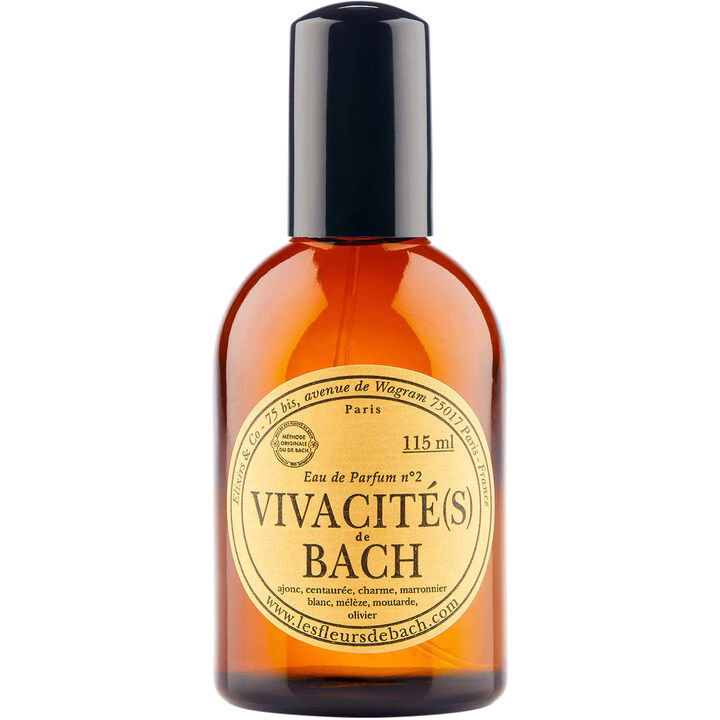
Vivacité(s) de Bach Les Fleurs de Bach

23
Top Review
The Vivace is nice too!
This fragrance was included as a bonus in an envelope with samples that I received from Gerdi - thank you very much! Spontaneously and while reading quickly, I thought that Vivacité(s) de Bach thematically referred to music by or at least after Johann Sebastian Bach. Vivace means "lively" or "brisk" and is a musical tempo and expression designation. Occasionally, such a term is used as the name of an entire piece, simply called a "Vivace." Well-known examples include Samuel Barber's "Adagio for Strings" [adagio = slow, calm] or especially Handel's "Largo" [largo = broad, slow], actually an aria called Ombra mai fu from the opera Serse/Xerxes. A typical "Ah, that" piece, because almost everyone has heard it somewhere (https://www.youtube.com/watch?v=Inl7-Fl77lA).
In this context, our choir director once reported that he had to musically accompany a church wedding as an organist. When the bride thought to ask him if he could play "the(!) Largo by Handel," it was too late; he had already prepared the discussed organ chorale. He was not upset about it, as these classical hits, which are often picked out as background music, can easily get on the nerves of full-blooded musicians. After the wedding, the lady said to him: "Well, the Largo was nice too."
In fact, the name of the fragrance refers to the so-called Bach flowers, an alternative treatment method devised by the English doctor Edward Bach using flower tinctures, whose production resembles the approach used in homeopathic medicines. The Bach flowers are thus a variant of those numerous products that are often accused of primarily benefiting the manufacturer. I am pragmatic about it. We have had some success with homeopathic globules for our children, and I don't care at all whether that might just be based on the placebo effect or not.
Well, at the latest when sniffing, I would have had quiet doubts about the musical background of the fragrance anyway. Bach has the "Coffee Cantata," but I know nothing of a garden-and-kitchen cantata. I olfactorily march directly from the garden into the kitchen. And the garden is not full of sweet-smelling flowers, but rather there is a - if you will - broom stinking away. In the northeast corner stands a larch. I can remember the smell well because there was a heavily climbed specimen next to my parents' house. I can't say anything about the other bizarre tree and herb ingredients due to lack of knowledge.
Now, off to the kitchen: The mustard note is incredibly well done - although I'm not sure I would have come up with it on my own. It is undoubtedly herb mustard. I suspect, for example, tarragon. It is mild. It lacks that sharp sourness of cheap everyday mustard. This one comes from a delicatessen, is certainly goooons exclusivly imported from France, and focuses on the herb, not the mustard. The olive note is rather sour, which I have to somewhat imagine. The question remains whether I want to smell like this? The surprisingly positive answer for me is: It's more than bearable!
As it develops (after about three hours), it becomes a bit more coniferous. Otherwise, there is no significant scent progression. At least none with twists or anything. The fragrance lasts a total of about six hours.
For fans of extravagant, kitchen-related scents, this stuff is a real test tip; for others, it is suitable as an unpretentious everyday fragrance. Fortunately, I do not share Turandot's unfortunate association with spirit of wine, or at most from a pleasant distance. And Vivacité(s) de Bach certainly deserves an originality award. To stay in the metaphor: So, the Vivace is nice too!
P.S.: Interestingly, I recently had Vivacité(s) de Bach on my secondary scent wrist while primarily testing Tom Ford's Noir Extreme. And since Noir Extreme is actually not extremely black but extremely sweet, a occasionally interjected spicy nose snack from the other side was a delightful balance - like the secret slice of salami in the kitchen while the Frankfurt crown battle rages at the coffee table in the next room. Thus, Vivacité(s) de Bach is an excellent second for a duel, for example, with a vanilla pamps opponent.
In this context, our choir director once reported that he had to musically accompany a church wedding as an organist. When the bride thought to ask him if he could play "the(!) Largo by Handel," it was too late; he had already prepared the discussed organ chorale. He was not upset about it, as these classical hits, which are often picked out as background music, can easily get on the nerves of full-blooded musicians. After the wedding, the lady said to him: "Well, the Largo was nice too."
In fact, the name of the fragrance refers to the so-called Bach flowers, an alternative treatment method devised by the English doctor Edward Bach using flower tinctures, whose production resembles the approach used in homeopathic medicines. The Bach flowers are thus a variant of those numerous products that are often accused of primarily benefiting the manufacturer. I am pragmatic about it. We have had some success with homeopathic globules for our children, and I don't care at all whether that might just be based on the placebo effect or not.
Well, at the latest when sniffing, I would have had quiet doubts about the musical background of the fragrance anyway. Bach has the "Coffee Cantata," but I know nothing of a garden-and-kitchen cantata. I olfactorily march directly from the garden into the kitchen. And the garden is not full of sweet-smelling flowers, but rather there is a - if you will - broom stinking away. In the northeast corner stands a larch. I can remember the smell well because there was a heavily climbed specimen next to my parents' house. I can't say anything about the other bizarre tree and herb ingredients due to lack of knowledge.
Now, off to the kitchen: The mustard note is incredibly well done - although I'm not sure I would have come up with it on my own. It is undoubtedly herb mustard. I suspect, for example, tarragon. It is mild. It lacks that sharp sourness of cheap everyday mustard. This one comes from a delicatessen, is certainly goooons exclusivly imported from France, and focuses on the herb, not the mustard. The olive note is rather sour, which I have to somewhat imagine. The question remains whether I want to smell like this? The surprisingly positive answer for me is: It's more than bearable!
As it develops (after about three hours), it becomes a bit more coniferous. Otherwise, there is no significant scent progression. At least none with twists or anything. The fragrance lasts a total of about six hours.
For fans of extravagant, kitchen-related scents, this stuff is a real test tip; for others, it is suitable as an unpretentious everyday fragrance. Fortunately, I do not share Turandot's unfortunate association with spirit of wine, or at most from a pleasant distance. And Vivacité(s) de Bach certainly deserves an originality award. To stay in the metaphor: So, the Vivace is nice too!
P.S.: Interestingly, I recently had Vivacité(s) de Bach on my secondary scent wrist while primarily testing Tom Ford's Noir Extreme. And since Noir Extreme is actually not extremely black but extremely sweet, a occasionally interjected spicy nose snack from the other side was a delightful balance - like the secret slice of salami in the kitchen while the Frankfurt crown battle rages at the coffee table in the next room. Thus, Vivacité(s) de Bach is an excellent second for a duel, for example, with a vanilla pamps opponent.
Translated · Show original
12 Comments
But I already have a Lalique with a curry note that sufficiently covers my need for food in fragrances ;-)
Your fragrance description sounds great to me; I'm especially pleased that "the Largo" was so well received by the wedding guests!
Handel trophy for you!