
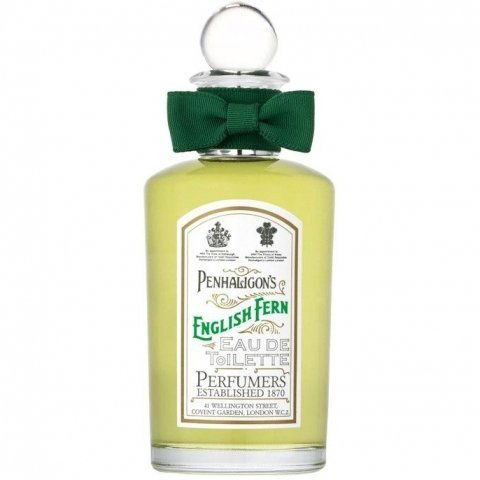
English Fern Penhaligon's 1910 Eau de Toilette

Top Review
Quality and Understatement
W. H. Penhaligon founded his house in 1870. English Fern saw the light of day in 1910 and has since stood as a calm, discreet park and country scent of the classic fougère genre, consistently within its offering segment.
If I were to attribute defining character traits to this fragrance creation that distinguish it, they would be "calm, serenity, and discretion."
Over a hundred years later, English Fern is still on the shelves, although its character has not changed, while the times and people have changed enormously in the meantime, and other laws govern everyday life.
Penhaligon's English Fern has thus existed for half an eternity, and yet it has maintained its popularity into the 21st century.
Regarding its market presence, it will certainly continue to be pushed to the sidelines, as financially strong profit-oriented new perfume companies act more aggressively in customer strategy.
In the fragrance world, the latest consumption-psychologically well-thought-out marketing strategies are being pursued, which aim to achieve maximum buyer attention with their precisely conceived new products, thereby ensuring that the investments made through risk minimization meet the targets set by business experts.
Penhaligon's English Fern has not changed in the last 100 years, neither in the beautifully designed cardboard packaging nor in its bottle.
Not to mention the content and ingredients.
Penhaligon, as an established English traditional house, shows inflexibility regarding its time-tested formulations and ingredients and rather evokes a feeling of clearly defined rigidity, reminiscent of the unyielding stubbornness mixed with nationalistic English pride of Margaret Thatcher during the Falklands issue.
The house of Penhaligon relies on proven tradition and has so far signaled a confident insistence on its own tradition and continuity regarding trends in reformulating their fragrances - in this respect, it is likely that in recent years, only due to legal requirements, the oak moss content in English Fern has been modified; otherwise, to my knowledge, we still have the original form of English Fern since 1910.
What a finely balanced fougère fragrance that has made the hearts of ladies and gentlemen beat faster with its elegant English presence for generations.
Unlike many other perfumes of this genre, English Fern completely does without the opening with citrus notes or bergamot.
The top note is characterized by a very typical duet of lavender and geranium in fresh, harmonious completion,
Anyone who has caught a whiff of the fragrance retains it deeply imprinted in their memory, and the recognition value is disproportionately high.
Both components, lavender and geranium, can have their quirks in presentation; here, Penhaligon has perfectly understood how to let each of these difficult personality accentuations in the fragrance presentation shine through the highlighting of each particularity, allowing English Fern to radiate in a wonderfully new symbiotic-sympathetic entirety.
As the fragrance develops, there is an impression that an additional freshness character in the form of mint joins in phases, whose presence in the further interplay never shines through dominance but rather through typical English understatement.
The heart note begins subtly with an additional spice influence and the appearance of clover but remains balanced throughout, thanks to the already harmonious lavender-geranium top note and the well-measured addition of clove, forming a well-thought-out, time-tested continuum of the initiated and ongoing fragrance development.
Oak moss, sandalwood, and patchouli appear later as additional players, giving this characteristic fragrance its appropriately well-tempered base, while only complementing the fragrance in its uniqueness and elegantly guiding it to its epilogue.
For me, the highest English quality work, and that for centuries.
If I were to attribute defining character traits to this fragrance creation that distinguish it, they would be "calm, serenity, and discretion."
Over a hundred years later, English Fern is still on the shelves, although its character has not changed, while the times and people have changed enormously in the meantime, and other laws govern everyday life.
Penhaligon's English Fern has thus existed for half an eternity, and yet it has maintained its popularity into the 21st century.
Regarding its market presence, it will certainly continue to be pushed to the sidelines, as financially strong profit-oriented new perfume companies act more aggressively in customer strategy.
In the fragrance world, the latest consumption-psychologically well-thought-out marketing strategies are being pursued, which aim to achieve maximum buyer attention with their precisely conceived new products, thereby ensuring that the investments made through risk minimization meet the targets set by business experts.
Penhaligon's English Fern has not changed in the last 100 years, neither in the beautifully designed cardboard packaging nor in its bottle.
Not to mention the content and ingredients.
Penhaligon, as an established English traditional house, shows inflexibility regarding its time-tested formulations and ingredients and rather evokes a feeling of clearly defined rigidity, reminiscent of the unyielding stubbornness mixed with nationalistic English pride of Margaret Thatcher during the Falklands issue.
The house of Penhaligon relies on proven tradition and has so far signaled a confident insistence on its own tradition and continuity regarding trends in reformulating their fragrances - in this respect, it is likely that in recent years, only due to legal requirements, the oak moss content in English Fern has been modified; otherwise, to my knowledge, we still have the original form of English Fern since 1910.
What a finely balanced fougère fragrance that has made the hearts of ladies and gentlemen beat faster with its elegant English presence for generations.
Unlike many other perfumes of this genre, English Fern completely does without the opening with citrus notes or bergamot.
The top note is characterized by a very typical duet of lavender and geranium in fresh, harmonious completion,
Anyone who has caught a whiff of the fragrance retains it deeply imprinted in their memory, and the recognition value is disproportionately high.
Both components, lavender and geranium, can have their quirks in presentation; here, Penhaligon has perfectly understood how to let each of these difficult personality accentuations in the fragrance presentation shine through the highlighting of each particularity, allowing English Fern to radiate in a wonderfully new symbiotic-sympathetic entirety.
As the fragrance develops, there is an impression that an additional freshness character in the form of mint joins in phases, whose presence in the further interplay never shines through dominance but rather through typical English understatement.
The heart note begins subtly with an additional spice influence and the appearance of clover but remains balanced throughout, thanks to the already harmonious lavender-geranium top note and the well-measured addition of clove, forming a well-thought-out, time-tested continuum of the initiated and ongoing fragrance development.
Oak moss, sandalwood, and patchouli appear later as additional players, giving this characteristic fragrance its appropriately well-tempered base, while only complementing the fragrance in its uniqueness and elegantly guiding it to its epilogue.
For me, the highest English quality work, and that for centuries.
Translated · Show original
12 Comments
Deine Vorliebe für die britische Insel ist nicht zu übersehen
What you mean, great article indeed!!!!!