
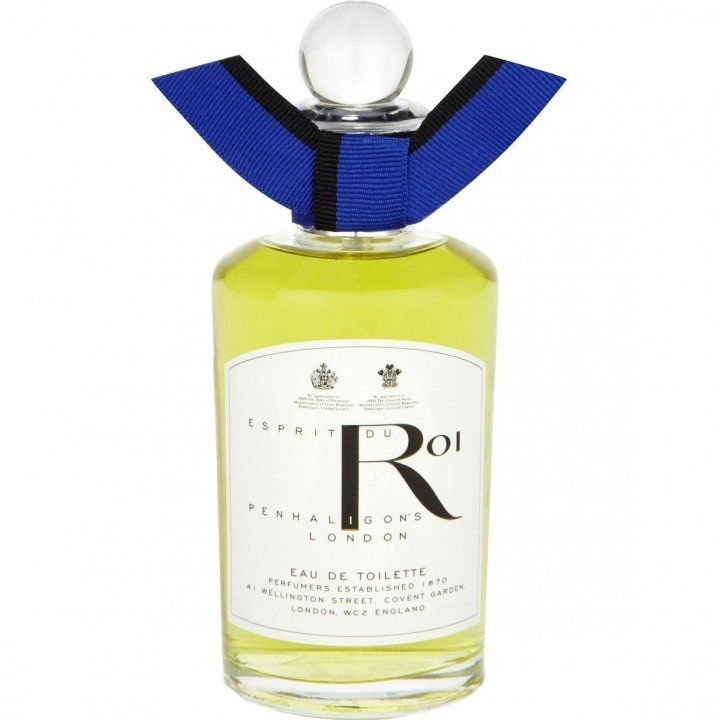
Esprit du Roi Penhaligon's 2011
Top Review
The King is dead, long live the King!
This king is no more. Apicius predicted 9 years ago that this middle-class Penhaligon’s would eventually be discontinued. Esprit du Roi was a reissue in 2011 of a perfume with the same name from 1983. I cannot comment on the 83 version; I am only referring to the re-release.
Now, I do not see the royal abdication as being based on its supposed mediocrity, but rather in the fact that consumers accustomed to effects simply demand "grabbier concepts" than one might recognize in such a somewhat quirky herbal men’s chypre.
This Duchaufour is certainly a well-crafted work of art, but upon closer inspection, it is neither fish nor fowl. And little about it seems royal. It comes from a time when classic large and loud men’s fragrances garnered a broad fan base, which still often exists today. Why this rather quiet Penhaligon’s did not succeed in the early 80s, I cannot judge; however, it certainly could not have stood miles away from its shoes with its little bit of tomato extravagance.
But why did the royal head have to roll now? It can hardly be due to the quality, as this scent is indeed made of high quality. Does the royalist naming not correspond enough to the spirit of the times?
When looking at the latest Penhaligon’s outputs, it is precisely the nobility factor that the brand is relying on... albeit now also equipped with a touch of British humor, which the poor tomato king always seemed to lack. So, are we seeing the failure in the joyless marketing that finds its consensus in this boring white label?
Be that as it may, I do not want to philosophize for long about why a product can succeed in the market while another cannot. However, it is interesting that it cannot solely be about the scent concept, as various "old-fashioned" formulations have experienced an almost exaggeratedly celebrated renaissance in recent years. For example, "Chypre Palatin," "Sartorial" (both by Duchaufour), "Invasion Barbare," "Masculin Pluriel" (Kurkdjian), etc., all indicate that the dead often live longer.
With Esprit du Roi, a certain perplexity spreads. This scent cannot quite decide. The king reigns, but he does not rule.
In the years I have been dealing with fragrances, my taste has changed significantly in some ways, and in others, it has expanded to the point that today I count perfumes in my collection that I would never have liked before.
For example, at the beginning, I was only drawn to citrusy, relatively nature-close scents without any sweetness, but I have since engaged with ambered, sweeter, or even gourmand fragrances and often made friends with them. The same goes for floral scents, which I did not appreciate at all at the beginning.
And I still remember well my first test of this Penhaligon’s. I received a sample together with Endymion, which I liked immediately.
I found the royal top note quite appealing, herbal-minty, then follows a fresh, not too extreme floral soapiness in the heart, which I like.
The very slightly sweet ambered vetiver-moss base seemed rather inappropriate to me and left me feeling somewhat helpless. I rated it back then with only 6.5 points and left it at that. My judgment must have been subjected to my then all-or-nothing maxim: spicy-exotic or citrus-fresh. I realized that this approach did not have endless validity since I started testing the classics from Guerlain & Co., where citrus complexes and floral hearts work wonderfully in conjunction with a well-tempered vanilla-wood base. I consider some compositions of this kind to be the greatest (and most complete) perfumes of all time.
This Penhaligon’s is essentially quite classically arranged, and one could easily overlook it because it does not really present anything new. However, the much-cited tomato note does propel it somewhat out of the habitual and may indeed be the bone of contention for some.
Esprit du Roi is still worth a test if one can generally appreciate British fragrance craftsmanship. You can still find some cheap leftovers online, and I also unhesitatingly grabbed one of those.
And surprisingly had to rehabilitate the king.
Long live the dead king!
Now, I do not see the royal abdication as being based on its supposed mediocrity, but rather in the fact that consumers accustomed to effects simply demand "grabbier concepts" than one might recognize in such a somewhat quirky herbal men’s chypre.
This Duchaufour is certainly a well-crafted work of art, but upon closer inspection, it is neither fish nor fowl. And little about it seems royal. It comes from a time when classic large and loud men’s fragrances garnered a broad fan base, which still often exists today. Why this rather quiet Penhaligon’s did not succeed in the early 80s, I cannot judge; however, it certainly could not have stood miles away from its shoes with its little bit of tomato extravagance.
But why did the royal head have to roll now? It can hardly be due to the quality, as this scent is indeed made of high quality. Does the royalist naming not correspond enough to the spirit of the times?
When looking at the latest Penhaligon’s outputs, it is precisely the nobility factor that the brand is relying on... albeit now also equipped with a touch of British humor, which the poor tomato king always seemed to lack. So, are we seeing the failure in the joyless marketing that finds its consensus in this boring white label?
Be that as it may, I do not want to philosophize for long about why a product can succeed in the market while another cannot. However, it is interesting that it cannot solely be about the scent concept, as various "old-fashioned" formulations have experienced an almost exaggeratedly celebrated renaissance in recent years. For example, "Chypre Palatin," "Sartorial" (both by Duchaufour), "Invasion Barbare," "Masculin Pluriel" (Kurkdjian), etc., all indicate that the dead often live longer.
With Esprit du Roi, a certain perplexity spreads. This scent cannot quite decide. The king reigns, but he does not rule.
In the years I have been dealing with fragrances, my taste has changed significantly in some ways, and in others, it has expanded to the point that today I count perfumes in my collection that I would never have liked before.
For example, at the beginning, I was only drawn to citrusy, relatively nature-close scents without any sweetness, but I have since engaged with ambered, sweeter, or even gourmand fragrances and often made friends with them. The same goes for floral scents, which I did not appreciate at all at the beginning.
And I still remember well my first test of this Penhaligon’s. I received a sample together with Endymion, which I liked immediately.
I found the royal top note quite appealing, herbal-minty, then follows a fresh, not too extreme floral soapiness in the heart, which I like.
The very slightly sweet ambered vetiver-moss base seemed rather inappropriate to me and left me feeling somewhat helpless. I rated it back then with only 6.5 points and left it at that. My judgment must have been subjected to my then all-or-nothing maxim: spicy-exotic or citrus-fresh. I realized that this approach did not have endless validity since I started testing the classics from Guerlain & Co., where citrus complexes and floral hearts work wonderfully in conjunction with a well-tempered vanilla-wood base. I consider some compositions of this kind to be the greatest (and most complete) perfumes of all time.
This Penhaligon’s is essentially quite classically arranged, and one could easily overlook it because it does not really present anything new. However, the much-cited tomato note does propel it somewhat out of the habitual and may indeed be the bone of contention for some.
Esprit du Roi is still worth a test if one can generally appreciate British fragrance craftsmanship. You can still find some cheap leftovers online, and I also unhesitatingly grabbed one of those.
And surprisingly had to rehabilitate the king.
Long live the dead king!
Translated · Show original
12 Comments
For me personally, tomato leaf has a scent that I often find hard to tolerate.
Great revival, vive le roi!