There, Count Danilo from Franz Lehár's operetta "The Merry Widow" spent his nights.
Who doesn’t remember Johannes Heesters, as he cheerfully tossed his white theater scarf, put on his top hat, and left the stage with a wink, ready for adventure?
First, he went behind it; whether he really went to "Maxim's" later is not known.
On April 7, 1883, the former waiter Maxim Gaillard opened a restaurant that he named after himself. Initially, its clientele consisted mainly of the cab drivers from the neighborhood.
It was only with the Belle Époque that this would change significantly.
Those who went to Paris's "Maxim's" left their wives at home; for there, the most famous grisettes (see "The Merry Widow") awaited the adventurous men, and soon one could also enjoy excellent dining there.
After World War II, "Maxim's" experienced a revival: anyone who was anyone could be found there; the guest list surely resembles a "Who's Who" of the celebrity/glamour world of that time.
Even though the three "Michelin stars" have since been lost, a visit to the museum established by Pierre Cardin is still just as interesting as the noteworthy Art Nouveau decor of the restaurant, which has been classified as a "Monument historique".
What, you may ask, is she rambling on about again?
Who cares about this establishment; after all, this is about perfumes.
Exactly!
For in 1981, Pierre Cardin, known as a couturier who never copied but always forged his own path, bought "Maxim's".
(Ah, what a "rustle in the forest" there was back then!)
Under this name, the enterprising man sold various gourmet items.
I still remember the champagne truffles in the tasteful packaging with the name "Maxim's," which sounded a bit risqué to me at the time. - Yes, that was a long time ago!
The champagne of the same name was also popular: how our working students rejoiced when they received a bottle of "Maxim's" champagne from the boss on their birthdays or at Christmas!
In this way, Pierre Cardin managed to make his name widely known and to stand on more than one leg.
Always more innovative than others, anticipating and capitalizing on the spirit of the times, Pierre Cardin was the first to make a mark in both ready-to-wear and haute couture women's fashion.
As early as 1958, he created a unisex clothing line, and in the 1960s, he was part of the avant-garde along with Courrèges.
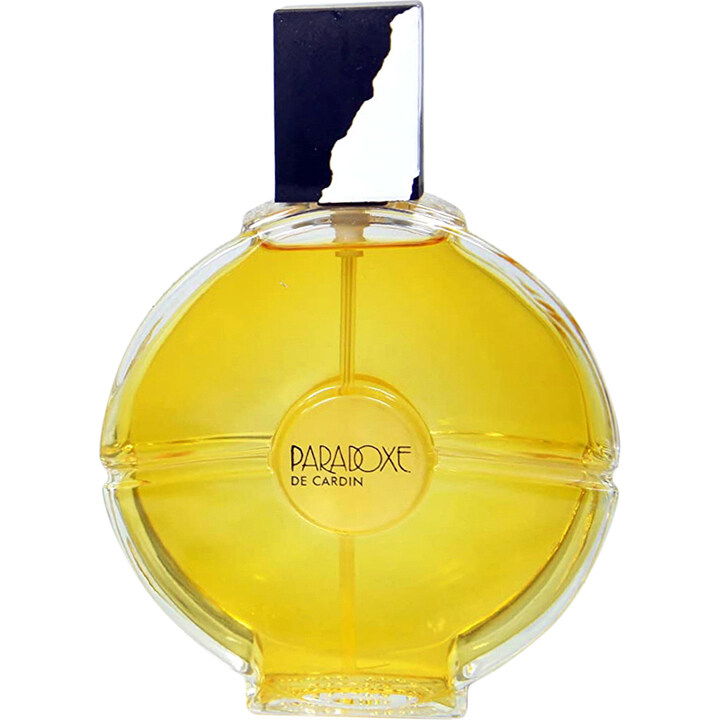
After his first Eau de Parfum "Choc" (1957: Even the name sets itself apart from the cloistered world of couture!), he launched "Paradoxe," also as an Eau de Parfum, in 1983 - one hundred years after the initial opening of Paris's "Maxim's".
This man knew his craft and mastered the art of riding the right wave at the right time.
Although Pierre Cardin was a creative mind and never copied in fashion, with "Paradoxe," he did follow the successful Chypre fragrance paths.
Thus, the fragrance pyramid shows the typical progression of a classic Chypre, which has been embellished and adapted: "Paradoxe" certainly has a pronounced strong character!
The top note is a stylish fresh combination of citrus notes gathered around bergamot; mandarin and lemon create a cheerful first impression.
Shifting more towards the iris and forgoing the classic rose, "Paradoxe" quickly transforms into a powdery direction.
The two intensely fragrant white flowers, tuberose and jasmine, get their share from the powder puff, and hyacinth and ylang-ylang have to duck a little.
The heart of "Paradoxe" is not as floral and radiant as one might expect.
Rather, it already hints at the base with brown, green, and smoky nuances; an interesting transition!
The already strong moss is supported by leather and spicy pepper:
Immediately, "Paradoxe" becomes darker, deeper, and less cuddly; some barbs can already be sensed.
Even though musk and amber draw a light curtain over this fragrance power, thus wanting to maintain the soft-feminine character of the previous fragrance progression: "Paradoxe" does not want to swim with the elegant Chypre stream!
It aims to give confident women an additional fragrance personality that attracts attention!
To this end, generous use of incense is made:
The woman of the eighties was strong and self-assured - and she should show it!
Perhaps "Paradoxe" was also intended as a counterpart to the overflowing colors and fabrics of fashion in those years.
I only recall the magnificent garments in "Dynasty" and similar cult series.
The woman so elaborately "packaged" there showed strength, and a fragrance that underscored this was just right!
The selected and very skillfully dosed fragrance notes give "Paradoxe" a corresponding sillage and longevity.
A business fragrance that was quite fitting for the time: I can hardly remember any offices where Chypre fragrances were not the most prominent "employees".
In any case, I will gladly use the fragrance sample left to me by Gelis (even if a bit of "iris powder" has now gotten into my nose and mouth while spraying, making me cough and sneeze!).
I thank her for that.
And between us:
A night at "Maxim's" could still be well endured today in the company of this fragrance creation, without needing to touch up - unless for pleasure!
A very interesting and enjoyable comment. I don't know Paradoxe, but based on your description, I think I would really like it, and I totally love incense............
I love the incense in this one, which beautifully balances the powdery notes and keeps it from feeling too "overdone." Paradoxe is definitely something special.
An extremely interesting and well-articulated comment! While I believe the scent may not necessarily match my preferences, I really enjoyed reading the story about Pierre Cardin!
Pierre Cardin is rarely appreciated here, so it's great that you took it on. I loved the scent "Paradoxe." I even miss it... for me, these old '80s fragrances are usually a thousand times more beautiful than current niche perfumes that cost a fortune and mostly just bore me.


 Ruesselchen 4 years ago
 Ergoproxy 4 years ago
 Renata 4 years ago
 Cravache 4 years ago
 Pollita 4 years ago
 Gandix 4 years ago
 Parfümlein 4 years ago
 Gold 4 years ago