
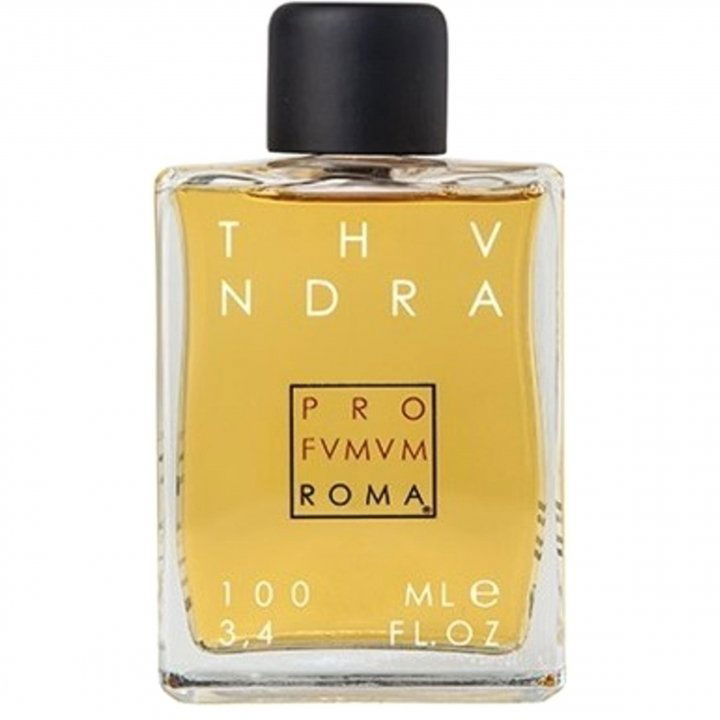
Thundra Profumum Roma 1996

16
Very helpful Review
"One does not travel to arrive, but to travel."
I would like to begin with the Goethe quote in the headline.
And I want to consciously frame this review between two quotes, as it refers to a fragrance named after a climate zone that is framed.
Framed in the truest sense of the word.
Framed between two other climate zones. And this circumstance will be reflected in the scent DNA... but we will get there.
To get there, we will travel together. This review will not be straightforward; it will meander and be lengthy. It will be a question-and-answer game and a search for definitions. Primarily, however, it will be a journey.
You can still drop out now, but I would be happy if you join me. We travel to understand a fragrance that deserves to be understood. Whether we can do it justice, I cannot promise you, but we will do our best on this journey.
Let’s start at the beginning and then slowly and steadily work our way forward, as the Thundra, or as I will henceforth write, the Tundra, does not allow otherwise.
To any exact elaboration belongs, first of all, a clarification of the terminology.
In my opinion, a certain understanding of what the Tundra means is even essential to understand the fragrance.
So what is the Tundra?
The Tundra, also known as treeless cold steppe, is simply put the umbrella term for the open land areas of the (sub-)polar climate zone.
What does that mean and where can you find this Tundra, or better, the Tundra areas?
Well, basically, there are only three major areas, which is why we want to briefly look at this together in theory before we then travel through the Tundra together.
The largest part of the Tundra is located in the northern hemisphere on the landmasses of the Arctic. Therefore, this part is also called Arctic Tundra, which includes parts of Canada, Siberia, Scandinavia, and Alaska.
Then there is the Tundra in the southern hemisphere. However, since Antarctica is almost completely covered with ice, the Tundra areas here are only found at the edge of Antarctica. Depending on the definition, significant parts of Tierra del Fuego and the Falkland Islands also belong to this southern hemisphere Tundra. This is then the Antarctic Tundra due to its geographical proximity to the South Pole.
The third major area is alpine Tundra, which is distributed all over the world. This includes Tundra areas in mountains like the Alps or the Himalayas.
These three major Tundra areas together cover a landmass of about 3-4% as cold steppe.
From now on, when I write about Tundra in this review, I will refer to the Arctic Tundra. On the one hand, because I have the greatest connection to it, and on the other hand - and this is much more important at this point - because it seems to me to be the most relevant for the perfume being reviewed here.
But how do we reconcile perfume and climate zone, you may wonder. And rightly so, but please be patient for a moment, and everything will become clear.
I will now take you on a short journey through the Tundra. Why THROUGH the Tundra and not IN the Tundra? Yes, this question is justified, and the answer is due to the nature of the Tundra.
Very few people settle in the Tundra or choose to reside here.
Primarily, one traverses the Tundra, at least as a traveler. One crosses it to get from the Taiga to the Arctic. (Or vice versa.)
Admittedly, I do not have an ideal knowledge of the Tundra either. I have traveled parts of the Taiga and have also reached the Tundra. However, I have never crossed it.
Nevertheless, I have engaged intensively enough with the map and travel routes to describe that the Tundra on one side borders directly on polar ice surfaces and on the other side, the more vegetation-friendly side, transitions into the Taiga, which is characterized primarily by its countless coniferous trees and is beautiful to travel through, but that is a topic for another review.
So let us now traverse the Tundra together in thought within the framework of this review.
To do this, we find ourselves on the Dempster Highway. This is one of the most remote roads in Canada and the only one that leads into the Arctic in both summer and winter.
Over 736 kilometers, this road winds over the permafrost, from the south of Yukon not far from the gold rush town of Dawson City to Inuvik in the Northwest Territories.
The Dempster Highway passes lonely lakes and subarctic forests.
It goes through the Tundra. Here, there is hardly a soul in sight.
What an adventure!
“At 66 degrees and 33 minutes north latitude, we cross the Arctic Circle, later we take ferries over the mighty rivers of the north. There is only one hotel along the road, including a gas station and workshop.
Otherwise, only emptiness, solitude, and the horizon that seems endless.
At the end of our journey, Inuvik offers superlatives with the northernmost greenhouse and the most famous igloo church in the country. A sophisticated ventilation system ensures that the round structure does not sink into the permafrost. In the fall, a new road will open in Inuvik that leads all the way to Tuktoyaktuk on the Arctic Ocean.” (Source: Travel Report Dempster Canada)
So, now you understand the bipolarity of the Tundra. Since we are in the subpolar region, the term bipolarity is probably not ideally chosen. But that doesn’t matter, because it’s about understanding that it is a diametrical landscape.
Caught between Taiga and Arctic, it lies there: The Tundra.
That is the situation, but what about the perfume? Hang in there, the Tundra is difficult to traverse...
Before we get to the fragrance itself, we must clarify not only the location of the Tundra but also its characteristics.
What is the climate like? Cold. The temperature and sunlight are very extreme. There are long winters here. Then the average temperature is below 15 degrees Celsius. However, there are also large fluctuations, as in summer the average temperatures rise above 15 degrees Celsius. The soils are completely covered with snow and frozen for eight to eleven months.
That is where the name permafrost comes from, namely from permanent frost.
What happens in summer? In summer, the top layer of ice melts, but only that.
Then the water cannot drain away, and a floodplain forms.
In summer, the sun shines in the Tundra mostly all day.
And this is where the short period for plants to grow lies.
The extreme climate makes it possible for only a few plants (and animals) to settle here.
Thus, the cold steppe is a very barren landscape.
And this is how you can determine the transition from the Taiga to the Tundra. Where there are no more trees, the Tundra area begins.
But why? The permafrost prevents the rooting of trees. Moreover, they cannot draw nutrients from the soil here.
And that is why you find no trees here, but many small plants like mosses, lichens, and shrubs.
+++++
The scent begins to reveal its interplay of patchouli and mint with the first spray.
The top note comes across quite piercing, as it is such a refined cold mint that one can olfactorily immediately grasp the permafrost.
At the same time, one smells such a deep earthy patchouli that one can almost taste the barren soil that forms the basis of all Tundra.
Immediately, you are there. On site. In the first minutes, you can already smell the Arctic in the distance (mint) and the distant Taiga (slight coniferous forest association) at your back.
Patchouli remains present throughout, but becomes more open, more voluminous. The coniferous forest association is completely displaced and replaced by moist, mossy soil. At the same time, the mint is always present, sometimes stronger and sometimes less strong. It blows like cold winds.
Over time, a slight herbal note emerges that I cannot pinpoint (thyme, lavender, rosemary), but at least the association with the shrubs and lichens of the Tundra comes to mind. Also, a very slight, restrained animalic note flashes through now and then, like a snow hare that briefly runs into the picture.
In the end, only patchouli remains. Beautifully trampled open patchouli. And yet this patchouli is not warm cocoa patchouli, not rich harvest patchouli, and not fireplace cuddle patchouli. This patchouli is cold-earthy, perfectly fitting with the subtle mint tone that accompanies it permafrost, uh, permanently. And yet, the patchouli radiates a certain warmth now and then, as if summer in the Tundra could melt the ice and the earth would receive moisture.
This fragrance is what one can truly understand as niche, as it consistently smells like what it claims to be and does not strive to please everyone.
The combination of patchouli and mint is not necessarily the first thing that comes to mind when going through fragrance pairs for harmony.
To become a so-called “crowd-pleaser,” it would have needed to be rounder, less demanding, and less brutal. But the Tundra is demanding.
And this is exactly what this fragrance masterfully shows: The Tundra. The beauty of the Tundra.
Dear ones, if you are ever (again) on the Dempster Highway, do not just look for the pole, the Arctic, and the glow of the stars and northern lights. Look at where you are. What this barren landscape has in beauty to offer you. There are already polar foxes, plenty of snow hares, reindeer, and the occasional polar bear. But there are also lichens. There are mosses. There are shrubs. They all smell wonderfully of nearly untouched and remarkably primal nature.
And there is snow and frost. And you can smell both of these too. Your nose will feel the cold.
Pause for a moment in thought at this beautiful transit station. You will arrive, don’t worry. But don’t look at the destination yet; instead, linger in the beauty of the moment.
Because
“Only looking at the destination spoils the joy of traveling.”
-Friedrich Rückert
And I want to consciously frame this review between two quotes, as it refers to a fragrance named after a climate zone that is framed.
Framed in the truest sense of the word.
Framed between two other climate zones. And this circumstance will be reflected in the scent DNA... but we will get there.
To get there, we will travel together. This review will not be straightforward; it will meander and be lengthy. It will be a question-and-answer game and a search for definitions. Primarily, however, it will be a journey.
You can still drop out now, but I would be happy if you join me. We travel to understand a fragrance that deserves to be understood. Whether we can do it justice, I cannot promise you, but we will do our best on this journey.
Let’s start at the beginning and then slowly and steadily work our way forward, as the Thundra, or as I will henceforth write, the Tundra, does not allow otherwise.
To any exact elaboration belongs, first of all, a clarification of the terminology.
In my opinion, a certain understanding of what the Tundra means is even essential to understand the fragrance.
So what is the Tundra?
The Tundra, also known as treeless cold steppe, is simply put the umbrella term for the open land areas of the (sub-)polar climate zone.
What does that mean and where can you find this Tundra, or better, the Tundra areas?
Well, basically, there are only three major areas, which is why we want to briefly look at this together in theory before we then travel through the Tundra together.
The largest part of the Tundra is located in the northern hemisphere on the landmasses of the Arctic. Therefore, this part is also called Arctic Tundra, which includes parts of Canada, Siberia, Scandinavia, and Alaska.
Then there is the Tundra in the southern hemisphere. However, since Antarctica is almost completely covered with ice, the Tundra areas here are only found at the edge of Antarctica. Depending on the definition, significant parts of Tierra del Fuego and the Falkland Islands also belong to this southern hemisphere Tundra. This is then the Antarctic Tundra due to its geographical proximity to the South Pole.
The third major area is alpine Tundra, which is distributed all over the world. This includes Tundra areas in mountains like the Alps or the Himalayas.
These three major Tundra areas together cover a landmass of about 3-4% as cold steppe.
From now on, when I write about Tundra in this review, I will refer to the Arctic Tundra. On the one hand, because I have the greatest connection to it, and on the other hand - and this is much more important at this point - because it seems to me to be the most relevant for the perfume being reviewed here.
But how do we reconcile perfume and climate zone, you may wonder. And rightly so, but please be patient for a moment, and everything will become clear.
I will now take you on a short journey through the Tundra. Why THROUGH the Tundra and not IN the Tundra? Yes, this question is justified, and the answer is due to the nature of the Tundra.
Very few people settle in the Tundra or choose to reside here.
Primarily, one traverses the Tundra, at least as a traveler. One crosses it to get from the Taiga to the Arctic. (Or vice versa.)
Admittedly, I do not have an ideal knowledge of the Tundra either. I have traveled parts of the Taiga and have also reached the Tundra. However, I have never crossed it.
Nevertheless, I have engaged intensively enough with the map and travel routes to describe that the Tundra on one side borders directly on polar ice surfaces and on the other side, the more vegetation-friendly side, transitions into the Taiga, which is characterized primarily by its countless coniferous trees and is beautiful to travel through, but that is a topic for another review.
So let us now traverse the Tundra together in thought within the framework of this review.
To do this, we find ourselves on the Dempster Highway. This is one of the most remote roads in Canada and the only one that leads into the Arctic in both summer and winter.
Over 736 kilometers, this road winds over the permafrost, from the south of Yukon not far from the gold rush town of Dawson City to Inuvik in the Northwest Territories.
The Dempster Highway passes lonely lakes and subarctic forests.
It goes through the Tundra. Here, there is hardly a soul in sight.
What an adventure!
“At 66 degrees and 33 minutes north latitude, we cross the Arctic Circle, later we take ferries over the mighty rivers of the north. There is only one hotel along the road, including a gas station and workshop.
Otherwise, only emptiness, solitude, and the horizon that seems endless.
At the end of our journey, Inuvik offers superlatives with the northernmost greenhouse and the most famous igloo church in the country. A sophisticated ventilation system ensures that the round structure does not sink into the permafrost. In the fall, a new road will open in Inuvik that leads all the way to Tuktoyaktuk on the Arctic Ocean.” (Source: Travel Report Dempster Canada)
So, now you understand the bipolarity of the Tundra. Since we are in the subpolar region, the term bipolarity is probably not ideally chosen. But that doesn’t matter, because it’s about understanding that it is a diametrical landscape.
Caught between Taiga and Arctic, it lies there: The Tundra.
That is the situation, but what about the perfume? Hang in there, the Tundra is difficult to traverse...
Before we get to the fragrance itself, we must clarify not only the location of the Tundra but also its characteristics.
What is the climate like? Cold. The temperature and sunlight are very extreme. There are long winters here. Then the average temperature is below 15 degrees Celsius. However, there are also large fluctuations, as in summer the average temperatures rise above 15 degrees Celsius. The soils are completely covered with snow and frozen for eight to eleven months.
That is where the name permafrost comes from, namely from permanent frost.
What happens in summer? In summer, the top layer of ice melts, but only that.
Then the water cannot drain away, and a floodplain forms.
In summer, the sun shines in the Tundra mostly all day.
And this is where the short period for plants to grow lies.
The extreme climate makes it possible for only a few plants (and animals) to settle here.
Thus, the cold steppe is a very barren landscape.
And this is how you can determine the transition from the Taiga to the Tundra. Where there are no more trees, the Tundra area begins.
But why? The permafrost prevents the rooting of trees. Moreover, they cannot draw nutrients from the soil here.
And that is why you find no trees here, but many small plants like mosses, lichens, and shrubs.
+++++
The scent begins to reveal its interplay of patchouli and mint with the first spray.
The top note comes across quite piercing, as it is such a refined cold mint that one can olfactorily immediately grasp the permafrost.
At the same time, one smells such a deep earthy patchouli that one can almost taste the barren soil that forms the basis of all Tundra.
Immediately, you are there. On site. In the first minutes, you can already smell the Arctic in the distance (mint) and the distant Taiga (slight coniferous forest association) at your back.
Patchouli remains present throughout, but becomes more open, more voluminous. The coniferous forest association is completely displaced and replaced by moist, mossy soil. At the same time, the mint is always present, sometimes stronger and sometimes less strong. It blows like cold winds.
Over time, a slight herbal note emerges that I cannot pinpoint (thyme, lavender, rosemary), but at least the association with the shrubs and lichens of the Tundra comes to mind. Also, a very slight, restrained animalic note flashes through now and then, like a snow hare that briefly runs into the picture.
In the end, only patchouli remains. Beautifully trampled open patchouli. And yet this patchouli is not warm cocoa patchouli, not rich harvest patchouli, and not fireplace cuddle patchouli. This patchouli is cold-earthy, perfectly fitting with the subtle mint tone that accompanies it permafrost, uh, permanently. And yet, the patchouli radiates a certain warmth now and then, as if summer in the Tundra could melt the ice and the earth would receive moisture.
This fragrance is what one can truly understand as niche, as it consistently smells like what it claims to be and does not strive to please everyone.
The combination of patchouli and mint is not necessarily the first thing that comes to mind when going through fragrance pairs for harmony.
To become a so-called “crowd-pleaser,” it would have needed to be rounder, less demanding, and less brutal. But the Tundra is demanding.
And this is exactly what this fragrance masterfully shows: The Tundra. The beauty of the Tundra.
Dear ones, if you are ever (again) on the Dempster Highway, do not just look for the pole, the Arctic, and the glow of the stars and northern lights. Look at where you are. What this barren landscape has in beauty to offer you. There are already polar foxes, plenty of snow hares, reindeer, and the occasional polar bear. But there are also lichens. There are mosses. There are shrubs. They all smell wonderfully of nearly untouched and remarkably primal nature.
And there is snow and frost. And you can smell both of these too. Your nose will feel the cold.
Pause for a moment in thought at this beautiful transit station. You will arrive, don’t worry. But don’t look at the destination yet; instead, linger in the beauty of the moment.
Because
“Only looking at the destination spoils the joy of traveling.”
-Friedrich Rückert
Translated · Show original
9 Comments
Thanks for the mention!
I know/knew the scent well, but I still had to peek at my old statement to bring the smell back.
Musk oxen don't freeze. :')
Patchouli has been a favorite of mine since my youth, and the scent sounds like it's just my thing.
Thanks for the great review.
Hopefully, your week in Rome lasts a long time if it brings us such amazing texts.
What a journey!
I've rarely been able to truly see, smell, and taste such images of an impressive landscape!
You've dedicated the best review to this fragrance.
And for that, you deserve a very special trophy.
Call it explorer, nature lover, gifted storyteller, genius nose-whatever you like!
🏆