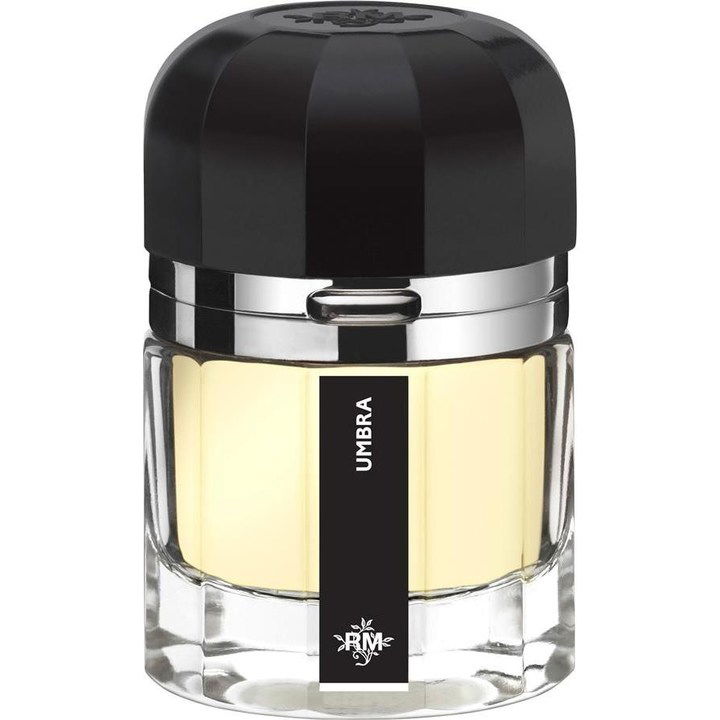
Stop! Let's not be confused by vague descriptions of the fragrance pyramid! Umbra is yet another scent in which I can hardly grasp what is presented to us as its content. I'm sorry - here the lifeline is decidedly too short, the nose finds hardly any anchor, and so one must at least try to swim freely. So let's go!
Together with Agar Musk and Dry Wood, Umbra forms a group of sleek, puristic, and more or less austere men's perfumes from the brand Ramon Monegal. Bitter woodiness is the underlying motif in all three, and I recognize the attempt to represent masculinity in a contemporary form - beyond the sweet worlds of Orientals or even overwhelming Aromatic Fougères.
The name Umbra already suggests it - Umbra is the color of the earth, and thus the connection to Terre d'Hermès in this fragrance is hard to deny. It's interesting that Ellena's successful fragrance continually inspires others to work on it.
The structure is similar - over the characteristic Terre d'Hermès note, which we usually encounter in the fragrance pyramids under the names cedarwood and vetiver, a citrus note is laid first. In the case of Umbra, however, the top note is so distinctive and dominant that the earthy undertone remains hidden for quite a while. Citrus in this case does not mean lemon or grapefruit; rather, it has a fruity or orange quality - a vague hint of neroli or corresponding colognes became noticeable to me. But that is only half the truth: the orange note is paired with a distinctly aromatic side. It is difficult to describe, perhaps one could speak of a slightly "tipsy" tendency.
The top note is good - it already feels considerably more serious than the usual lemon, grapefruit, or bergamot and thus prepares well for the upcoming earthiness.
This earthiness is enriched with black pepper - the only note I want to concede as clearly recognizable in the fragrance pyramid. The earthiness appears much more timid than in Ellena's model, and it does not assert itself immediately. The "booziness" of the top note remains somewhat present and distorts the earth.
Among the three very austere men's perfumes from Ramon Monegal, Umbra is the most pleasant - although this quality of pleasantness should only be seen relatively to the mentioned comparison fragrances. For the bitter earthiness never has a chance to fully present itself. The friendly top note hands over the baton - without completely letting go, of course - to a certain creaminess, perhaps even an oriental touch. One might call it tonka, although it may not be - or at least not only. Possibly other balsamic notes are involved. Thus, the drydown further softens the bitterness, and as I see from the already existing reviews, not everyone appreciates this.
That Ramon Monegal takes a slightly gentler approach here compared to the very extreme Agar Musk and Dry Wood fits quite well into the collection - not everyone likes fragrances that hurt! The question of whether they have perhaps overdone it with the softening and smoothing can be answered either way.
A direct comparison with Ellena's earthy successful fragrance as well as with L'Homme Infini - Yann Vasnier's recently released contribution to the topic - shows that Umbra cannot hold a candle to the two in terms of expression and character. This is especially true during the rather early onset of the drydown. This is certainly not a reason for rejection - it simply makes clear that Umbra ultimately caters to different preferences. It places the earthy accord from Ellena's successful fragrance in a more pleasing and restrained context - and thus Umbra may balance out what it lacks in character in terms of wearability.


 Yalla 12 years ago
  Aava 13 years ago
  Unterholz 13 years ago
  Yatagan 13 years ago