
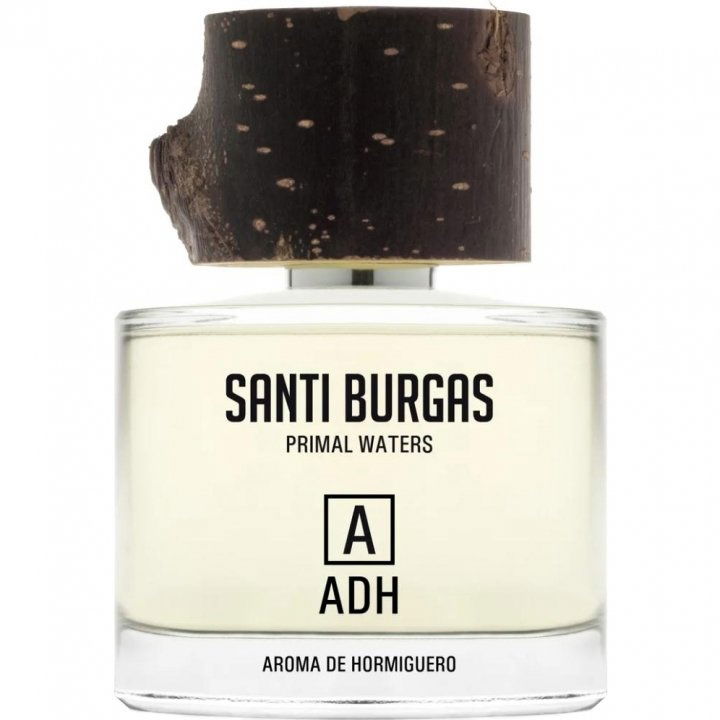
Primal Waters - ADH: Aroma de Hormiguero Santi Burgas 2019

32
Top Review
What's that tingling...?
Blowing olfactory gloom and sending meaningless compositions into the vastness of the perfume universe was certainly not what Santi Burgas aimed to showcase with the release of the Primal Waters series. Originally, using unadulterated and natural raw materials, these are all characteristics that Rodrigo Flores-Roux wanted to convey as a guiding principle for his series. The way he has achieved this in an extraordinary manner is conveyed by Aroma de Hormiguero through its puristic, sustainable, and light-footed appearance.
The goal here, as the name suggests, was to preserve and olfactorily reproduce the aura of an anthill, or a mound of ants. This idea immediately evokes certain associations with forest, earth, and nature, as well as cleanliness and order, since ants are known as the environmental police.
But how does one conceive such an undertaking? On one hand, the choice of natural ingredients is certainly paramount; on the other hand, and this is exactly what makes the scent so authentic, a typical aroma is needed! Stylishly, and fitting like a glove, formic acid is indeed used. Of course, no ants are sacrificed; rather, it involves naturally occurring derivatives of formic acid. Thus, through their use, the ant nest can be manifested in liquid form, and captured in this beautiful bottle, it is always ready to invite you into the depths of the ant colony…
Even the opening immediately reveals the direction it takes. A herbaceous fresh opening accord signals purity and gives a first impression of how "clean" this dwelling is.
In my perception, the scent is constantly accompanied by a certain mineral facet. This makes the ant nest literally shine and lends the concept the necessary emphasis to be ethereally pure.
Somewhere or at some point in between, the acid also comes into play. It creates aromatic sharpness, but without being biting or even caustic. Not in the slightest, as this well-measured use contributes to the indescribable aroma of the ant nest…
To ensure that it doesn't remain too clean, and since we are in the forest, woody forest aspects complement the mood. As the scent develops, it is primarily the fir that beautifies immensely and elevates everything to a whole different, mild resinous level. The interpretation allows for much leeway, which certainly reveals earthy and slightly fungal veils. Overall, this only rounds off or enhances the olfactory offering!
A trip into the ant nest is definitely worthwhile and comes highly recommended. I couldn't even say what might be unappealing or bothersome about the scent. The longevity and projection are adequate, but in my opinion, could be a bit better. This is often the catch when the ingredients are of natural origin and not the full synthetic spectrum is offered.
***
It is in human nature that we do not stumble over a mountain, but rather over an anthill…
Many thanks for the samples to Gentilhomme and Scentennial
The goal here, as the name suggests, was to preserve and olfactorily reproduce the aura of an anthill, or a mound of ants. This idea immediately evokes certain associations with forest, earth, and nature, as well as cleanliness and order, since ants are known as the environmental police.
But how does one conceive such an undertaking? On one hand, the choice of natural ingredients is certainly paramount; on the other hand, and this is exactly what makes the scent so authentic, a typical aroma is needed! Stylishly, and fitting like a glove, formic acid is indeed used. Of course, no ants are sacrificed; rather, it involves naturally occurring derivatives of formic acid. Thus, through their use, the ant nest can be manifested in liquid form, and captured in this beautiful bottle, it is always ready to invite you into the depths of the ant colony…
Even the opening immediately reveals the direction it takes. A herbaceous fresh opening accord signals purity and gives a first impression of how "clean" this dwelling is.
In my perception, the scent is constantly accompanied by a certain mineral facet. This makes the ant nest literally shine and lends the concept the necessary emphasis to be ethereally pure.
Somewhere or at some point in between, the acid also comes into play. It creates aromatic sharpness, but without being biting or even caustic. Not in the slightest, as this well-measured use contributes to the indescribable aroma of the ant nest…
To ensure that it doesn't remain too clean, and since we are in the forest, woody forest aspects complement the mood. As the scent develops, it is primarily the fir that beautifies immensely and elevates everything to a whole different, mild resinous level. The interpretation allows for much leeway, which certainly reveals earthy and slightly fungal veils. Overall, this only rounds off or enhances the olfactory offering!
A trip into the ant nest is definitely worthwhile and comes highly recommended. I couldn't even say what might be unappealing or bothersome about the scent. The longevity and projection are adequate, but in my opinion, could be a bit better. This is often the catch when the ingredients are of natural origin and not the full synthetic spectrum is offered.
***
It is in human nature that we do not stumble over a mountain, but rather over an anthill…
Many thanks for the samples to Gentilhomme and Scentennial
Translated · Show original
31 Comments
True. The scent is initially frog-fresh/woody. Let's see if the ants 🐜 start crawling as it develops.
Otherwise, I completely agree with you, it's an outstanding and above all: exceptionally clever fragrance!
Really interesting.
No ants... No, no, no!
I still have the Ambroxan bomb "Lôant" from the first series by SantiBurgas, where the -ant probably also stands for ant. Those little creatures seem to serve as a sustainable source of inspiration here.
Fragrances continually reveal worlds that truly astonish me.