


FvSpee
323 Reviews
Translated · Show original

FvSpee
Top Review
19
Czech is back! Or: The Pharaoh of Cyprus
The dry spell of two Czech aftershaves, which I could only rate with six points (with "Olimon" I still managed to leave a comment, while "Diplomat Forever" only warranted a dull statement), is over. With the Pharaoh, which I have long hunted and finally tested, I can once again connect to the series of cheerful to enthusiastic Bohemian reviews that had stumbled and award a (still quite conservative!) 8.5.
"Pharaoh" has nothing to do with lighthouses or the Faroe Islands, but, as one can guess from the hieroglyphs and drawings on the label, means "Pharaoh." My expectation was therefore (although this would be unusual for an aftershave) directed towards something sweetly oriental or at least a spice bomb in the style of Old Spice. However, it turned out differently.
The scent first greets me with a rich woody note; by this, I do not mean that dry, sawdust-like sharp note that is considered modern today, but rather a beautiful deep dark hardwood tone, almost gnarled, saturated with polish, and decades of wear from oak wood. Complementary notes, which I perceive as finely herbal-fresh (perhaps lemon balm?), clean-soap-like (maybe with a hint of flowers), mentholated, and just a tiny bit gingerbread-spicy, join this main motif. I find the scent bear-like, more specifically forest-brown bear-like, but more for a bear leadership figure, perhaps an attractive top bear in its prime.
For a little water in this price range (1 Euro in the drugstore on the other side of the border, 12 Euros at Pomadeshop for shipping; I have no connection to the company, am not even a customer, but to my knowledge, it is the only way to obtain it if one does not want to physically travel to Bohemia), I find this complexity as fascinating as the clearly present scent development (moving towards warmer and fuller), the very high-quality impression (nothing feels flat, creaky, uneven, synthetic, or cheap), and the appropriate longevity for an Eau de Rasage of about 2 hours. I had expected the good skin care effect based on previous experiences.
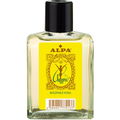
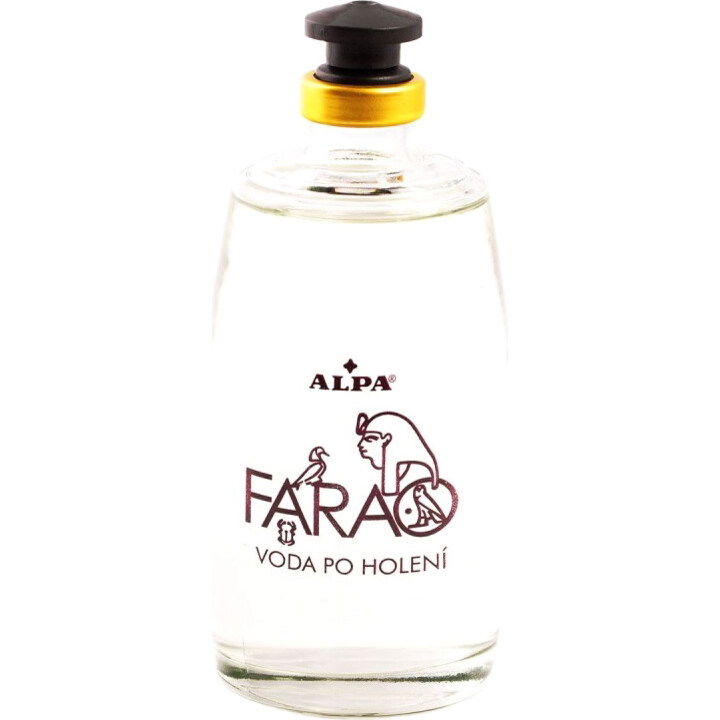
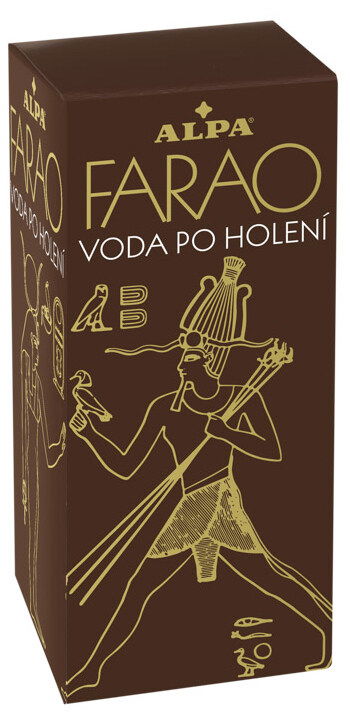
Let’s briefly turn to the exterior: I could now refer to the sister product "Farao Koliska Voda" (the corresponding cologne, which I do not know yet), which is represented on Parfumo with an image, and add that the aftershave looks exactly the same, except that the box has dark brown as the main color and the bottle is labeled in gold-yellow. You can also view the bottle on the manufacturer's website Alpa or at Pomadeshop. However, since even football reports on the radio have their charm, I will attempt to describe the invisible (at least the bottle; I will skip the much prettier box): It is a 120 ml bottle made of simple glass with a fundamentally simple cylindrical shape, which, however, is bulbous in the middle. The shape is somewhat unusual and resembles a hand grenade that has been cut off at the top and bottom. It is not beautiful, but it is special. The golden lettering is not printed on the glass but on a transparent film that sticks to the glass, which I imagine to be quite challenging in production due to the bulbous shape. Even more original is the pouring mechanism, which I only know from dish soap bottles, but not from fragrances. It is a kind of plastic button on a metal ring that you have to lift to pour out the contents. When you press the button back onto the ring, the bottle automatically closes.
Finally, a few descriptions from another source. Since it will probably take some time until the second comment arrives here, I can provide several opinions right away. The nose on my side found Pharaoh "wonderfully retro and really masculine." A colleague was equally taken with it. On the Pomadeshop page, which is characterized by moderate product poetry that does not reach the threshold of embarrassment, one reads about menthol, sandalwood, "woody-spicy in the style of the 40s," and "earthy-soapy." The German version of the manufacturer's website expresses itself briefly, as usual in a linguistically curious but somehow accurate way: "The preparation provides soothing and refreshing care for the skin after shaving. It contains a mixture of active ingredients that disinfect and regenerate the skin. It has a typical Chypre wood scent." Exactly.
"Pharaoh" has nothing to do with lighthouses or the Faroe Islands, but, as one can guess from the hieroglyphs and drawings on the label, means "Pharaoh." My expectation was therefore (although this would be unusual for an aftershave) directed towards something sweetly oriental or at least a spice bomb in the style of Old Spice. However, it turned out differently.
The scent first greets me with a rich woody note; by this, I do not mean that dry, sawdust-like sharp note that is considered modern today, but rather a beautiful deep dark hardwood tone, almost gnarled, saturated with polish, and decades of wear from oak wood. Complementary notes, which I perceive as finely herbal-fresh (perhaps lemon balm?), clean-soap-like (maybe with a hint of flowers), mentholated, and just a tiny bit gingerbread-spicy, join this main motif. I find the scent bear-like, more specifically forest-brown bear-like, but more for a bear leadership figure, perhaps an attractive top bear in its prime.
For a little water in this price range (1 Euro in the drugstore on the other side of the border, 12 Euros at Pomadeshop for shipping; I have no connection to the company, am not even a customer, but to my knowledge, it is the only way to obtain it if one does not want to physically travel to Bohemia), I find this complexity as fascinating as the clearly present scent development (moving towards warmer and fuller), the very high-quality impression (nothing feels flat, creaky, uneven, synthetic, or cheap), and the appropriate longevity for an Eau de Rasage of about 2 hours. I had expected the good skin care effect based on previous experiences.
Let’s briefly turn to the exterior: I could now refer to the sister product "Farao Koliska Voda" (the corresponding cologne, which I do not know yet), which is represented on Parfumo with an image, and add that the aftershave looks exactly the same, except that the box has dark brown as the main color and the bottle is labeled in gold-yellow. You can also view the bottle on the manufacturer's website Alpa or at Pomadeshop. However, since even football reports on the radio have their charm, I will attempt to describe the invisible (at least the bottle; I will skip the much prettier box): It is a 120 ml bottle made of simple glass with a fundamentally simple cylindrical shape, which, however, is bulbous in the middle. The shape is somewhat unusual and resembles a hand grenade that has been cut off at the top and bottom. It is not beautiful, but it is special. The golden lettering is not printed on the glass but on a transparent film that sticks to the glass, which I imagine to be quite challenging in production due to the bulbous shape. Even more original is the pouring mechanism, which I only know from dish soap bottles, but not from fragrances. It is a kind of plastic button on a metal ring that you have to lift to pour out the contents. When you press the button back onto the ring, the bottle automatically closes.
Finally, a few descriptions from another source. Since it will probably take some time until the second comment arrives here, I can provide several opinions right away. The nose on my side found Pharaoh "wonderfully retro and really masculine." A colleague was equally taken with it. On the Pomadeshop page, which is characterized by moderate product poetry that does not reach the threshold of embarrassment, one reads about menthol, sandalwood, "woody-spicy in the style of the 40s," and "earthy-soapy." The German version of the manufacturer's website expresses itself briefly, as usual in a linguistically curious but somehow accurate way: "The preparation provides soothing and refreshing care for the skin after shaving. It contains a mixture of active ingredients that disinfect and regenerate the skin. It has a typical Chypre wood scent." Exactly.
13 Comments