123lole321
Reviews
Detailed
Translated · Show original
Black and White
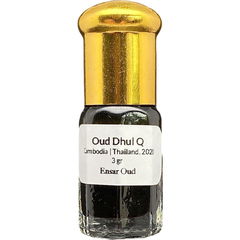
Oud Dhul Q is a typical smoky-incensy Oud that initially strongly reminds of "Aroha Kyaku | Ensar Oud / Oriscent" (AK).
Only this one has a deeper and darker soul.
Overall, this Oud presents itself more complexly. The "vegetable" side that AK has is completely absent here and is now overshadowed by the smoke and incense.
In general, the smoky components have been even more amplified and pushed to the forefront compared to AK.
It also has a slightly metallic quality, with sparkling incense flashing through from time to time. It is leathery as well.
One might think it is black leather treated with birch tar.
Nevertheless, this oil feels quite young. You can tell it was distilled only recently, as this oil still feels very "sorted." There is only black and white here. No brown tones, no green tones... only black and white. Black sparkling resins, black earth, and white smoke. Not the smoke of a fire, but rather a vapor of incense and other smoldering materials.
A better Aroha Kyaku! If you love smoky Ouds, then this one is a must-try.
Many thanks to Rhombus for the sample!! :)
Only this one has a deeper and darker soul.
Overall, this Oud presents itself more complexly. The "vegetable" side that AK has is completely absent here and is now overshadowed by the smoke and incense.
In general, the smoky components have been even more amplified and pushed to the forefront compared to AK.
It also has a slightly metallic quality, with sparkling incense flashing through from time to time. It is leathery as well.
One might think it is black leather treated with birch tar.
Nevertheless, this oil feels quite young. You can tell it was distilled only recently, as this oil still feels very "sorted." There is only black and white here. No brown tones, no green tones... only black and white. Black sparkling resins, black earth, and white smoke. Not the smoke of a fire, but rather a vapor of incense and other smoldering materials.
A better Aroha Kyaku! If you love smoky Ouds, then this one is a must-try.
Many thanks to Rhombus for the sample!! :)
Translated · Show original
Epitome of Malaysian Oud
First of all, I must sincerely thank the lovely PallasCC and the dear Caligari for warmly recommending this oil to me, especially Taha's Ouds/Agar Aura! For me, a new world has opened up in this regard over the past few weeks :-)
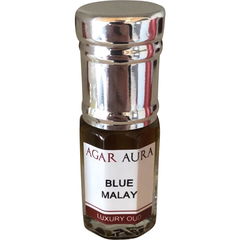
As a lover of ouds - specifically the varieties from Indochina and Malaysia - I was very excited to receive and study my recently ordered bottle of Blue Malay.
I must say upfront that Taha's oils differ immensely from the "normal" ouds of other brands. Specifically, I mean the character of the oil, the way it behaves when it comes into contact with air and the scent molecules begin to leave the skin.
(This is the case with all AA's I have tested; I will go into more detail later about what one can imagine by this)
I don't want to talk about notes and complexity yet - this oil is very complex and multi-layered - rather, I want to describe the feeling, that is, the way the oil "affects" me.
After applying the oil and allowing it to connect with the skin for 30 seconds, the oil takes its "starting position" from which it can be perfectly studied. Right away, one notices upon inhalation that it is a "cold" oil (the term comes from PallasCC :-)). Cold here means, on the one hand, that it literally cools the airways and lays like an ice-cold blue veil over the face. On the other hand - referring to the synesthesia of "cold" and "blue" - that the scent evokes bright blue and green tones. These tones go hand in hand with the cold - not mentholated or minty, but like actual cold - and alternate rapidly with deep, transparent dark green tones.
However, the oil also has a completely different side. The colors shift immensely, creating the impression of sunlight breaking on salt crystals or water droplets... a quick flicker of colors and nuances.
I consciously refer to these two things here, as I personally am reminded of a transparent yet classically Malay oil profile. Notes of salt, jungle, water... it's very difficult to put the notes into words, as this oil is incredibly complex. It evokes a clearing in the jungle, the sun shining on a waterfall, and the rays being broken into their spectra by the mist.
This effect lasts for hours. Sometimes stronger, sometimes weaker. Time and again, one is surprised by a new, different side of the oud and sent on a cinematic scent journey.
Don't get me wrong, the oud should not be compared to a Walla Patta oud/Sri Lankan oud - which can indeed be maritime, sea-water-like - rather, this metaphor is meant to emphasize the green and blue notes. A slight damp earthiness also resonates with the green notes.
Regarding projection, one can say that a "dot" on the back of the wrist ensures that one is surrounded by blue wafts all day long. For me, this oil is the epitome of Malay oud. The reference.
Initially, I mentioned that Taha's oils are different from "normal" oils. By this, I mean that these oils literally radiate when applied. They are pure, incredibly strong, and possess a certain transparency. As if the scent molecules are colliding with each other, constantly driving the concentration in the air higher.
This oil is very special and drives one crazy. When inhaled correctly, one experiences a "brain buzz" or better yet a "brain freeze". It's hard to describe, one must experience it for oneself. It’s insane.
As a lover of ouds - specifically the varieties from Indochina and Malaysia - I was very excited to receive and study my recently ordered bottle of
Blue Malay.I must say upfront that Taha's oils differ immensely from the "normal" ouds of other brands. Specifically, I mean the character of the oil, the way it behaves when it comes into contact with air and the scent molecules begin to leave the skin.
(This is the case with all AA's I have tested; I will go into more detail later about what one can imagine by this)
I don't want to talk about notes and complexity yet - this oil is very complex and multi-layered - rather, I want to describe the feeling, that is, the way the oil "affects" me.
After applying the oil and allowing it to connect with the skin for 30 seconds, the oil takes its "starting position" from which it can be perfectly studied. Right away, one notices upon inhalation that it is a "cold" oil (the term comes from PallasCC :-)). Cold here means, on the one hand, that it literally cools the airways and lays like an ice-cold blue veil over the face. On the other hand - referring to the synesthesia of "cold" and "blue" - that the scent evokes bright blue and green tones. These tones go hand in hand with the cold - not mentholated or minty, but like actual cold - and alternate rapidly with deep, transparent dark green tones.
However, the oil also has a completely different side. The colors shift immensely, creating the impression of sunlight breaking on salt crystals or water droplets... a quick flicker of colors and nuances.
I consciously refer to these two things here, as I personally am reminded of a transparent yet classically Malay oil profile. Notes of salt, jungle, water... it's very difficult to put the notes into words, as this oil is incredibly complex. It evokes a clearing in the jungle, the sun shining on a waterfall, and the rays being broken into their spectra by the mist.
This effect lasts for hours. Sometimes stronger, sometimes weaker. Time and again, one is surprised by a new, different side of the oud and sent on a cinematic scent journey.
Don't get me wrong, the oud should not be compared to a Walla Patta oud/Sri Lankan oud - which can indeed be maritime, sea-water-like - rather, this metaphor is meant to emphasize the green and blue notes. A slight damp earthiness also resonates with the green notes.
Regarding projection, one can say that a "dot" on the back of the wrist ensures that one is surrounded by blue wafts all day long. For me, this oil is the epitome of Malay oud. The reference.
Initially, I mentioned that Taha's oils are different from "normal" oils. By this, I mean that these oils literally radiate when applied. They are pure, incredibly strong, and possess a certain transparency. As if the scent molecules are colliding with each other, constantly driving the concentration in the air higher.
This oil is very special and drives one crazy. When inhaled correctly, one experiences a "brain buzz" or better yet a "brain freeze". It's hard to describe, one must experience it for oneself. It’s insane.
5 Comments
Translated · Show original
Lavender and Patchouli
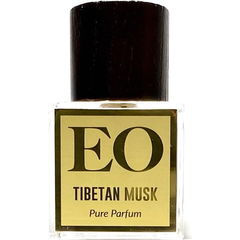
Tibetan Musk has a strong, powerful opening that consists of herbal and fruity lavender, blackcurrant, incense, and a slightly medicinal and spicy musk note. Quickly, the entire composition transforms into a zesty cool lavender and a creamy, soft musk. I definitely smell the musk, even something skin-like, but very old, slightly earthy, and later almost like patchouli.
The incense makes the whole composition appear cool and meditative, while the musk creates grounding, a base, a foundation.
In the background, one notices a minimal sweetness that emphasizes the creamy musk and complements the entire experience.
On one hand, I feel like I smell creamy chocolate, but I also get the impression of cola! Tibetan Musk actually smells like cola; the fizzy light sweetness and the whole texture remind me of it.
On the other hand, I think Tibetan Musk is also a classic perfume.
During the drydown, I experience more and more facets; the musk comes through stronger, and everything turns into a gentle, chocolatey patchouli base.
The scent is a journey, a journey through the Himalayas. The incense reminds of temples, of prayers, the lavender of the cold air, ice, and snow. The musk creates a nature feeling, earthy, scratchy, herbal.
4 Comments