Log in

Baptiste

Baptiste

Reviews
1 - 5 by 16
Translated · Show originalShow translation
Quarter of Eternal Youth
Paris! Ah! When one thinks of Paris, everyone has their own unique way of envisioning this city. There are as many associations with Paris as there are countless sights in this city. With such a plethora of options, describing the places, spots, and buildings visited can often be challenging. If you want to tell someone where to see something magnificent, the terms arrondissement or quartier will eventually come up. And that's when it gets confusing. Paris is divided into 20 arrondissements. Each of these 20 districts is further divided into 4 quartiers, making a total of 80 neighborhoods. While the arrondissements are spirally arranged clockwise from the Louvre, the 80 quartiers follow no discernible pattern. Moreover, we often talk about Parisian quartiers that aren't actually administrative districts. For example, the Quartier Latin, which is located in the 5th arrondissement, is not a district in itself but merely describes the university area. Or the trendy Marais in the 4th and partly 3rd arrondissements with its numerous small boutiques and cafés.

Of course, Paris can also be humorously divided according to the preferences of tourists. There are those hopeless romantics on Montmartre, singing the Moulin Rouge soundtrack while crying or climbing the Sacré-Cœur in Zorro costumes, eating raspberries off their fingers. Or under the Eiffel Tower, where the World Expo enthusiasts gather to snap selfies. In the Quartier Latin, on the other hand, you encounter the library nerds and endless students sipping beer on the go. Around the Louvre, you find royalists and art historians mumbling to themselves, sporting nickel glasses and questionable Mona Lisa smiles. Then there's the Marais, where predominantly queer tourists parade through the narrow streets and populate the countless street cafés in the name of freedom and tolerance from early hours. And there’s the Rue Saint-Honoré with the haute couture houses in the side streets, where mainly members of the Parfumo community drag themselves and their killer collection from perfumery to perfumery.

And then there is the Quartier Saint-Germain-des-Prés.

It is indeed a real quartier, located in the 6th arrondissement, and is considered THE neighborhood of intellectuals and artists. At least it used to be. Here, existentialism was born, along with many other -isms of art and literature. From the mid-20th century onwards, all the greats of painting, literature, music, film, and the boulevards mingled here. It is said that in a small attic apartment at Quai Malaquais No. 3, Romy Schneider and Alain Delon were still in love during their early years, while in the famous cafés like Les Deux Magots and Café de Flore, stars and starlets would admire each other.
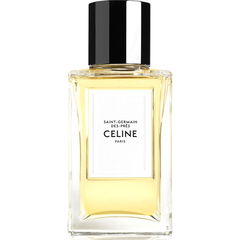
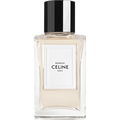
Apparently, Hedi Slimane, as the creative mind behind the new Celine perfume line, often sat in one of the cafés on Boulevard Saint-Germain and drew inspiration for this scent. He speaks of a quarter of eternal youth with its look shaped by novel and film heroes that he claims to have captured here.

The fragrance starts off fresh-green thanks to petitgrain and neroli, possibly alluding to the addition "des Prés," which means "in the meadows." However, this fresh green excursion to the meadow disappears after just a few minutes, and a characteristic powderiness typical of the line develops. The scent remains bright, and despite the increasing sweetness, one can still sense the neroli for quite a while. As it progresses, iris, heliotrope, and vanilla take the lead, and the fragrance evokes melted butter without being overpowering. The scent concept remains bright, creamy, powdery, dry, sweet, and darkens slightly towards the end. The presence of the fragrance is rather subtle and close to the skin, creating a fine and clean, not overly sweet butter-vanilla-cream aura that lingers throughout the day. This caters to the current zeitgeist with more sweetness in perfumes, yet it is never overwhelming or excessive. I would still classify the fragrance as unisex despite its powderiness and sweetness. If one is looking for comparable scents, one might imagine soft, creamy variations of Dior's Bois d'Argent and Guerlain's Cuir Beluga.

Saint-Germain-des-Prés is a bright, slightly greenish, light powdery-creamy, very noble, and high-quality clean scent that I have come to appreciate and love. Nothing here scratches or bites, so the association with the namesake quartier doesn't quite succeed for me. Given the history, I tend to think of something colorful, exciting, playful, shimmering, and unconventional when I think of Saint-Germain-des-Prés, while the fragrance fails to convincingly deliver the expected sophistication in that regard.
But as a Paris lover who enjoys sitting (at least out of a certain tradition) in the touristy Café de Flore and people-watching, I will wear the fragrance next time. And then I’m sure I will feel much younger and perhaps even strike up a conversation with one or another star or starlet. Maybe. Or maybe not. It doesn’t matter. As long as I feel young. As long as it’s Paris. Ah.
13 Comments
Translated · Show originalShow translation
The Rise and Fall of Mitsy Stardust
On the evening of July 3, 1973, David Bowie announced on stage at the London Hammersmith Odeon with the words “…not only is it the last show of the tour, but it’s the last show that we’ll ever do” the end of Ziggy Stardust. While the world of fans collapsed after these words, Bowie created a myth with them. Ziggy Stardust, an androgynous artistic figure who believes in love and peace but ultimately fails in his own life and sinks like a hymn. The Rise and Fall of Ziggy Stardust and the Spiders from Mars, an album that made rock history, helped establish Glam Rock, and inspired so many other artists up to the present day.

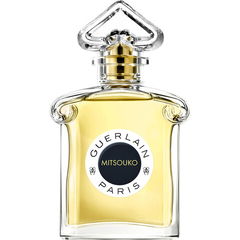
When Jacques Guerlain created Mitsouko in 1919, he also created a myth in the world of fragrance. Like Ziggy Stardust, “Mitsy,” as it is fondly called by its fans, quickly became very successful, influenced the perfume world, broke with the typical feminine scent schema by spreading more masculinity with spices, vetiver, and oak moss, thus reviving the Garçon - Garçonne theme, and has since been generally regarded as a reference chypre and one of the best perfumes ever created.

But alongside any lasting success and star hype, the fall and decline are not far away. However, it was not the creator himself, Guerlain, who dealt the death blow to Mitsy. Nor were it the loyal fans of the fragrance who turned away and left empty concert halls. No, it was the IFRA regulations, from which the words “but it’s the last show we’ll ever do” originated. The IFRA, founded in 1973 by the way, decided around the turn of the millennium that bergamot, musk, and oak moss would be placed on the index. Those building blocks that make up the soul of a chypre were banned and had to be replaced if one did not want to discontinue the fragrance. Mitsy was reformulated multiple times, but it was not until 2013 that Thierry Wasser succeeded in creating an award-winning version that was supposed to come very close to the original scent from 1919. This reformulation affected not only the Eau de Parfum and the Extrait but also the Eau de Toilette. But unfortunately, this could not prevent the downfall of Mitsy Stardust.

In my opinion, the Eau de Toilette benefited the most from the reformulation. The dark, musty, bread dough-like start after spraying disappeared and was replaced by a bright, transparent, citrus-floral top note. It was as if the dust of entire failed generations of reformulations fell away all at once. Mitsy shone in the bright-spicy chypre framework. Dreamlike. So dreamlike that I wore it daily, could not get enough of its scent, stocked up on it, which would save me for two years, and even wrote an ode to the Extrait.

But then came the year 2015, and Mitsy Stardust suffered a fateful deep fall once again. According to Guerlain, there were problems with the stability of some ingredients, which led to a leathery, tar-like scent taking over the top note. This was a market disaster for Guerlain, as the EdP and the Extrait were taken off the market for more than six months, and production was halted. It was said that the Eau de Toilette was not affected, and I felt secure. What a fatal mistake.
The EdP, the Extrait, AND the EdT were affected by this tar note. And it was again Thierry Wasser who reformulated himself to the brink until the end of 2016, when a version of the EdT appeared that, while free of tar, unfortunately presented with significantly more synthetic monotony and a lack of freshness in the top and heart notes. In projection, this may not be so noticeable, but the glory of Mitsy Stardust is forever tarnished, and the fall as a signature scent is hard to stop when there are few alternatives.

I have no choice but to do as Bowie did at his concerts, by asking before I sing “Mitsy Stardust”: “Why do you kill Mitsy?”
15 Comments
Translated · Show originalShow translation
Sans contrefaçon
“Mom, why am I not a boy?” With this grammatically not quite correct question posed by a little girl, a song by Mylène Farmer begins, which stormed the French charts in 1987 and later also the German ones. “Say Mom, why am I not a boy?” This is how the song starts, addressing the question of what (gender) role one is supposed to take on as a girl or a boy, or which role one is willing to assume. And Ms. Farmer postulates in the chorus, of course, very clearly and unadulterated (= sans contrefaçon), that she is a boy: “Since one must choose, I say it in gentle words, very clearly, I am a boy.”
In this song, autobiographical traits of the artist come into play, who as a child probably saw herself more as a boy and at the beginning of her career often had a somewhat doll-like and at the same time somewhat boyish and androgynous appearance. Additionally, she refers in the song to an aristocratic Frenchman from the 18th century who lived openly as a transvestite later in life. However, it must be said that “Sans contrefaçon” is not a song about transsexuality. Rather, it addresses the Garçon - Garçonne theme. However, not in its playful form as we often experience in fashion, but with profound questions and doubts about the socially conditioned role model of the identity-less adolescent.
This theme struck a chord with the youth at the end of the 80s, and the song helped Mylène Farmer achieve an incredible career. Not without reason can she be referred to today as the “Madonna” of the French, who are nearly reverent towards her like a saint. Her stage shows are legendary, and when a Stade de France filled with over 70,000 people sings along, then… but that is another story.

Guerlain has already created one of the first perfumes with Jicky, which, according to legends, was appreciated and worn more by men than by women. Later creations like L’Heure Bleue, Mitsouko, etc. also increasingly acquired the touch of a unisex fragrance over the years. And now comes Lui. An openly declared unisex fragrance that leaves no doubt regarding gender roles.

Lui starts off briefly fresh, slightly floral, bright. Quite quickly, a delicate leather scent spreads, which does not scratch but rather resembles an armchair in a library where the host likes to puff on a cigar. A somewhat musty clove joins in, as we already know from L’Heure Bleue, Sous le Vent, and Derby. So somewhat old school and definitely elegant, with the clove not perceived as dominant or even as green as in the aforementioned three fragrances. To prevent the clove and leather from becoming too dull, there is a barely noticeable, slightly sweet balsamic undertone, which may involve benzoin. Overall, the scent quickly recedes and remains very close to the skin. There is hardly any sillage.
The combination of leather, clove, and benzoin lasts about 2-3 hours. The leather fades first, then the clove, and subsequently a minimally sweet balsamic base emerges, which has nothing to do with the well-known Guerlinade.
After another 2-3 hours, the base is reduced to the point that one’s own perceived gender role takes over again.

Very clearly and unadulterated, therefore sans contrefaçon, one can say that Lui is a fine, well-made perfume. And one must say sans contrefaçon that this scent is so completely different from what we have been presented by Guerlain in recent years. Lui is quiet, discreet, not sweet, a little old school, skinny, and definitely unisex. I like it, even though I still haven’t understood what Guerlain actually wants to convey with it. For an Eau de Parfum, the sillage and longevity are frankly a disaster. Moreover, the wordplay and the similarity to the bottle with Liu as a very feminine, aldehyde-heavy, and strongly scented perfume are not entirely comprehensible. Lui is conceived so differently and much more gender-neutral than one would assume even with the Garçon - Garçonne theme, and therefore the fragrance will not withstand direct comparison with Guerlain’s classic scents.
One thing is certain about Lui. Like many of its older predecessors from the house of Guerlain, Lui is not a simple fragrance that is immediately accessible and quickly reveals itself. Here, it’s about testing and waiting. Sometimes that takes years...

Not quite sans contrefaçon, one might ask: “Dis Guerlain, pourquoi je suis pas un parfum?”
6 Comments
Translated · Show originalShow translation
Why Shouldn't a Woman Have an Affair?
It was September 1, 1932. Fritzi Massary sat in front of the makeup mirror in her dressing room at the Berlin Metropol Theater, the dull light bulbs illuminating her fifty-year-old but fine face. She was excited; it was the premiere night of "A Woman Who Knows What She Wants." Nervously, she fiddled with the hem of her skirt and adjusted it. "You'll see," Oscar had emphasized again and again, "the people will love you and this operetta! Trust me!" This didn't really calm her down. At least now, as so often, she was overtaken by the dreaded stage fright, which seemed to melt away any confidence. A deep breath, a silent prayer, a sigh, and off she went. She reached for the glass of champagne, drank it in one gulp, took Mitsouko from the makeup table, tilted her chin slightly into the light of the bulbs, and dabbed a fine drop on either side of her neck, which had been eagerly kissed by burning lips the night before. "What was his name again?" she thought, but she had forgotten his name. "Come on, Fritzi!" she said aloud to herself, stood up, spun around once on her axis, and pushed open the dressing room door. Just at the right moment, as the music began, she ascended the steps to the stage and stepped into the spotlight...

Fritzi's life in Berlin was glamorous. Since 1904, she had been performing at the Metropol Theater in Berlin Mitte, shining in numerous operettas and admired by just as many admirers as admirers. She didn't care what people said about her. She was already too famous for that. Even though she saw herself as very hardworking, disciplined, and, deep down in her heart, bourgeois, she nonetheless stood for a modern image of women in the emerging 20th century that was intelligent, self-assured, but also passionate. For both men and women, she embodied on stage the attractive, open-minded woman who still valued a certain traditional femininity. When Jacques Guerlain created Mitsouko in 1919, he likely had exactly this type of woman in mind. If not, the fragrance itself may have contributed to women becoming more aware of themselves and beginning to encroach into men's spheres of life.
What could fit Mitsouko better than the famous, slightly frivolous operetta hit by Massary from the premiere night "Why Shouldn't a Woman Have an Affair?":

"What society talks about
between lunch and dinner,
in the afternoon at 5 o'clock?
About Madame X and Madame U,
it's best not to listen to people at all."

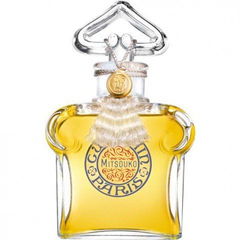
Mitsouko Extrait starts confidently. Jasmine, a hint of bergamot, and a whispered rose create a floral-fresh opening. The peach is already making its way quickly, while the spices and oakmoss from the base quickly provide the unmistakably fascinating "moldy" undertone. The heart of peach, lilac, and ylang-ylang deepens the fragrance, making it sensual, slightly slippery, and interesting. Here, Mitsouko remains fruity-floral-spicy-dark for several hours, leaving a mysterious aura that provides plenty of conversation material about the fascinating woman at the neighboring table during the 5 o'clock gathering.

"Do you know Mrs. Y, the beautiful, slender blonde?
Do you know what they say about her?
She has a man, she has a friend,
and an uncle who means very well with her.
Yes, then she has a lion hunter
and also a jazz band N*.
Goodness, the consumption!"

But every rumor holds a little truth. And so, the greatest truth of Mitsouko lies in its base. Oakmoss, spices, amber, vetiver, and cinnamon wrap themselves around its wearer in a balsamic, slightly sweet, and powdery flattering way. Mysterious, tempting, sensual. Not frivolous, but as self-assured as the top note, regardless of how the whole chatter at the neighboring table affects one's reputation. Whether she is with him, he with her, she with her, or he with him. All variations are familiar to Mitsouko, making it irresistible.

"They say about her, they gossip,
she's also a bit different!"

And so, Massary also convinced on that evening of September 1, 1932, as a woman who knows what she wants. And just as Massary is for the audience, Mitsouko is made for women and men who know what they want. Those who engage with Mitsouko will experience a passion that is strong, deep, and long-lasting. And those who enter into an affair with Mitsouko need not fear gossip. Or do they?

"Why shouldn't a woman have an affair?
If she's pretty, they'll say:
Well, she must have one, it would be silly!
And if people are already talking and she doesn't have one.
Well, then it's much better if she has one!
Why shouldn't a woman have an affair?
Can you tell me why?"

(*In the original song, the N-word for African Americans is used)

10 Comments
Translated · Show originalShow translation
Café de Flore
"I was born one evening in March 1941 under a bench in the Café de Flore," noted Simone Signoret in her memoirs, describing the beginning of her film career. Further on, one reads an almost endless list of French actors, directors, and writers who gathered there for breakfast, lunch, and certainly by evening, to work on their careers, talk, smoke, drink, and fall in love.
Already in the early days of the café, a kind of bohemian lifestyle quickly developed. Montmartre was a thing of the past, and Montparnasse was still too young. Here, poets, painters, and thinkers early on populated the tables, enjoying the Parisian flair of the Saint-Germain-des-Prés district, creating "Surrealism," inventing "Existentialism," writing books upstairs, and dreaming in color. Later, actors and filmmakers joined them. Even Hollywood stars mingled on the terrace of Flore starting in the 60s, observing the Parisian hustle and bustle behind large sunglasses while sipping a Diabolo Menthe. Here, one was among like-minded people and could live and share their lifestyle, thoughts, and creativity. In short: one was free!

Who doesn’t know this corner café on Boulevard Saint-Germain? The famous Café de Flore. Or simply "Flore," as the knowledgeable insiders call it.
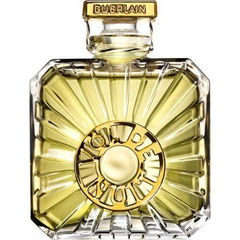
Like Guerlain, it is another myth of Paris. And not only famous actors or writers lingered there, but also a classic fragrance like Vol de Nuit must have wafted around the tables. Its scent composition fits wonderfully with the uniform jumble of voices reciting a script, the coffee aroma being consumed, and the clinking glasses being toasted. This special atmosphere of the café, with its variation, depth, and lived artistic passion, corresponds to the essence of the Extraits of Vol de Nuit.

At the beginning, the scent is greenish fresh due to its large amount of galbanum, bergamot, and orange, yet it remains dark. Here it is most perceptible in its environment. After about half an hour, the scent brightens with aldehydes, iris, daffodil, and vanilla, becoming powdery with a slightly creamy-floral note. Already here, the heart note begins to be overlaid by the base, grounding the fragrance with the help of oak moss, sandalwood, iris, and a barely noticeable amount of spices. This lasts for over 3-4 hours until only this nose-pleasing balsamic base remains for another 8-12 hours.

Vol de Nuit is, as an extrait, a deep, warm, serious, passionate, and intimate fragrance. Both intellectual and knowledgeable as well as lost in thought, dreamy, and nostalgic. The scent reflects a spirit of the times that can only be found in the Paris of the last century. This does not mean that it is unbearable today or smells too old-fashioned. Vol de Nuit Extrait is a novel by Sartre, a role by Simone Signoret, a poem by Jacques Prévert, a painting by Picasso, a sketch and a film by Cocteau, a chanson by Gainsbourg, a lascivious movement of Brigitte Bardot.

Nowadays, there are more tourists than stars at the Café de Flore, and one ends up here rather after a tiring sightseeing tour or after an extensive shopping spree at Le Bon Marché, relaxing tired feet over an overpriced café crème or an Aperol Spritz.
Just recently, I entered the bustling, loud café with its many people, and it seemed to me that one of the passing guests had applied Vol de Nuit.
Perhaps it was just my own scarf.
16 Comments
1 - 5 by 16