
Rosenut
Reviews
Filter & Sort
Detailed
Translated · Show original
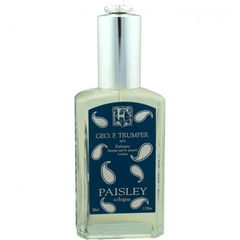
With something like this, I imagine the still naive Emma Bovary washing her face on her wedding day
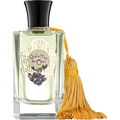
There is actually nothing really green about "Paisley," which is why I wouldn't classify it as a Fougère, but rather in the small niche of summery-light spice waters. These completely non-citrusy summer waters based on anise are original, profoundly idyllic, and touching. Comparable was Acqua di Stresa's dreamy "Calycanthus Brumae," which unfortunately is no longer in production. The citrus notes mark "Paisley" as a spring and summer fragrance, but they are merely an introductory design. After just a few seconds, they retreat and reveal a warm heart of sweet mint and star anise. The mint note is sugary, free from menthol sharpness, and evokes not the plant itself, but rather old-fashioned little mint pastilles. It merges with the anise into a powdery unity that forms the base tone of this fragrance. While the cardamom also closely hugs this base tone, the pepper stands out a bit and creates a subtle freshness. That "Paisley" (like "Calycanthus Brumae") is a quieter fragrance seems to me a completely plausible, thoroughly stylistic decision. The delicately complex nature of such fragrances can only exist in a somewhat subdued sillage; if it were stronger, it would become something else, much more pretentious. Beautiful words that reviewer Darvant finds on 'basenotes' for "Calycanthus Brumae" can also be said about "Paisley": "A poetic little shadowy juice for struggling souls."
5 Comments
Translated · Show original
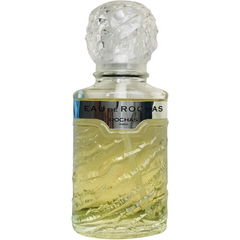
Lime Pickle and Floral Soap
In terms of construction and overall impression, very comparable to Annick Goutal's "Les Nuits d'Hadrien" (2003). Both are sharp, slightly bitter citrus scents with a spicy heart and a warm amber-musk-patchouli-sandalwood base. However, there is a crucial difference: typical for its time, "Eau de Rochas" contains a floral aspect (rose, clove, daffodil), while the "Nights of Hadrian" - devoid of flowers, but featuring cumin and juniper - is characterized by a strong spice focus. As a result, "Les Nuits d'Hadrien" is thoroughly gourmand and can no longer be described as fresh or "cologne." Rather, this perfume feels deep, intimate, and "carnal"; for some, it smells like the T-shirt of someone who has been cooking Iranian stew with limes for hours on a hot day; the citrus peel aspect is, so to speak, nestled in a dark, aromatic armpit. "Eau de Rochas" is also not free from a certain gourmand character - a kind of lime-pickle note - but this spiciness is moderate and balanced by a subtle floral counterweight. A simply wearable, daytime-appropriate perfume - vividly sour, slightly zesty-bitter, herbal, spicy, and all the while retaining a hint of floral-soap traditional chic. It passes as formal yet is full of wildness.
5 Comments
Translated · Show original
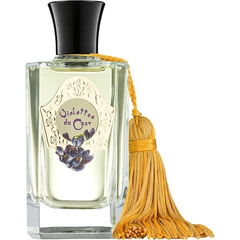
Violet Addiction: Symptom of the First Urban Neurotics
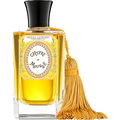
Violettes du Czar (2014) is the reconstruction of a "masculine" violet perfume composed by Oriza Legrand in 1862. The name honors Tsar Alexander II, a regular customer of the house. The violet was the favorite flower of the Belle Époque, a time when the industrial revolution had already triumphed. In the cities, people loved the shy aura of this precious woodland flower, which was actually mass-produced under glass. Street vendors sold small bouquets of violets. Manet's portrait "Berthe Morisot with a Violet Bouquet" (1872) shows what was done with them: they were pinned to clothing. Violettes du Czar is based on the androgynous idea of "violet leather." It opens with strict, light green notes, where the medicinal aspect is hard to distinguish from the toxic. The green notes seamlessly transition into a slightly piercing, tannin-like sharpness of the leather aspect. From this harsh mélange of medicine, spring flowers, and leather emerges an unsweetened, earthy-mineral violet scent. The violet note here seems to primarily rest on the root of the Florentine iris, which was common in the 19th century. Without the sunny character of real violets, this root absolute convincingly embodies a cool, more contemplative variation of them. With a modern interest in conflict, Violettes du Czar (2014) places this violet in the context of nature captured by humans, transformed into medicine and leather. Although initially somewhat piercing, this perfume does not project very strongly. A chic and subtle scent for the still cold part of spring. P.S.: A less progressive, but noteworthy violet-leather scent is the softer and sweeter "Jolie Madame" by Balmain from 1953.
5 Comments

Translated · Show original
Violet Licorice and Highlighter
This fragrance from 1978 can perhaps only be learned to love by those who are willing to understand it in the context of its time. Knize Two stems from the taste of an era that does not seek the naturalistic, but rather integrates the artificial into its idea of elegance. In the opening, the scent has a typical sharpness reminiscent of schnapps, which quickly gives way to a spicy depth. On a leathery base, it intertwines deep green notes and a dark, licorice-like floral quality with a somewhat chemical highlighter character. Not bad.
2 Comments
Translated · Show original
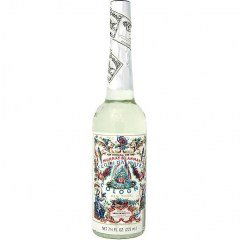
Coca-Col-ogne
Its components actually resemble the original Coca-Cola recipe from 1886, which reads like a cologne formula: https://en.wikipedia.org/wiki/Coca-Cola_formula. However, the Florida Water developed about 80 years earlier has stronger citrus top notes. A good idea that the Augsburg brewery Riegele had again in 1956: Spezi. Spezi is only available in Germany, Austria, Switzerland, and Finland. Those who grew up here will remember this not-so-stylish yet delicious lemonade mix. The rest of the world can enjoy Florida Water as an atypical and delightful cologne that - a bit alpine - combines wonderful mountain herb accents à la Ricola with Italian citrus flair.
4 Comments