Log in

Seerose

Seerose

Reviews
11 - 15 by 775
Translated · Show originalShow translation
Great Expectations - Great Disappointment
It is not easy for me to write this review. I take it upon myself because the fragrance is new and being promoted. And strangely, no review has been written yet.
I found it very peculiar for this new and promising scent.
I was looking forward to testing this perfume. I had never been disappointed by a L' Artisan fragrance, although some scents did not quite match my preferences, I at least did not have such high expectations.
I had expected a spring-like delicate floral scent.
But I tried three times, blind, to extract something from this Peach Blossom or to find the Peach Blossom. The flowers in general should at least be perceivable. At first, I was so disappointed that I thought Fleur de Pêche was a failed fragrance. I washed it off.
The second time, I was not only distracted during the course, it was also very hot, and I only noticed it again after wearing it for a while: a synthetic slightly sharp scent was still on my skin.
But I thought: This can't be right, there must be something wrong with my perception.
However, I set the sample aside and tested two other fragrances that I liked for a few days. One was even from L' Artisan.
Now it is a cool evening and I have time.
So what do I perceive?
The opening of Fleur de Pêche is, as before, aquatic with an acetone note. Then follows what I perceive as a dull tuberose note that I have encountered in many fragrances. This is why I did not like tuberose fragrances for many years, especially at the beginning.
I try in vain to find something like jasmine, even lily of the valley or other white flowers. Instead, I perceive a dominating sweet ambroxan note, apart from a sharp note that is listed here as pepper. After that, nothing happens anymore. Fortunately, it is not a strong fragrance. With a lot of goodwill, I can perceive a trace of watery flowers. And what I usually like about fragrances with peach, a special kind of powderiness, I cannot detect.
Then my husband comes by, and I let him smell my wrist and ask: "What do you think of this fragrance?"
He is usually very uncritical; I can wear the perfumes I want.
He smells intently and says: "What is that? Smells kind of dull, it smells like, like, honestly, don't be offended, like a cleaning product, I can't remember what it's called."
No, I am not offended. His otherwise almost stereotypical judgment: "But this is a strong fragrance, and I smell lily of the valley or jasmine" would have at least been an argument for Fleur de Pêche.
I vaguely think that Délira/Sautes Humeur from L'Artisan would have smelled in this direction. I can somewhat trace this based on my notes. Délira was much sweeter in the base and overall denser. This is supported by the fact that the fragrance I tested about 7 years ago comes to mind now while writing.
I wrote among other things: Needs getting used to.
I am curious about the next review.


20 Comments
Translated · Show originalShow translation
Tocade: A Welcome Review
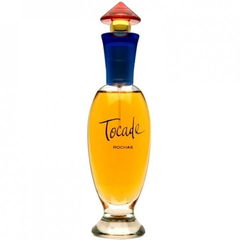
At the very beginning here on Parfumo, I also tested Tocade, first as a mini, then I acquired a bottle. I loved the bottle already because of its "Bauhaus" cap with the hand-friendly round-bellied shape that is so easy to handle. Bauhaus indeed: FfF = Form follows Function.
Even more, however, I love the perfume. As the name somewhat suggests: It touches me time and again. I primarily perceive a blend of zesty rose geranium, as well as peppery freesia, fresh patchouli, a distinctive floral mix, not too sweet, with a dry powderiness. Lily of the valley and jasmine are listed here. Fortunately, I do not perceive them. Perhaps they are so well integrated that no indolic nuances are detectable for me.
Otherwise, I cannot identify any further ingredients individually - perhaps I don't want to. I just want to enjoy it.
A fresh, not exactly light perfume that always made me cheerful whenever I wore it and perceived it around me.
Then it was stated here that it apparently would no longer be produced. Therefore, I used the rest in the bottle only for special occasions.
However, over time, Tocade transformed; it became more and more like 'Fahrenheit Super E 10', it also became tobacco-like and the liquid darkened.
I set it aside, removed it from my collection.
A Bauhaus-enthusiast friend found the bottle so beautiful; she did not know the fresh Tocade and also liked the transformed version. She took the bottle with her.
Then I went searching. But apart from vintages, I could find nothing.
Since I feared that a vintage might undergo the same development as the one I owned, I did not want to take that risk.
I have had some negative experiences with vintages.
I came to terms with it. Better no Tocade than one that no longer smells like I loved.
However, a few days ago, I received a newsletter from a Dresden company with Mother's Day offers. While browsing, an offer for Tocade popped up. At a very moderate price.
I ordered it immediately. It is about a 1-year-old perfume, so still fresh.
I waited until it acclimatized to me, then I applied it and thought with delight: How wonderful that you are back.
Otherwise, I do not like to wear the same perfume every day. Just as I do not wear the same clothes every day. But now I want to spray Tocade every day for days.
Each time it fills me with a kind of happiness that has become increasingly rare to experience.
This time I will not handle it so "sacrificially" in the fear that I might not be able to buy Tocade again.
Now I will enjoy it whenever I feel the need. And as long as it is still fresh. After that? I am not thinking about that right now.
22 Comments
Translated · Show originalShow translation
The Soul's Longing for Beauty
of flowers, plants. Recognizing, appreciating, and respecting them is roughly the guiding motif of the oldest Ikebana school "Ikenobo". Emphasizing this beauty, making it accessible and visible to others and oneself by carefully arranging flowers and plants is the rule and goal of this school - to put it briefly. Ikenobo is the foundation of every Ikebana style that has developed from it.
Originally, the frugal arrangement of blossoms and plants was presumably a floral offering.
The highest and most magnificent arrangement is the Rikka. Being able to create this and to bring people to pause, marvel, and also delight requires much practice, experience, and talent.
I mention the Rikka in connection with "Flower by Kenzo" because I perceive this fragrance as a Rikka of floral scents.
Luxurious yet not deviating from the path of a floral scent.
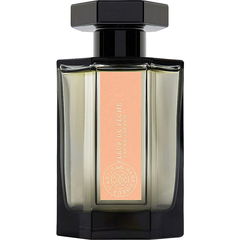
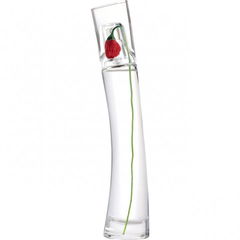
Just as in Ikebana, the choice of the vessel is crucial, which must be carefully selected and incorporated into the overall artwork, so too is the bottle of "Flowers by Kenzo" - a modern Ikebana vase. Even the cap can serve as a vase for a small arrangement of tiny flowers.
Although Alberto Morillas created the perfume, Kenzo, who has long since departed, most likely wanted to release a fragrance with such a bottle. He certainly had his vision of how to realize this scent, especially suited for us Europeans.
And he was likely thinking in line with my explanation (in the introduction). This, as I know from many sources, still resides unspoken in the culture and thinking of the Japanese. As modern as they may seem to us.
I only know a bit about Kenzo from Liza Dalby's book: "Geisha," in which she published her ethnological field research on the geisha world for a dissertation. She met Kenzo during her time as a geisha. She describes him as an exuberant man who, however, instructed her on how to hold and use her fan as a geisha. Kenzo was evidently still aware of his origins and was very knowledgeable about his Japanese culture and its rites and customs, despite his European fame as a fashion designer.
I have known "Flower by Kenzo" longer than I have been registered here on Parfumo. Initially, I paid little attention to it. I had original samples, even minis, but never thought of buying it.
Then I bought a small bottle from which I recently squeezed out the last sprays. I immediately put it back on my wish list.
There was a very good offer at Notino for Easter, so I treated myself to it for Easter.
Over the years, "Flower by Kenzo" has gradually moved into the ranks of fragrances that I always want to have available, surpassing many much more spectacular scents in my expanding knowledge of perfume. For me, "Flower by Kenzo" is a basic floral scent. I have tested many very beautiful floral fragrances, I also own some, and yet I often find in comparison to very expensive floral scents: Yes, very beautiful, noble, but fundamentally I still have a very beautiful floral scent: "Flower by Kenzo"
So how is "Flower by Kenzo" for me?
It is a very finely tuned and balanced floral blend. No single flower plays a leading role, no overwhelming white flowers disturb me. I cannot precisely name any individual flower.
My perception varies. Sometimes I smell violets.
Of course, musk and amber are always present.
At times, the top note seems too aldehydic-creamy-soapy and a bit scratchy for me. That is then not a day for Flower.
However, after a while, I find Flower enchanting once again.
The character of Flowers is that of a creamy floral perfume, without noticeable woods, without identifiable incense and patchouli for me, thus without a distinctive base.
However, towards the end, the vanilla stands out a bit for me, although it does not become dominant and repeatedly intensifies the beautifully creamy floral scent for me in intervals.
The sillage is quite strong in my perception. The longevity is very good for me and remains consistently strong in projection for a long time.
Even I have to be careful with the dosage and think about where I am going while wearing it. I do not want to stand out particularly.
I am not at all pleased when my fragrance is noticed too often and seemingly positively, as this can also imply: She has over-perfumed herself.
This can easily happen with "Flower by Kenzo".
That is why I do not wear this fragrance too often. Moreover, it lingers in clothing for a long time. Even my empty 30 ml bottle, which I often use as a vase for a flower, still distinctly and unchanged smells of "Flowers" after frequent water changes and washing after use, regardless of which flower was in it.
My new bottle has no altered scent; Flowers smells just as I have always perceived it.
Hopefully, "Flower by Kenzo" will always remain with us like this.



24 Comments
Translated · Show originalShow translation
Which customer segment is this name and label supposed to appeal to?
If I hadn't received this cheerful and pleasant perfume from my generous and lovely friend, who is mostly interested in scents rather than names, I would have never even tested it. Namely because of the name.
I thought about what exactly the name means. I looked into my Latin grammar, my dictionary, and discussed it with my husband. It cannot be translated directly into German, only in a figurative sense. We considered some possible figurative translations.
"Flora" was the goddess of flowers in Roman antiquity. We still refer to the plant world as "flora" (we call the animal world "fauna").
The adjective "mortis" comes from "mors," meaning death.
If we understand it from today's usage of the word "flora,"
the name of the fragrance could mean the "Dying Plant World."
Antique: The dying flower goddess/Flora.
The 100% Latin scholars might know it better or interpret it differently.
Additionally, the name of the label: Allsaints (All Saints) refers to the day: All Saints' Day, which adds a strange meaning to it all.
The dying flora/goddess of flowers of all saints or on All Saints' Day?
I suspect that this perfume is meant to appeal to a certain esoteric customer segment and possibly superstitious buyers, maybe even the goth scene. Or women who want to be a bit provocative?
To whom could one easily gift "Flora Mortis" with this name? That could also be offensive. However, I do not wish to elaborate on that.
Fortunately, 'Flora Mortis' has nothing morbid, nothing dark, nothing apocalyptic.
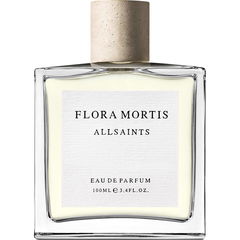
Flora Mortis is a feminine, subtle floral scent softened by a slightly synthetic amber with a cool, not uninteresting modern metallic note.
It starts with a rather strong pepper note and quickly transitions to a bright, ephemeral, delicate, and lovely perfume. I cannot identify individual flowers in this floral base. There are no indolic-animalic white flowers present. Immediately, the creamy amber comes into play. This makes 'Flora Mortis' fluffier, softer, and indeed creamy. I also perceive a subtle, interesting synthetic-metallic note. I like this modern touch. Otherwise, 'Flora Mortis' would remind me of some Gucci fragrances, Premier Jour by Nina Ricci, and similar floral scents.
The scent lingers for a long time, becoming a bit sweeter after hours; I suspect it involves vanilla, labdanum, and perhaps a resinous-sweet wood scent. Meanwhile, 'Flora Mortis' is almost only close to the skin, and thus it remains for a long time.
For me, it will be a pleasant summer scent, as there are no citrus notes included. 'Flora Mortis' is a restrained quality fragrance that a woman of any age can never go wrong with: Flora Viva!


19 Comments
Translated · Show originalShow translation
Bois yes, Sandal: Nowhere
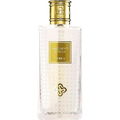
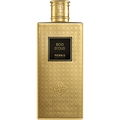
On a whim, due to the name and the very moderate price (including high shipping costs), I ordered 100 ml of "Bois des Santal" directly from "Prestige de Menton." It arrived in a few days.
Because I want to test sandalwood scents at the moment and hopefully find another beautiful sandalwood fragrance to add to my collection.
But this perfume, which is only listed as "Santal" in the booklet, as it is here in Parfumo, is in no way a sandalwood scent.
Sure, I expected a soapy or even cardboard-like sandalwood fragrance.
But this perfume is classified in the brochure as a feminine scent. Here it is labeled as unisex, which in my opinion it is not.
This perfume, which is now called "Bois de Santal" and apparently was re-released in 2020 according to the brochure under the addition "Artisan Parfumeur," is quite harsh and borders on a cough syrup.
If it weren't for the vanilla and the geranium softening the scent. Additionally, an earthy patchouli brings a warming constant to Bois de Santal. The cedar is softened by the pine, which takes the edge off the pencil note.
Both are coniferous trees, so I can't distinguish them precisely.
I have been searching for the scent here, initially testing it several times blind and thought: Surely there is lavender included. And indeed, it is listed here. I can clearly identify the ingredients mentioned here.
I only sprayed a spritz on the inside of my wrist each time: The sillage is very strong for me and "Bois des Santal" has a very long longevity.
Towards the end, it becomes milder; the vanilla does its job.
In summary: A very herbaceous scent on one hand, yet it also radiates warmth on the other.
For me, "Bois de Santal" is a somewhat old-fashioned masculine scent. I really like such scents - on men.
I do not understand at all why this perfume is called "Bois de Santal." Throughout the entire linear scent, there is no hint of sandalwood, not a molecule of the creamy-green-soft sandal. Not even one of the stronger synthetic sandalwood.
I will let Bois de "Santal" pass me by. It does not suit me.
Since I initially couldn't find the scent here, I took screenshots until I found it.
6 Comments
11 - 15 by 775