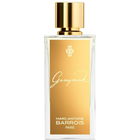
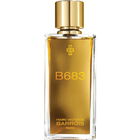
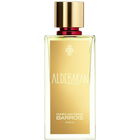
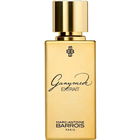
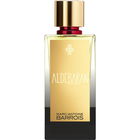
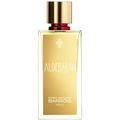
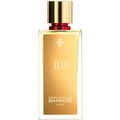
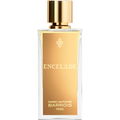
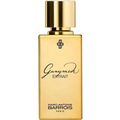
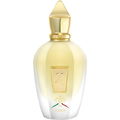
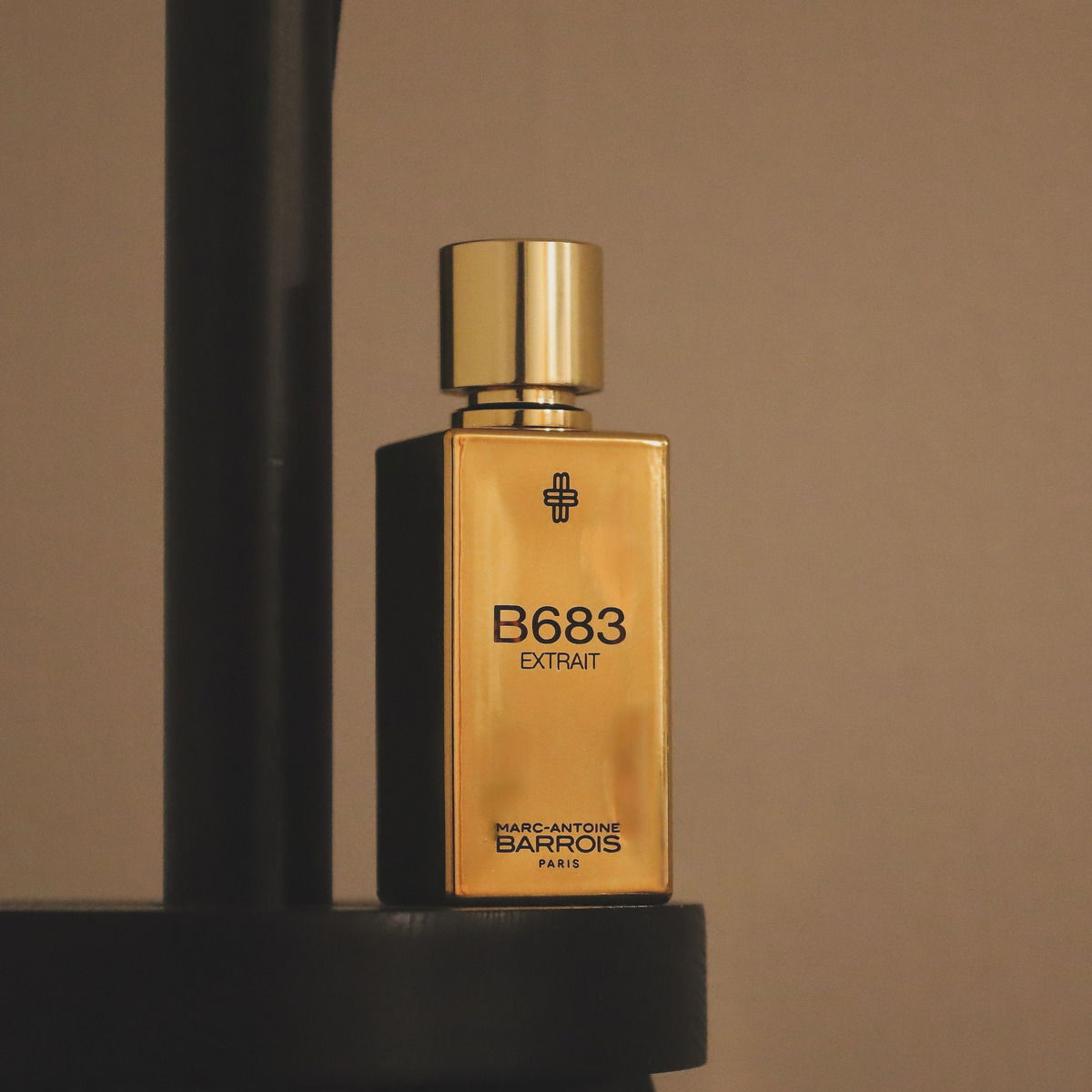
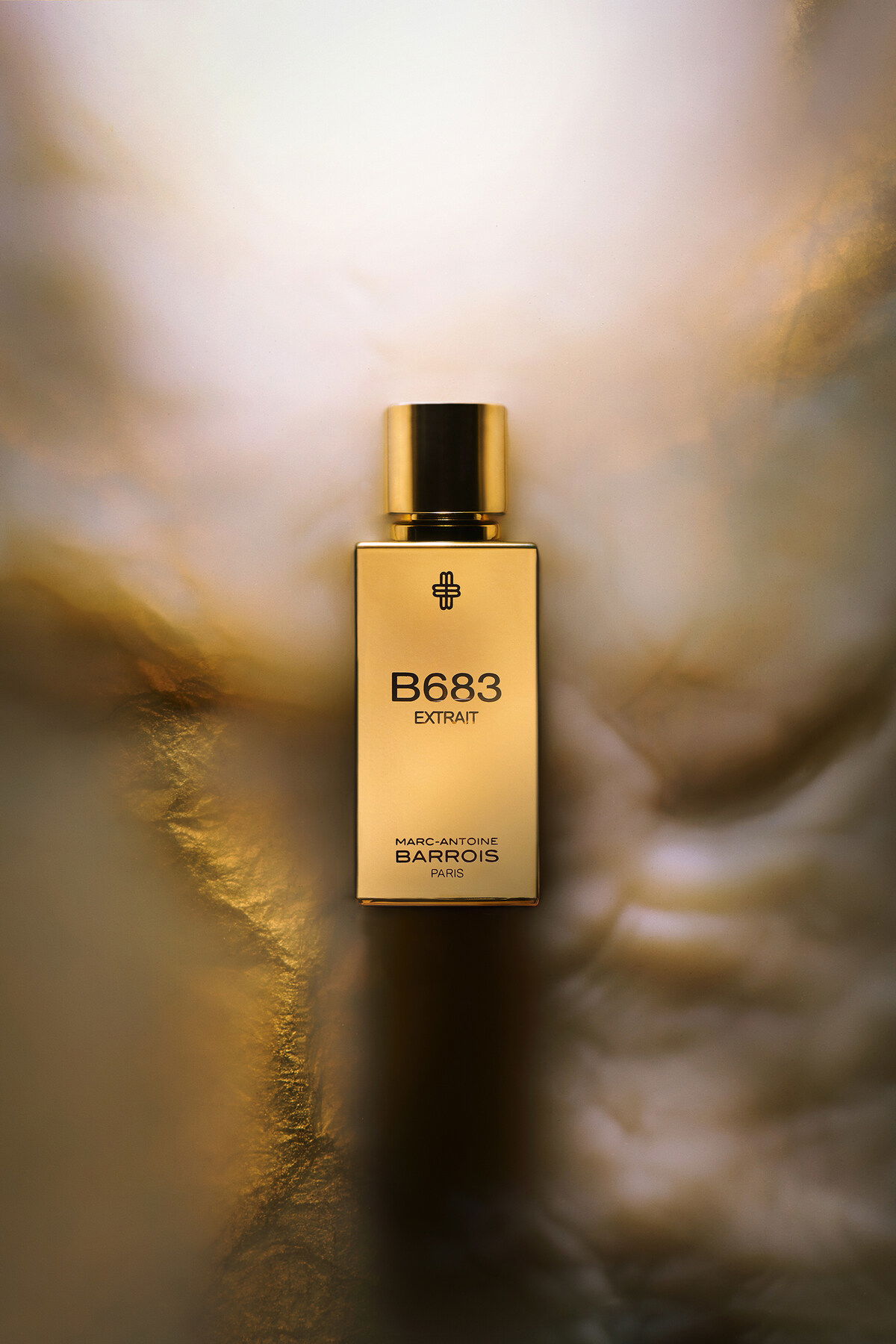
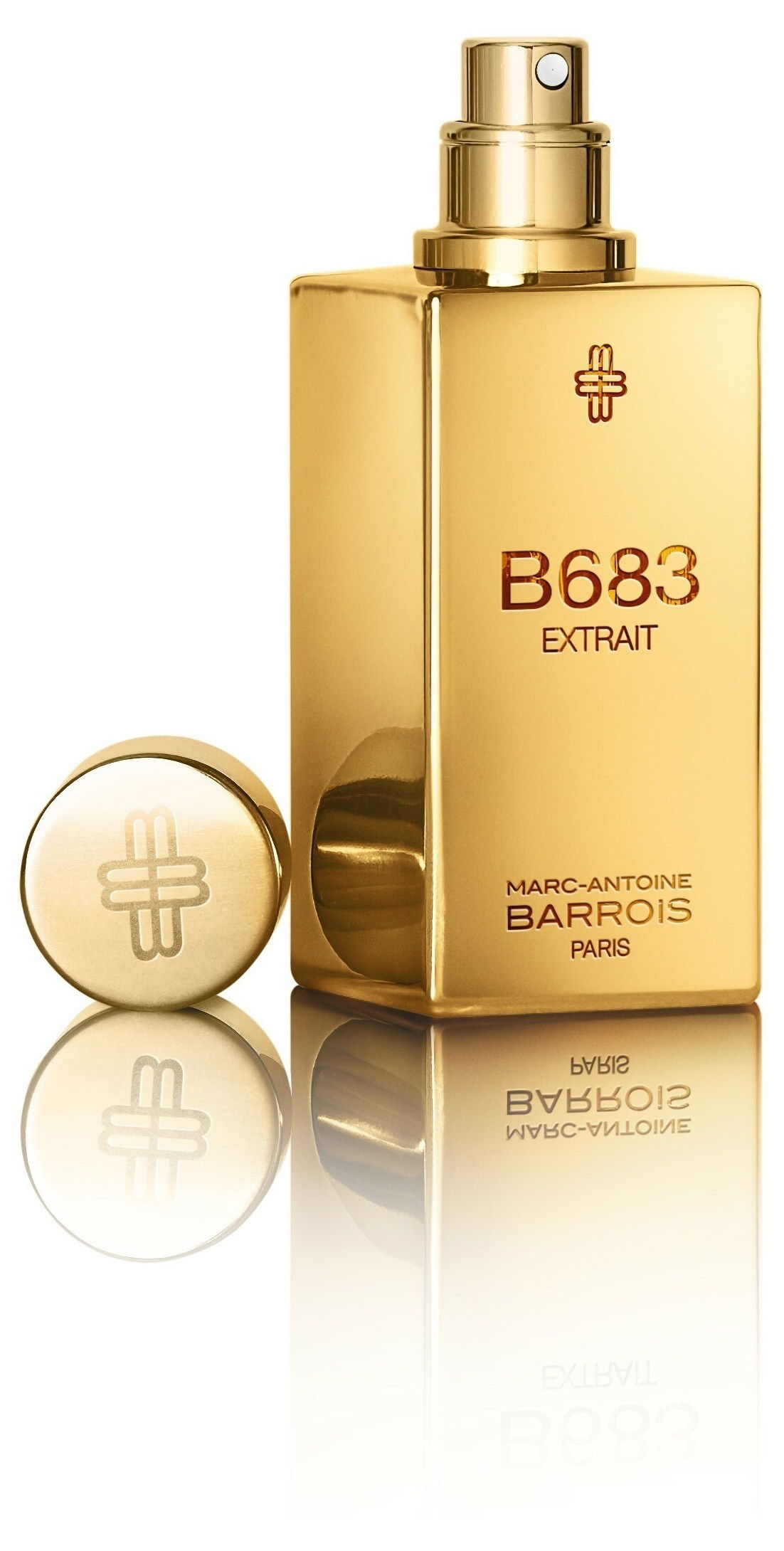
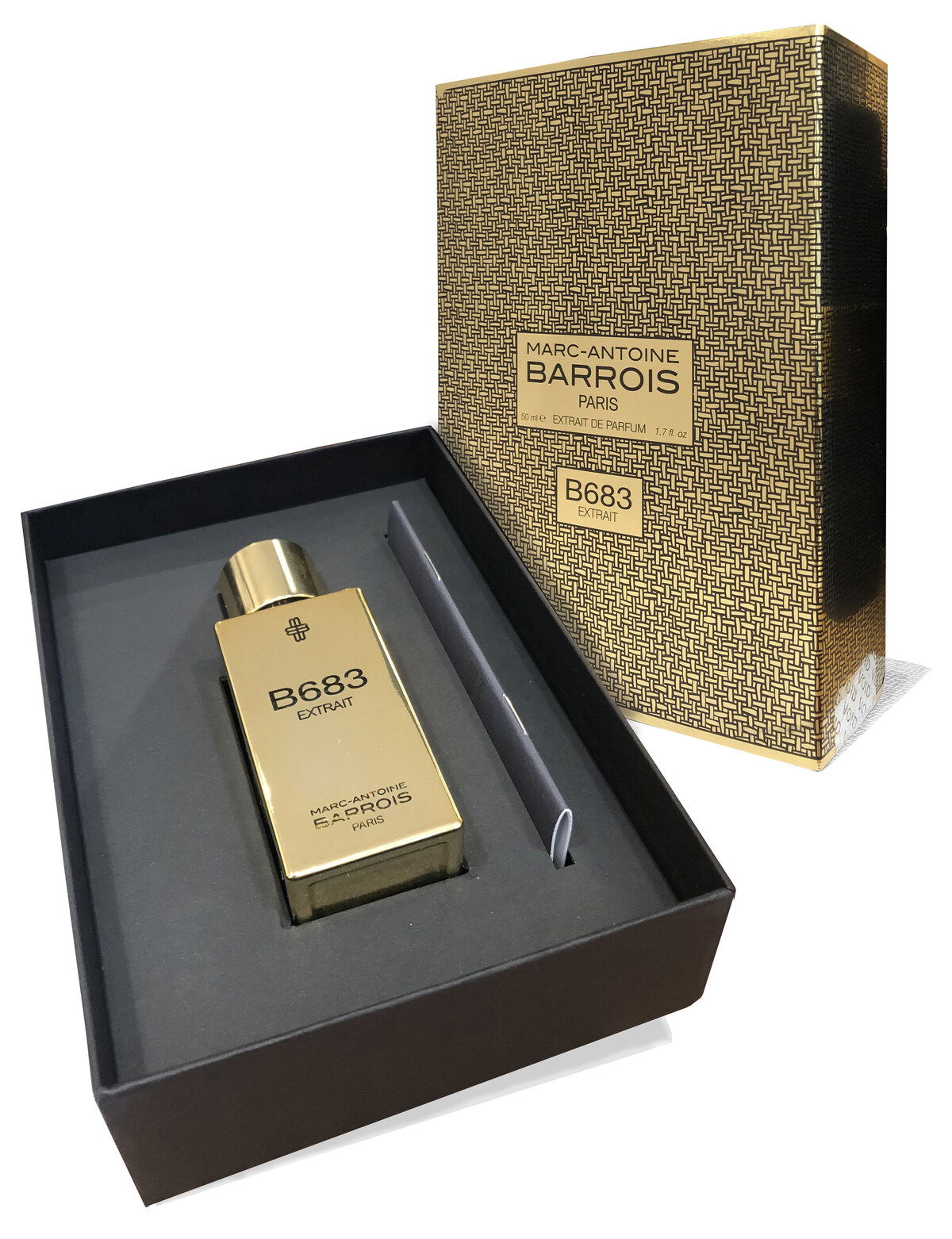
After ‘B683’ and ‘Ganymede’, we now have ‘B683 Extrait de Parfum’.
Three fragrances with almost identical DNA: a modern leather accord that develops entirely differently than we know from classic leather concepts, such as a Cuir-de-Russie, for example.
Marc-Antoine Barrois’ trio unfolds its leather accord from the dry spiciness of pepper and saffron, which greets us here in the form of Givaudan's fragrance material ‘Safraleine’: the bitter-leathery aroma of the pungent spice, spiced up with nuances of tobacco and rose. Grassy, moist violet leaf and the cool, woody aspects of a fractionated patchouli, sometimes referred to as ‘Patchouli-Coeur’ or marketed by Givaudan as ‘Akigalawood’ (the perfumer works at the company!), complement the leather accord and form a kind of Barrois fragrance framework.
Another substance from Givaudan's fragrance arsenal urgently needs mentioning, as it is particularly present in both ‘B683’ fragrances: ‘Ambroxan’, or recently called ‘Ambrofix’. It is characterized by a sweetish, again tobacco-like and slightly salty ozonic note, and synthetically represents a small excerpt from the much broader fragrance cosmos of amber.
For Ambroxan haters, of whom I count myself, this is of course a challenge, but I must admit that the suspected synthetic nature here surprisingly does not bother me as much.
As cool and smoothed as the leather is in the EdP, as if one were entering a stylish shoe store; in the extrait, it begins to come alive, becomes soft, and suddenly has roughened spots. At times, a hinted intimacy replaces the otherwise stylishly sober distance, but it quickly fades away, leaving it merely a flirtation with the daring. The couturier, especially when he is named Marc-Antoine Barrois, always maintains composure when it comes to leather. Others might think of something more animalistic: castoreum, for example, which is already blessed with leathery facets, or even civet and hyrax, which could end up soiling the noble footwear - God forbid! - as if one had accidentally stepped into an unsightly legacy. No, such antiquated filth has no place in a modern Ambrox-saffron concept.
What a pity.
Never mind.
Instead, there’s apple, green apple.
When I read that, I thought: oh dear, this could be cheerful.
Anyone who, like me, grew up with the screechingly loud scent of apple shampoo has learned to distrust this note.
Unjustly.
The apple actually smells quite good here. Somehow not really natural, but still good. That’s the strange thing about Barrois fragrances (as with actually all fragrances from Monsieur Bisch): they smell terribly synthetic, as if all the notes contained, which initially read so naturally, are at best nature-identical, not to say: faked. Nevertheless, I like his fragrances, at least most of them. Apparently, Bisch has found a signature that allows him to create something valuable and artistic from supposedly inferior synthetics, even if the starting material of this apparent synthetic is of natural origin.
The extrait of ‘B683’ is a perfect example of this.
Besides the apple, the cumin also somehow doesn’t smell real, yet it gives the fragrance a certain something in a brief phase: an artfully shimmering erotic physicality that, however, vanishes as quickly as it appeared. A chimera that I enthusiastically sniff after.
The oud, supposedly even real from Laos: yes, it is there, but strangely de-oudized. Without any semblance of natural origin and reduced solely to its medicinal nuances and a few shy hints of smoke. Similarly, the patchouli sourced from Indonesia: stripped of any damp, creaky crypt-like qualities through fractionation. And even the sandalwood seems to have never truly seen the Australian wilderness, too smoothly polished, too sterile it appears.
And yet: it smells great!
Especially the combination of apple, cumin, and leather is, despite all its artificiality, really appealing. For my taste, it could have been even more pronounced, as it unfortunately gets quickly overshadowed by the sweetly woody ozonic base, which increasingly spreads like a thick, heavy blanket over the fragrance experience.
All these strangely styled notes develop a lush volume and a dense, velvety texture that vaguely reminds one of old Guerlain extraits. Because, unlike the many perfumes and extraits that are foisted upon today’s consumers (essentially just slightly higher concentrated Eau de Parfums), this is a real extrait, with nearly 40 percent perfume oil content.
Such a highly concentrated perfume is usually dabbed on, but even dabbing would seem anachronistic given the radically modern fragrance language. So it is sprayed. Fortunately, the spray mechanism is designed so that only the smallest amounts are nebulized into the finest droplets.
In contrast to ‘Ganymede’, the extrait of ‘B683’ stays just close enough to its wearer, without trailing behind it for kilometers. In terms of persistence, however, the extrait far surpasses its two predecessors.
Here, too, the fragrance behaves like comparably high-percentage extraits: steady and slow development, instead of explosive detonation; clear and long-lasting presence, without knocking down the counterpart.
Whether I will like this fragrance in the long run, I do not yet know. I admire it for its artistic execution and its modernity. Perhaps I am already too old to be swept away unreservedly by it.
I still vividly remember a colleague more than twenty years older than me, who told me in 1988, when I first wore ‘Cool Water’ enthusiastically, that he was definitely too old for such synthetics. It may be that I am experiencing something similar today, although I strive not to become conservative. But, I confess, it is becoming increasingly difficult for me,
So I will probably be working through the two ‘B683’ fragrances for a while longer, with an uncertain outcome.
One thing, however, must be said about the Barrois/Bisch team: they have created a fragrance logo that captures the work of couturier and menswear designer Barrois in a congenial way. It hasn’t been seen for a long time. Vincent Roubert achieved a similar feat 90 years ago: for the Viennese menswear designer Knize, he created the legendary ‘Knize Ten’. Twenty years later, Edmond Roudnitska composed a comparable fragrance signature for Hermès, the well-known manufacturer of saddles and leather bags: ‘Eau d’Hermès’. Here and there, leather goods play a central role, here and there, the leather reflects in the center of the fragrances.
‘B683’ is in a way the ‘Knize Ten’ of today. Unlike its famous predecessors, it only cryptically hints at its manufacturer in its naming: ‘B683’ is actually a homage to ‘B612’, the planet of Saint-Exupéry’s ‘The Little Prince’. Barrois changed the number sequence according to his birth date: 6/83.
For now, ‘Ganymede’ remains my favorite from the trio, but the extrait - just behind it - is increasingly closing the gap.

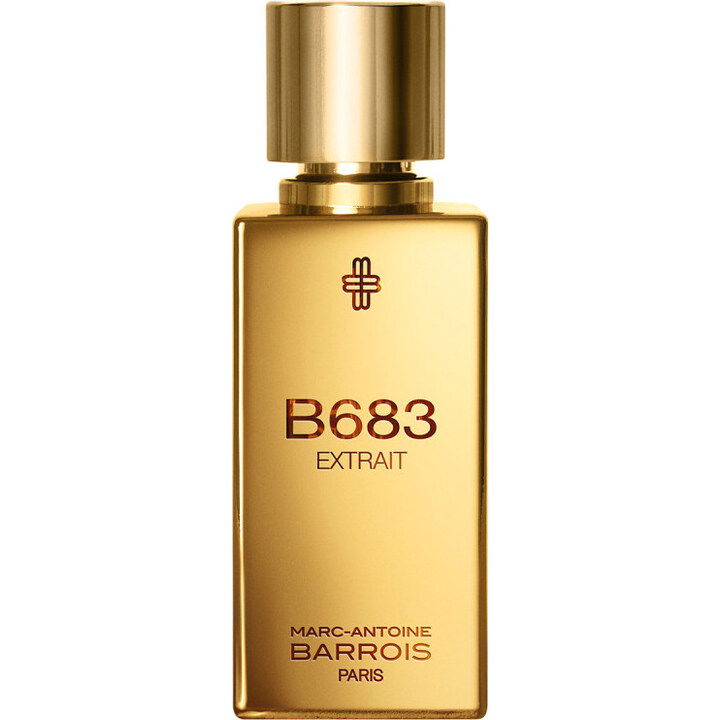


 Top Notes
  Green apple
 Black pepper
 Cumin
Cumin Heart Notes
  Laotian oud
 Safraleine
 Violet leaf
 Base Notes
  Australian sandalwood
 Indonesian patchouli
 Vanilla






 BertolucciK
 RisingChaos
 SVT
SVT HappyMilf
 Shemsmeller
 NicheOnly
 Minamkina
 FrancisF
 Linoskoczek
 Estbienla