
Esther19
Reviews
Filter & Sort
Detailed
Translated · Show original
Global Bastard
I'm not particularly fond of lavender in fragrances. In food, yes: lamb steak with lavender, absolutely. But in fragrances, my enthusiasm is very limited: with three exceptions, the very beautiful "Helmut Lang," the somewhat tiring "Gris claire," and - this damn bastard here. I've never been able to warm up to "Jicky" enough to want to own it.
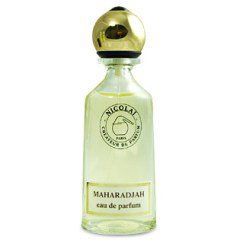
Maharadjah is, as could be expected, a warm scent. However, I find the female declaration decidedly outdated - and to my knowledge, there isn't a Maharadhjne in the realms that women don't typically prefer.
For me, this fragrance primarily features two ingredients: lavender and cinnamon. Like two seemingly mismatched partners, they manage not only to tolerate each other but to complement and merge in a sort of cultural exchange. Even in India, lavender plantations can now be seen - just like olives are being cultivated now - it's no harm! The freshness and strength of the lavender blend so wonderfully with the energetic cinnamon that it truly excites me. The lavender may be the stronger component, but it gains a very positive "alienation" through its embrace with the cinnamon and later a hint of patchouli.
One pauses briefly - just as I did with unusual recipes from the Orient or India at first - and the excitement grows when something wonderful emerges. The fragrance naturally leans towards oriental warmth, without being a classic oriental; it is not sweet, and the lavender's fresh kick remains consistently present. And nothing "chemically" oppressive - if you know what I mean: of course, the scent is "chemical"! But it is artfully crafted so that it doesn't smell like a chemical cloud.
Patricia de Nicolai has succeeded in creating an expressive fragrance with a high recognition value. A global bastard - and what a one! The bottle, even though it is a standard bottle from de Nicolai, fits here: an oriental allusion, but without unnecessary embellishments - modern and traditional at the same time.
7 Comments
Translated · Show original
Replacement - Plastic Spoon without Engraving
As a fan of the movie "Breakfast at Tiffany's," I was quite curious about this fragrance, especially since perfumes play a role in it - noble scents. And of course, during my first visit to New York, I had to stop by this store - well aware that such jewelry does not suit me. However, on the ground floor, there was only what is intended for the "passing customers" of the noble house. Well, I’ve seen it once. The real investors seem to be served in other rooms. Anyway, what I saw did not impress me; a few streets away, I did see some really beautiful jewelry in a display, modern and elegant - of course, at astronomical prices.
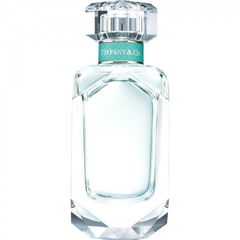
Back to Tiffany's latest creation: It does have a floral aspect, but it feels flat and lacks refinement. Green mandarin? I couldn’t detect it, not even close; rather, from the very beginning, there’s an abstract floral quality that exudes little sensuality and remains strangely faceless. Iris? There are hundreds of fragrances that handle it much more sophisticatedly and "authentically." I can derive nothing more from this scent than desolation across the board. Even the patchouli in the base doesn’t save it; while it doesn’t smell like a cellar vault, it fails to round things off softly and instead becomes slightly annoying. The longevity, on the other hand, is enormous, which is entirely unnecessary.
High house! It is by no means creative to feed something produced a hundred times into a regurgitation process - this pasture has been grazed. In the end, a film comes to mind: Theo Lingen says to his seemingly moderately talented students: "Sad, sad, sad!" - Fits perfectly here as well.
Back to Tiffany's latest creation: It does have a floral aspect, but it feels flat and lacks refinement. Green mandarin? I couldn’t detect it, not even close; rather, from the very beginning, there’s an abstract floral quality that exudes little sensuality and remains strangely faceless. Iris? There are hundreds of fragrances that handle it much more sophisticatedly and "authentically." I can derive nothing more from this scent than desolation across the board. Even the patchouli in the base doesn’t save it; while it doesn’t smell like a cellar vault, it fails to round things off softly and instead becomes slightly annoying. The longevity, on the other hand, is enormous, which is entirely unnecessary.
High house! It is by no means creative to feed something produced a hundred times into a regurgitation process - this pasture has been grazed. In the end, a film comes to mind: Theo Lingen says to his seemingly moderately talented students: "Sad, sad, sad!" - Fits perfectly here as well.
5 Comments
Translated · Show original
Candied
I have already fallen for several Hermès fragrances: the repeatedly returning "24 Faubourg", "Hiris", "Rouge", while others, like "Une Jardin sur de Nil", did not excite me.
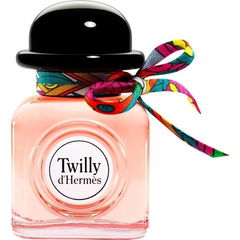
I received a sample of "Twilly" with the words "Exactly your thing!" - which is worth investigating.
What I encounter: sweetness. If it is ginger, then it is strongly candied. It is not the freshly grated, cheeky, fresh from the root, but a candied one. A certain acidity does appear, but rather a citrusy one. After a while, a slight spiciness develops, which is, however, underlaid with sweetness. Such moments remind me of South African cuisine. Perhaps a bit of patchouli is smuggled in, not earthy - grave-like, but as ballast. I'm not quite sure yet.
Tuberose? Oh yes, I love it - so much - in a room-filling dose! This one is a little tuberose. That doesn't have to be bad; sometimes I like to tone down the party girl. However, it becomes more blurred, as the fragrance enters a slightly creamy vanilla-wood phase while maintaining a consistent level of sweetness. And this phase lasts surprisingly long, while the sillage remains moderate.
Conclusion: The fragrance is really not bad, and in contrast to many recent releases, it avoids characterless, yet puffing fruity surrogates. It never comes across as cheap and does not bring shame to the house of Hermès, but it also does not bring any particular honor. I would have wished for more courage with the ginger or the tuberose, just a bit more bite. As it is, it feels a bit too indecisive.
Not a candidate for purchase for me.
I received a sample of "Twilly" with the words "Exactly your thing!" - which is worth investigating.
What I encounter: sweetness. If it is ginger, then it is strongly candied. It is not the freshly grated, cheeky, fresh from the root, but a candied one. A certain acidity does appear, but rather a citrusy one. After a while, a slight spiciness develops, which is, however, underlaid with sweetness. Such moments remind me of South African cuisine. Perhaps a bit of patchouli is smuggled in, not earthy - grave-like, but as ballast. I'm not quite sure yet.
Tuberose? Oh yes, I love it - so much - in a room-filling dose! This one is a little tuberose. That doesn't have to be bad; sometimes I like to tone down the party girl. However, it becomes more blurred, as the fragrance enters a slightly creamy vanilla-wood phase while maintaining a consistent level of sweetness. And this phase lasts surprisingly long, while the sillage remains moderate.
Conclusion: The fragrance is really not bad, and in contrast to many recent releases, it avoids characterless, yet puffing fruity surrogates. It never comes across as cheap and does not bring shame to the house of Hermès, but it also does not bring any particular honor. I would have wished for more courage with the ginger or the tuberose, just a bit more bite. As it is, it feels a bit too indecisive.
Not a candidate for purchase for me.
12 Comments
Translated · Show original
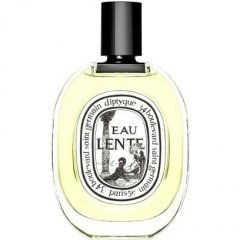
It starts off well
This was yet another spice oriental that really tempted me.
Cinnamon and a whole lot of clove. It starts off well. I also like to use cinnamon and clove in the kitchen - alongside really a lot of other spices; my arsenal of spices and blends would surely astonish the average innkeeper. I enjoy Arabic, Indian, Chinese, South African, Indonesian, Persian cuisine. And I like it spicy, very spicy - but never so much that it overshadows the other components. I go through sambal oelek in 750ml jars, sambal terasi at least by the teaspoon. And this fragrance starts off just like that: clove, cinnamon - and pepper. Just my taste, pure, distinct, unadulterated. It's not necessarily sophistication, but a consistent urgency that stands here with legs wide apart. And that is already a kind of sophistication. Especially since the clove then rises above the cinnamon - beautiful, that's how it should be, that's how it must be. This pleasure lasts for about a good hour.
Oh, if only it could stay like this. Later, what I particularly like fades away: the pepperiness of the spices cinnamon and clove, which are often relegated to the sweet direction here, where they can indeed do good, but have quite different potentials.
Gradually, the opulent splendor ebbs away. The whole thing becomes really sluggish; I would almost suspect something oily,
the newer version of "Narcisse noir" comes to mind, where orange blossoms can either come off as clever-elegant or fatty; unfortunately, here the latter applies. Now, one should not imagine that the fragrance suddenly turns into an oily trail - no, but the temperament that thrilled me at the beginning becomes too disciplined for me; there is a certain break between fiery intensity and prematurely setting phlegm. The cinnamon remains - but in a somewhat mushy alliance that has entered into a partnership with cocoa. I do not regret the purchase, though - I just spray a bit more here, gently of course - I am simply thrilled by the impact of the opening.
I once read that the quality of a fragrance is also assessed by how well the phases of a scent do not drift too far apart. Of course, the transitions can be very different and appealing - and not everything has to unfold "classically." Here, something that started off grandiosely was brought to a lackluster finish. Partial reformulation to the beginning - but with a punch, please!
Cinnamon and a whole lot of clove. It starts off well. I also like to use cinnamon and clove in the kitchen - alongside really a lot of other spices; my arsenal of spices and blends would surely astonish the average innkeeper. I enjoy Arabic, Indian, Chinese, South African, Indonesian, Persian cuisine. And I like it spicy, very spicy - but never so much that it overshadows the other components. I go through sambal oelek in 750ml jars, sambal terasi at least by the teaspoon. And this fragrance starts off just like that: clove, cinnamon - and pepper. Just my taste, pure, distinct, unadulterated. It's not necessarily sophistication, but a consistent urgency that stands here with legs wide apart. And that is already a kind of sophistication. Especially since the clove then rises above the cinnamon - beautiful, that's how it should be, that's how it must be. This pleasure lasts for about a good hour.
Oh, if only it could stay like this. Later, what I particularly like fades away: the pepperiness of the spices cinnamon and clove, which are often relegated to the sweet direction here, where they can indeed do good, but have quite different potentials.
Gradually, the opulent splendor ebbs away. The whole thing becomes really sluggish; I would almost suspect something oily,
the newer version of "Narcisse noir" comes to mind, where orange blossoms can either come off as clever-elegant or fatty; unfortunately, here the latter applies. Now, one should not imagine that the fragrance suddenly turns into an oily trail - no, but the temperament that thrilled me at the beginning becomes too disciplined for me; there is a certain break between fiery intensity and prematurely setting phlegm. The cinnamon remains - but in a somewhat mushy alliance that has entered into a partnership with cocoa. I do not regret the purchase, though - I just spray a bit more here, gently of course - I am simply thrilled by the impact of the opening.
I once read that the quality of a fragrance is also assessed by how well the phases of a scent do not drift too far apart. Of course, the transitions can be very different and appealing - and not everything has to unfold "classically." Here, something that started off grandiosely was brought to a lackluster finish. Partial reformulation to the beginning - but with a punch, please!
6 Comments
Translated · Show original
Winter Color Seeker
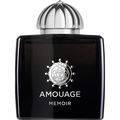
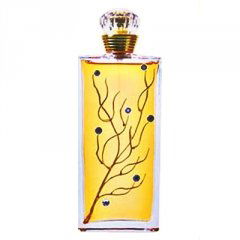
Here it certainly wasn't the bottle that attracted me: I can usually do without golden paintings and rhinestones! But: This fragrance is, so to speak, a true gem in my fragrance cabinet.
The opening is already a delight: I doubt that the notes listed in the top are complete. Many fragrances open hesperidic, but here the orange and neroli are downright full-bodied, rich, ripe - and I think the iris is already pushing its way in. A shimmer and softness at the same time, a fruitiness that has nothing in common with sharp, artificial penetration.
Hölderlin laments in his poem "Half of Life"
"Alas, where do I take, when winter comes
The flowers and shadows of the earth." (1806 - no worries about copyright)
We miss colors in winter - those who go outside notice that there are indeed splashes of color even in winter: evergreens, red branches, moss, brown buds, tree fungi, edible winter mushrooms, and sometimes even a few cheeky little flowers, colorful shrubs. You just have to look closely. Here you have to smell closely, and it's hard for me to name the details:
The scent is full of colors and warmth - and yet composed in such a way that it fits into winter: lightly semi-oriental warming, but not contrastingly shrill. The "spices" are "missing," yet I don't miss them at all here. If I imagine it in colors, there are many shades from yellowish to ochre and brown, muted dark red - and anthracite speckles, always woven together differently. Some paintings by Klee are done this way. All transitions are soft, ylang-ylang and soft jasmine seem to be the centering gentle forces that integrate, embrace, and do not intend to show off, but rather rise in common sense, and a dry musk serves as a supporting element for fluffiness as well as for a transparent stability. It leans towards the more powdery-elegant fragrances like "Cornubia," the latter being significantly spicier. This relative restraint, if one were to take an oriental as a benchmark, does not turn into arbitrariness! Definition of this winter fragrance: No oriental broiling heat, but gentle, intelligent emphasis on winter colors. Subdued refinement. A candidate for repurchase!
The opening is already a delight: I doubt that the notes listed in the top are complete. Many fragrances open hesperidic, but here the orange and neroli are downright full-bodied, rich, ripe - and I think the iris is already pushing its way in. A shimmer and softness at the same time, a fruitiness that has nothing in common with sharp, artificial penetration.
Hölderlin laments in his poem "Half of Life"
"Alas, where do I take, when winter comes
The flowers and shadows of the earth." (1806 - no worries about copyright)
We miss colors in winter - those who go outside notice that there are indeed splashes of color even in winter: evergreens, red branches, moss, brown buds, tree fungi, edible winter mushrooms, and sometimes even a few cheeky little flowers, colorful shrubs. You just have to look closely. Here you have to smell closely, and it's hard for me to name the details:
The scent is full of colors and warmth - and yet composed in such a way that it fits into winter: lightly semi-oriental warming, but not contrastingly shrill. The "spices" are "missing," yet I don't miss them at all here. If I imagine it in colors, there are many shades from yellowish to ochre and brown, muted dark red - and anthracite speckles, always woven together differently. Some paintings by Klee are done this way. All transitions are soft, ylang-ylang and soft jasmine seem to be the centering gentle forces that integrate, embrace, and do not intend to show off, but rather rise in common sense, and a dry musk serves as a supporting element for fluffiness as well as for a transparent stability. It leans towards the more powdery-elegant fragrances like "Cornubia," the latter being significantly spicier. This relative restraint, if one were to take an oriental as a benchmark, does not turn into arbitrariness! Definition of this winter fragrance: No oriental broiling heat, but gentle, intelligent emphasis on winter colors. Subdued refinement. A candidate for repurchase!
18 Comments