
NiMaJazzEr
Reviews
Filter & Sort
Detailed
Translated · Show original
Linden Tree Kaleidoscope
Step by step. Leisurely strolling along the straightened avenue.
Everything shimmers, glimmers, light and dreamy.
Chatter, blurred snippets of words, some silly laughter - passersby in company. And yet each one is alone, unhurried, lifted from time.
Eagerly, the warmth of pastel light points caresses hair and face. The deep sun breaks through the heart-shaped, gently swaying leaves; a linden tree kaleidoscope.
At the edge, a row of shop windows bundles the reflecting light into dazzling rays. The gaze slips away - too much abundance. To forget.
Self-forgetfulness and self-indulgence as counter-concepts.
The absinthe from the night before still vividly lingers in the nose as a fresh, bitter memory.
Exquisite, sweet linden blossom tea with bergamot for breakfast was not enough to create clarity and lightness in my head.
Step by step - it weighs heavy on the mind, the passersby become aware as foreign beings, unapproachability an inner certainty.
Fallen asleep on the park bench.
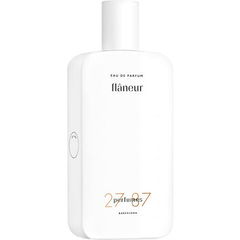
My feelings towards Flâneur are tangled and ambiguous. I don’t really like it, quite subjectively, but it fascinates me. And I marvel at how successfully it fulfills its concept. For indeed, impressionistic city views with parks, dandyish decadence culture, deliberately slow indulgences, aimlessness in the warm yet fresh air - such scenes pass by with clarity in my inner eye. I recall that remark by Walter Benjamin, where the feeling of flâneur reaches a peak for me: “Around 1840, it was temporarily fashionable to walk turtles in the passages. The flâneur liked to let them dictate his pace.”
Well then, I don’t smell a turtle, but there is at least a decelerating elegance inherent in the dominant linden blossoms here. At first, they enchant me very much, fresh, airy, and exciting with the absinthe-like undertone. I haven’t smelled anything like this before. The heaviness that follows becomes a problem, with iris butter and almond (I generally like both). The floral aspect becomes much sweeter, the overall effect quite creamy - overwhelming for me. It feels like too much boredom, an excess of “idle hours.”
Nevertheless: The scent seems quite underrated to me, given its visual power and individuality. This review has certainly come to me completely unplanned and in haste. I would like to praise the development, the independence, the connection of natural and urban elements. And I can’t quite let go of it. If I could handle this sweetness,Flâneur would probably be a partner in which I would completely lose myself.
Everything shimmers, glimmers, light and dreamy.
Chatter, blurred snippets of words, some silly laughter - passersby in company. And yet each one is alone, unhurried, lifted from time.
Eagerly, the warmth of pastel light points caresses hair and face. The deep sun breaks through the heart-shaped, gently swaying leaves; a linden tree kaleidoscope.
At the edge, a row of shop windows bundles the reflecting light into dazzling rays. The gaze slips away - too much abundance. To forget.
Self-forgetfulness and self-indulgence as counter-concepts.
The absinthe from the night before still vividly lingers in the nose as a fresh, bitter memory.
Exquisite, sweet linden blossom tea with bergamot for breakfast was not enough to create clarity and lightness in my head.
Step by step - it weighs heavy on the mind, the passersby become aware as foreign beings, unapproachability an inner certainty.
Fallen asleep on the park bench.
My feelings towards
Flâneur are tangled and ambiguous. I don’t really like it, quite subjectively, but it fascinates me. And I marvel at how successfully it fulfills its concept. For indeed, impressionistic city views with parks, dandyish decadence culture, deliberately slow indulgences, aimlessness in the warm yet fresh air - such scenes pass by with clarity in my inner eye. I recall that remark by Walter Benjamin, where the feeling of flâneur reaches a peak for me: “Around 1840, it was temporarily fashionable to walk turtles in the passages. The flâneur liked to let them dictate his pace.”Well then, I don’t smell a turtle, but there is at least a decelerating elegance inherent in the dominant linden blossoms here. At first, they enchant me very much, fresh, airy, and exciting with the absinthe-like undertone. I haven’t smelled anything like this before. The heaviness that follows becomes a problem, with iris butter and almond (I generally like both). The floral aspect becomes much sweeter, the overall effect quite creamy - overwhelming for me. It feels like too much boredom, an excess of “idle hours.”
Nevertheless: The scent seems quite underrated to me, given its visual power and individuality. This review has certainly come to me completely unplanned and in haste. I would like to praise the development, the independence, the connection of natural and urban elements. And I can’t quite let go of it. If I could handle this sweetness,
Flâneur would probably be a partner in which I would completely lose myself.
9 Comments
Translated · Show original
Wachtraum
Dewdrops tremble in the early morning silence on fine spider webs.
It is still dawn. Only slowly does the environment reconstruct itself from the fresh fog. The vast, hilly meadow, the wild woodruff bushes at the roadside, the stream winding irregularly down the steep rocky slope.
Both my eyes and my thoughts do not want to obey me yet, swaying between wakefulness and sleep, between clarity and dream. Laconically, I turn to you. We steam, lying naked together on this soft blanket. The cool air caresses us like two clean newborns.
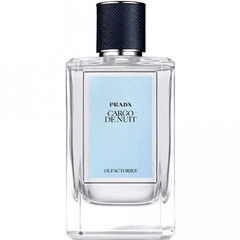
Cargo de Nuit is something like the delicate breath of a transparent spirit on the verge of disappearing. The conscious artificiality of a felt dream. A negation of clear contours. Hard to grasp.
It begins very aldehydic, synthetic in the best sense, and develops with poetic fragility. The scent caresses one with a subtly sweet powderiness that never becomes heavy or sticky, instead enlivened by a bluish freshness. An almondy hint seems to accompany wonderfully bright musk. Followed by young woodruff plants and a touch of iris.
The surreal nature of the images that Cargo de Nuit immediately evokes in me is primarily fed by the mineral notes that distort colors and surfaces, giving everything a strange, unknown, ambiguous glow.
I tested Luna Rossa Black for comparison (and because Cargo de Nuit is currently hard and expensive to obtain), which is repeatedly referenced for its similarity, and yes, there are clear parallels in the base tone. But unfortunately, it lacks this specific mineral tint (as well as a bit of the musk melancholy). And it is precisely this mysterious coolness woven with skin-warm tenderness that makes Cargo de Nuit so special.
The sillage is clearly perceptible yet subtle. A fragrance suitable for everyday and work that does not disturb and also does not bore. For me, it also works in the evening as a cozy caresser with an aura of enigmatic sexiness. An elusive, evasive sensuality, always on the side of stylish understatement. Always somewhat absent.
Elsewhere.
Don’t wake me up.
Dream on and on and on…
It is still dawn. Only slowly does the environment reconstruct itself from the fresh fog. The vast, hilly meadow, the wild woodruff bushes at the roadside, the stream winding irregularly down the steep rocky slope.
Both my eyes and my thoughts do not want to obey me yet, swaying between wakefulness and sleep, between clarity and dream. Laconically, I turn to you. We steam, lying naked together on this soft blanket. The cool air caresses us like two clean newborns.
Cargo de Nuit is something like the delicate breath of a transparent spirit on the verge of disappearing. The conscious artificiality of a felt dream. A negation of clear contours. Hard to grasp.
It begins very aldehydic, synthetic in the best sense, and develops with poetic fragility. The scent caresses one with a subtly sweet powderiness that never becomes heavy or sticky, instead enlivened by a bluish freshness. An almondy hint seems to accompany wonderfully bright musk. Followed by young woodruff plants and a touch of iris.
The surreal nature of the images that Cargo de Nuit immediately evokes in me is primarily fed by the mineral notes that distort colors and surfaces, giving everything a strange, unknown, ambiguous glow.
I tested
Luna Rossa Black for comparison (and because Cargo de Nuit is currently hard and expensive to obtain), which is repeatedly referenced for its similarity, and yes, there are clear parallels in the base tone. But unfortunately, it lacks this specific mineral tint (as well as a bit of the musk melancholy). And it is precisely this mysterious coolness woven with skin-warm tenderness that makes Cargo de Nuit so special.The sillage is clearly perceptible yet subtle. A fragrance suitable for everyday and work that does not disturb and also does not bore. For me, it also works in the evening as a cozy caresser with an aura of enigmatic sexiness. An elusive, evasive sensuality, always on the side of stylish understatement. Always somewhat absent.
Elsewhere.
Don’t wake me up.
Dream on and on and on…
7 Comments

Translated · Show original
Between Flower Boutique and Provençal Soap Shop
White Light deserves a little review. This should be said upfront, as I don't actually consider myself part of the target group. I am definitely not a potential wearer of this voluminous white-flowering fragrance. Such scents do not suit me, feel foreign, like an uncomfortable disguise. Nothing that would entice me. If I were to wander into a boutique for such lush floral bouquets and arrangements, my gaze would instinctively scan the room to see if there might be some refined little cacti hidden in a corner.
But still; the sample was in the discovery set, and I generally like to let my curiosity guide me. So, right onto my wrist with it.
While it doesn't mark a turning point in my perfume orientation, I am nonetheless somewhat impressed. Perhaps I lack experience with such fragrances (be kind, I haven't been testing actively for long), but I have rarely detected the individual nuances so clearly and vividly in a floral-fresh composition.
Instantly, it teleports me to the pedestrian zone of a Provençal old town on a mild summer day. A flower shop - yes, indeed, in full splendor. And from the tiny shop next door wafts the typical lavender soap, in all its confident soapy glory. The freshness is primarily due to sun-ripened citrus fruits.
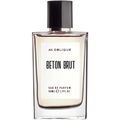
This is incredibly old-fashioned, without any restraint. Cliché grandma associations in your face. But it is precisely for this directness that I can very much respect Atl. Oblique here, while the evoked summer feelings are exceedingly real. Is it due to the still cold and rainy April weather? Regardless, nothing here is blurred or softened. It does last quite a while, even if not with full radiance. The lavender gradually turns into orange soap, while the white flowers slowly get dusted.
I wouldn't wear it myself, though I might recommend it to some cheerful vintage-loving granny spirits.
But still; the sample was in the discovery set, and I generally like to let my curiosity guide me. So, right onto my wrist with it.
While it doesn't mark a turning point in my perfume orientation, I am nonetheless somewhat impressed. Perhaps I lack experience with such fragrances (be kind, I haven't been testing actively for long), but I have rarely detected the individual nuances so clearly and vividly in a floral-fresh composition.
Instantly, it teleports me to the pedestrian zone of a Provençal old town on a mild summer day. A flower shop - yes, indeed, in full splendor. And from the tiny shop next door wafts the typical lavender soap, in all its confident soapy glory. The freshness is primarily due to sun-ripened citrus fruits.
This is incredibly old-fashioned, without any restraint. Cliché grandma associations in your face. But it is precisely for this directness that I can very much respect Atl. Oblique here, while the evoked summer feelings are exceedingly real. Is it due to the still cold and rainy April weather? Regardless, nothing here is blurred or softened. It does last quite a while, even if not with full radiance. The lavender gradually turns into orange soap, while the white flowers slowly get dusted.
I wouldn't wear it myself, though I might recommend it to some cheerful vintage-loving granny spirits.

Translated · Show original
Canonization of Woodworking
A search finds its fulfillment.
Bowmakers seems to be the ultimate realization of a scent promise I had long hoped for. The embodiment of a memory.
Childhood and nostalgia, yes, but not for their own sake, not like some legendary favorite cake, but out of fascination, from the magical impression this fragrance has imprinted on me.
Right after opening the front door, this scent greeted me softly, coming up from the basement. Grandpa's retreat, his wood workshop, where he dedicated himself to the various steps of woodworking with self-constructed tools and machines. From raw materials, he created decorative fence boards, stools, or candle holders. Some were practical, born out of necessity, others functional, or simply beautiful. But everything was executed with much love and perfection, meant to last forever.
Quietly, almost soundlessly, he would hum to himself while individual pieces were shaped, assembled, or painted. Rays of sunlight streamed through the small window niches in the ceiling, where the dust from the wood shavings danced. I loved to blow away or sweep up those fine wood particles that coated everything in the room, letting this velvety wood powder slip through my fingers. Sometimes I helped with the sweeping, but I never found it dirty, as this layer enveloped the many systematically sorted items, whether screws, saw blades, or paint pots.
Anyone who has such a traditional woodworking shop at home surely knows the specific scent; that cozy blend of raw, dry wood, shavings, and a bit of resin with turpentine, varnish, and nourishing waxes. Bowmakers captures these tones for me incredibly directly and accurately, vividly recalling the individual nooks of my grandpa's workshop in their details. The meditative concentration, the comforting warmth, but also the noble grace of the finished, quality items with their individual surface grains and hues.
The focus of the fragrance lies on the resinous-waxy notes that assert themselves over time. Rosin - this scent is also familiar to me from childhood - certainly plays a significant role, without immediately conjuring imaginary violins in my mind. Despite the dusty dryness, I do not perceive any mustiness. It is probably the moss and the "air" accord that breathe a little green freshness into the composition.
As my thoughts nestle completely in that workshop, my friend, unaware of the concept of the perfume or its ingredients, shared direct associations of a service in a wooden church. And indeed, the harmony and inner peace not only unfold spiritual depth but also feel quite sacred. There is probably no incense included; it is likely the rosin that conjures a similar reverent atmosphere. A formal canonization of the processed wood.
Although this may be a rather specific description for a perfume, even for a wood scent, I find Bowmakers quite wearable. It imparts a soothing, warm feeling and remains understated in its outward effect. Instead of a DIY outfit or priestly robes, it conveys a timeless, somewhat decadent sense of style, definitely with an edge, but without being offensive. For me, this lingers close to the skin for quite a while, so that my wrist unconsciously glides to my nose throughout the day, encountering the surrounding hustle and bustle with dreams from that enchanted world of the woodworking shop.
Bowmakers seems to be the ultimate realization of a scent promise I had long hoped for. The embodiment of a memory.
Childhood and nostalgia, yes, but not for their own sake, not like some legendary favorite cake, but out of fascination, from the magical impression this fragrance has imprinted on me.
Right after opening the front door, this scent greeted me softly, coming up from the basement. Grandpa's retreat, his wood workshop, where he dedicated himself to the various steps of woodworking with self-constructed tools and machines. From raw materials, he created decorative fence boards, stools, or candle holders. Some were practical, born out of necessity, others functional, or simply beautiful. But everything was executed with much love and perfection, meant to last forever.
Quietly, almost soundlessly, he would hum to himself while individual pieces were shaped, assembled, or painted. Rays of sunlight streamed through the small window niches in the ceiling, where the dust from the wood shavings danced. I loved to blow away or sweep up those fine wood particles that coated everything in the room, letting this velvety wood powder slip through my fingers. Sometimes I helped with the sweeping, but I never found it dirty, as this layer enveloped the many systematically sorted items, whether screws, saw blades, or paint pots.
Anyone who has such a traditional woodworking shop at home surely knows the specific scent; that cozy blend of raw, dry wood, shavings, and a bit of resin with turpentine, varnish, and nourishing waxes. Bowmakers captures these tones for me incredibly directly and accurately, vividly recalling the individual nooks of my grandpa's workshop in their details. The meditative concentration, the comforting warmth, but also the noble grace of the finished, quality items with their individual surface grains and hues.
The focus of the fragrance lies on the resinous-waxy notes that assert themselves over time. Rosin - this scent is also familiar to me from childhood - certainly plays a significant role, without immediately conjuring imaginary violins in my mind. Despite the dusty dryness, I do not perceive any mustiness. It is probably the moss and the "air" accord that breathe a little green freshness into the composition.
As my thoughts nestle completely in that workshop, my friend, unaware of the concept of the perfume or its ingredients, shared direct associations of a service in a wooden church. And indeed, the harmony and inner peace not only unfold spiritual depth but also feel quite sacred. There is probably no incense included; it is likely the rosin that conjures a similar reverent atmosphere. A formal canonization of the processed wood.
Although this may be a rather specific description for a perfume, even for a wood scent, I find Bowmakers quite wearable. It imparts a soothing, warm feeling and remains understated in its outward effect. Instead of a DIY outfit or priestly robes, it conveys a timeless, somewhat decadent sense of style, definitely with an edge, but without being offensive. For me, this lingers close to the skin for quite a while, so that my wrist unconsciously glides to my nose throughout the day, encountering the surrounding hustle and bustle with dreams from that enchanted world of the woodworking shop.
5 Comments
Translated · Show original
Rosy wafts the magic potion
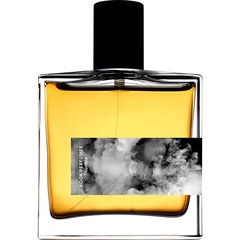
"Thuribulum" generally refers to the incense vessel that is swung on a chain in the Catholic Church to distribute the fragrant smoke. My first associations with  Thurible (2020) settled more in the pagan society of an archaic sorceress brewing a love potion, hidden somewhere at night in dark, lush green nature.
The glow of the embers under her rustic cauldron is perceptible through the thicket. The steam of the mysterious brew flows enticingly towards me, mixing various nuances with alchemical depth. Where it smokes and sparks, the dominant notes for me are mainly the clove as well as rose, conveying positive intentions.
I find this exciting, but the effect remains absent; the formulation just doesn't come together.
I generally struggle a bit with roses, and here it unfortunately overwhelms me instead of harmoniously blending with the other ingredients. In addition to the incense and green herbs, earthiness, resinous notes, and a hint of leather also come into play. A mixture that certainly unfolds a rather willful expression. However, it remains too cloying for me for a long time until the clove-rose steam eventually dissipates slightly and gives space to the balsamic-smoky, tamer base tone, which I appreciate, but, as is often the case with lukewarm punch, the tension is lacking.
Nevertheless, the Rook perfumes remain interesting, and I would not want to deter anyone from testing them.
Thurible (2020) settled more in the pagan society of an archaic sorceress brewing a love potion, hidden somewhere at night in dark, lush green nature.The glow of the embers under her rustic cauldron is perceptible through the thicket. The steam of the mysterious brew flows enticingly towards me, mixing various nuances with alchemical depth. Where it smokes and sparks, the dominant notes for me are mainly the clove as well as rose, conveying positive intentions.
I find this exciting, but the effect remains absent; the formulation just doesn't come together.
I generally struggle a bit with roses, and here it unfortunately overwhelms me instead of harmoniously blending with the other ingredients. In addition to the incense and green herbs, earthiness, resinous notes, and a hint of leather also come into play. A mixture that certainly unfolds a rather willful expression. However, it remains too cloying for me for a long time until the clove-rose steam eventually dissipates slightly and gives space to the balsamic-smoky, tamer base tone, which I appreciate, but, as is often the case with lukewarm punch, the tension is lacking.
Nevertheless, the Rook perfumes remain interesting, and I would not want to deter anyone from testing them.
5 Comments