Translated · Show originalShow translation
The Search for the Signature.
Since I started consciously choosing, testing, and now (ultimately based on my needs) evaluating my fragrances a few years ago, I am still on the hunt for "my" scent. It all began with Gaultier's Le Male, which, like unfortunately so many others, "somehow always works." Since it feels like three out of four men (guys) are dousing themselves with it daily, Le Male, while I find it a very pleasant and "smart" composition, is more of a copy than a signature. The characteristics "pleasant/wearable," "suitable for almost all occasions," and "not too sweet or powdery" are certainly desirable, which is why such brilliant EdPs like Nasomatto Duro or Dior Homme Intense are not suitable under these conditions and are therefore only worn on specific occasions. (The comparison with Le Male admittedly falls short... Tastes change, and everyone grows up eventually.) ;)
A more fitting comparison is the similarity to the legendary Knize Ten. (More on that later.)
In a small but fine perfumery in my hometown, the beautiful Hanseatic city of Bremen, I had the opportunity to test Carbone directly and carry it with me for the rest of the day. I had read about this scent and had become curious. Herb, spicy, smoky were clearly present in my imagination. But right after the first spray, I had to look at the salesperson questioningly and then check the bottle to see if it was indeed the intended tester... Green freshness? Lightness? Almost slightly fruity in the first seconds? Very pleasant, but that was not at all what I expected! Nevertheless, the bottle was the right one, and the salesperson nodded knowingly. And indeed: After a few moments, at most a few minutes, the green, fresh, zesty notes recede into the background, and a distinct, not at all Hanseatic smoke rises and pushes forward. Initially intrusive in contrast, but over time, it becomes pleasantly rounded.
On the way back, I passed one of the smaller Douglas stores, which had been recommended to me by the previous salesperson because they had the aforementioned Knize Ten. (Who would have thought...) Sprayed on the other arm, I had to realize that Knize Ten comes across much more powerfully at the outset, as if it wants to hit Carbone hard in direct comparison. :) Direct smoke clouds surround the wrist, so to speak, not fresh, not green. Knize Ten bites through, initially being more intense. However, over the course of both fragrances, I find them quite comparable, and the later it gets, the more similar they become. In terms of longevity, both are equally good. The scent developments are (as has been occasionally criticized) unremarkable. Both smell consistently of smoke, rubber, tar, and are slightly spiced. In contrast to Knize Ten, Carbone becomes far less sharp after a short time, somewhat less definable, more subtle, and therefore, in my opinion, more wearable in today's times, without subordinating itself to the well-known "common scents."
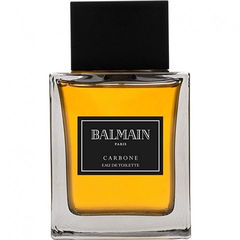
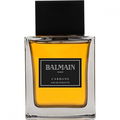
The bottle should also be mentioned, which is absolutely successful, simple, and chunky, reflecting the content consistently.
Additionally, the price is pleasing: At around €70/50 ml, Carbone is positioned (similar to Knize Ten) in the upper mid-range, without having to fear comparison with much more expensive waters in terms of quality.
Conclusion: Carbone de Balmain is a thoroughly successful fragrance that starts surprisingly and, in the further course, is neither intrusive nor reserved but also not very varied. It stands out from the currently sweeter or simply "fresh" sport/summer fragrances and represents an interesting exception. For me, it is clearly one of the top 10 fragrances with good chances of becoming my "signature."