
Yatagan
Reviews
Filter & Sort
Detailed

Translated · Show original
How does one approach this fragrance?
Uncommented Fragrances No. 194
In my opinion, RedBird does not want to be a perfume (at best a natural perfume), nor is it a scent in the strictest sense of the word; describing it merely as a smell would be far too little.
How does one approach such a fragrance?
I noticed RedBird because of its extraordinary ingredients from the highly regarded brand Kamila Aubre: There is Wild Lavender (lavender is, as has been mentioned many times, my favorite scent), Goldenrod, which had already caught my attention positively before and which I like to see by the roadside (included, for example, in Field Songs: see my review on that), Rosemary, Spruce, and Juniper, which I also like, Sea Fennel (as in
  Phtaloblue and
  Mediterranean Pine Forest) and the modestly shy Yarrow, which I loved as a child - probably because of its natural simplicity - (references could be
  Wild Achillea and once again Field Songs).
It is of course obvious that this wild herbal composition does not exude a pronounced pleasant scent, but the result is still surprisingly different: sharp, earthy, herbal, lacquer-like, yet ethereal, bright spicy, bright resinous, and bright woody.
Despite a certain initial resistance, I now find the fragrance fascinating, personally very wearable (even if that certainly does not apply to everyone) and moreover, it harmoniously fits into the extremely diverse, mostly floral-herbal scents of Kamila Aubre.
Final excursion: Behind the brand stands the talented perfumer of the same name from Belgium, who experiments with unusual ingredients and sees her focus in the area of natural fragrances.
In my opinion, RedBird does not want to be a perfume (at best a natural perfume), nor is it a scent in the strictest sense of the word; describing it merely as a smell would be far too little.
How does one approach such a fragrance?
I noticed RedBird because of its extraordinary ingredients from the highly regarded brand Kamila Aubre: There is Wild Lavender (lavender is, as has been mentioned many times, my favorite scent), Goldenrod, which had already caught my attention positively before and which I like to see by the roadside (included, for example, in
Field Songs: see my review on that), Rosemary, Spruce, and Juniper, which I also like, Sea Fennel (as in Phtaloblue and Mediterranean Pine Forest) and the modestly shy Yarrow, which I loved as a child - probably because of its natural simplicity - (references could be Wild Achillea and once again Field Songs). It is of course obvious that this wild herbal composition does not exude a pronounced pleasant scent, but the result is still surprisingly different: sharp, earthy, herbal, lacquer-like, yet ethereal, bright spicy, bright resinous, and bright woody.
Despite a certain initial resistance, I now find the fragrance fascinating, personally very wearable (even if that certainly does not apply to everyone) and moreover, it harmoniously fits into the extremely diverse, mostly floral-herbal scents of Kamila Aubre.
Final excursion: Behind the brand stands the talented perfumer of the same name from Belgium, who experiments with unusual ingredients and sees her focus in the area of natural fragrances.
57 Comments
Translated · Show original
The Added Value of Disruptive Changes in the Fragrance Market
Uncommented Fragrances No. 193
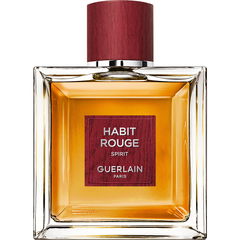
One must be grateful to fragrances like Habit Rouge Spirit for their disruptive change of the established
  Habit Rouge Eau de Toilette DNA: It now provides a better understanding of what we had in this original father of oriental warm men's fragrances.
The original, "Habit Rouge (Eau de Toilette) | Guerlain," first encountered me in my youth at around 15 years old in the 80s (yes, I am that old) at my uncle and aunt's upscale hotel, where they maintained a showcase of a local perfumery, predominantly featuring bottles from Guerlain: "Shalimar (Eau de Toilette) | Guerlain," "Chamade (Eau de Parfum) | Guerlain," "Mitsouko (Eau de Toilette) | Guerlain," and of course "Habit Rouge (Eau de Toilette) | Guerlain."
Prior to that, I had already become acquainted with rather cool and masculine men's fragrances and was fascinated by the oriental warm, metrosexual orientation of the scent, which fit well with the ideas of New Romanticism in the 80s. Shortly thereafter, it became my signature scent: a citrusy (bergamot) opening that was only briefly present, followed by notes of orange blossom, probably jasmine, iris, patchouli, tonka, and balsamic (less resinous) opoponax notes, which were strongly reminiscent of the Guerlinade of Guerlain's women's fragrances. Nevertheless, Habit Rouge was occasionally described as distinctly masculine, likely due to the rather harsh tonka note, which lacked the marzipan-like sweetness of some of today's tonka fragrances and resonated with the fougère notes. Luca Turin wrote about Habit Rouge in his unmistakably apt style: "One of the immediately and unchangeably appealing inventions in the history of perfume..."
Especially with Habit Rouge, with its now countless flankers and (more or less moderate) reformulations, it has become increasingly difficult to track and categorize the initially subtle, later more pronounced changes to the original. I would summarize briefly: One can still recognize the original quite well, especially because it has preserved its original spirit.
But how does "Spirit" fit into the above-described context? Here, too, a brief initial attempt: Spirit is clearly recognizable as a derivative of the original Habit Rouge (EdT / EdP) and deserves a certain respect because it preserves and carries forward the DNA of this great creation (see Luca Turin) for the noses trained more on niche fragrances from Marly of the post-postmodern (feel free to add another "post," which I will omit for better readability) generation.
Certainly, the list of listed ingredients is not complete; in my opinion, iris, opoponax, or other balsamic or resinous notes are missing, perhaps even bergamot and/or orange and patchouli or a comparable substitute. Oak barrel - iris - vanilla sounds clearer, more tangible, and seems to allow for selective systematization in the age of niche, which many are after here: the desire for apparent (and futile) individualization in the age of the masses. So be it. I can handle that.
In the drydown, Habit Rouge Spirit then even becomes increasingly similar to the old red jacket, which naturally pleases me as a dinosaur.
In this respect: not bad done Guerlain, you have launched worse in recent years.
One must be grateful to fragrances like
Habit Rouge Spirit for their disruptive change of the established Habit Rouge Eau de Toilette DNA: It now provides a better understanding of what we had in this original father of oriental warm men's fragrances. The original, "Habit Rouge (Eau de Toilette) | Guerlain," first encountered me in my youth at around 15 years old in the 80s (yes, I am that old) at my uncle and aunt's upscale hotel, where they maintained a showcase of a local perfumery, predominantly featuring bottles from Guerlain: "Shalimar (Eau de Toilette) | Guerlain," "Chamade (Eau de Parfum) | Guerlain," "Mitsouko (Eau de Toilette) | Guerlain," and of course "Habit Rouge (Eau de Toilette) | Guerlain."
Prior to that, I had already become acquainted with rather cool and masculine men's fragrances and was fascinated by the oriental warm, metrosexual orientation of the scent, which fit well with the ideas of New Romanticism in the 80s. Shortly thereafter, it became my signature scent: a citrusy (bergamot) opening that was only briefly present, followed by notes of orange blossom, probably jasmine, iris, patchouli, tonka, and balsamic (less resinous) opoponax notes, which were strongly reminiscent of the Guerlinade of Guerlain's women's fragrances. Nevertheless, Habit Rouge was occasionally described as distinctly masculine, likely due to the rather harsh tonka note, which lacked the marzipan-like sweetness of some of today's tonka fragrances and resonated with the fougère notes. Luca Turin wrote about Habit Rouge in his unmistakably apt style: "One of the immediately and unchangeably appealing inventions in the history of perfume..."
Especially with Habit Rouge, with its now countless flankers and (more or less moderate) reformulations, it has become increasingly difficult to track and categorize the initially subtle, later more pronounced changes to the original. I would summarize briefly: One can still recognize the original quite well, especially because it has preserved its original spirit.
But how does "Spirit" fit into the above-described context? Here, too, a brief initial attempt: Spirit is clearly recognizable as a derivative of the original Habit Rouge (EdT / EdP) and deserves a certain respect because it preserves and carries forward the DNA of this great creation (see Luca Turin) for the noses trained more on niche fragrances from Marly of the post-postmodern (feel free to add another "post," which I will omit for better readability) generation.
Certainly, the list of listed ingredients is not complete; in my opinion, iris, opoponax, or other balsamic or resinous notes are missing, perhaps even bergamot and/or orange and patchouli or a comparable substitute. Oak barrel - iris - vanilla sounds clearer, more tangible, and seems to allow for selective systematization in the age of niche, which many are after here: the desire for apparent (and futile) individualization in the age of the masses. So be it. I can handle that.
In the drydown, Habit Rouge Spirit then even becomes increasingly similar to the old red jacket, which naturally pleases me as a dinosaur.
In this respect: not bad done Guerlain, you have launched worse in recent years.
78 Comments
Translated · Show original
About Collecting Blueberries in Iceland
Uncommented Scents No. 192
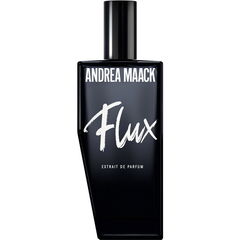
So we are collecting blueberries in Iceland with Andrea Maack - and as it is with berries in fragrances: Generally, these are scent components made up of esters, aldehydes, and various alcohol compounds. So anyone expecting blueberries to be pressed and filtered here will likely be disappointed. However, that doesn't really matter, because synthetic elements in perfume don't have to be bad: on the contrary! Well-crafted artificiality creates what truly makes scent an art form (think of fragrances like Jicky Eau de Toilette,
  N°5 Parfum,
  Eau Sauvage Eau de Toilette, or
  Mitsouko Eau de Toilette. Pure natural scents can be very beautiful, but they often smell like a mix of health food store and fragrance lamp.
The fact that I still rarely form a real friendship with the scents of Andrea Maack probably has to do with her approach to fragrance: clear, simple, Icelandic plain. This is too little artificial for me, if I may once again draw a comparison with Mitsouko. However, if one likes that, Flux could also be an interesting option.
Blueberries in fragrances are currently a small, steadily ongoing trend since around 2000 (471 available scents are counted by the Parfumo search with "blueberries"), and those who enjoy it will be well served: The small blue spheres have been well processed with authentic aroma from start to finish (unfortunately, I do not know the exact ester-aldehyde-alcohol connection here), which means that the longevity and aura of this molecular compound is quite strong, but never unpleasantly harsh. What bothers me a bit is a subtle sweetness that seems a bit too artificially thin to me.
In addition, green notes can be identified, although one cannot really differentiate the listed ingredients clearly, but both herbal and ethereal as well as light resinous elements are present.
Flux also retains its blueberry note in the drydown, while the green transforms into woody accents and presumably the listed cashmere note (again, of course, synthetic) appears. In any case, one can find this plausible, but it doesn't necessarily have to be liked.
Recently, I tested a fragrance from Alkemia that seemed quite similar to me: Baccante. Here, blueberries are also consistently at the center.
I'm not sure whether I should rate the fragrance more positively or less positively, but somehow I ultimately find it sympathetic. Probably because I like blueberries (hence a 7: means good, but I neither have to wear it nor buy it). One could criticize it mainly for its rather monothematic concentration on blueberries. Such things often seem too straight and too little perfumey to me.
So we are collecting blueberries in Iceland with Andrea Maack - and as it is with berries in fragrances: Generally, these are scent components made up of esters, aldehydes, and various alcohol compounds. So anyone expecting blueberries to be pressed and filtered here will likely be disappointed. However, that doesn't really matter, because synthetic elements in perfume don't have to be bad: on the contrary! Well-crafted artificiality creates what truly makes scent an art form (think of fragrances like
Jicky Eau de Toilette, N°5 Parfum, Eau Sauvage Eau de Toilette, or Mitsouko Eau de Toilette. Pure natural scents can be very beautiful, but they often smell like a mix of health food store and fragrance lamp. The fact that I still rarely form a real friendship with the scents of Andrea Maack probably has to do with her approach to fragrance: clear, simple, Icelandic plain. This is too little artificial for me, if I may once again draw a comparison with Mitsouko. However, if one likes that,
Flux could also be an interesting option.Blueberries in fragrances are currently a small, steadily ongoing trend since around 2000 (471 available scents are counted by the Parfumo search with "blueberries"), and those who enjoy it will be well served: The small blue spheres have been well processed with authentic aroma from start to finish (unfortunately, I do not know the exact ester-aldehyde-alcohol connection here), which means that the longevity and aura of this molecular compound is quite strong, but never unpleasantly harsh. What bothers me a bit is a subtle sweetness that seems a bit too artificially thin to me.
In addition, green notes can be identified, although one cannot really differentiate the listed ingredients clearly, but both herbal and ethereal as well as light resinous elements are present.
Flux also retains its blueberry note in the drydown, while the green transforms into woody accents and presumably the listed cashmere note (again, of course, synthetic) appears. In any case, one can find this plausible, but it doesn't necessarily have to be liked. Recently, I tested a fragrance from Alkemia that seemed quite similar to me:
Baccante. Here, blueberries are also consistently at the center. I'm not sure whether I should rate the fragrance more positively or less positively, but somehow I ultimately find it sympathetic. Probably because I like blueberries (hence a 7: means good, but I neither have to wear it nor buy it). One could criticize it mainly for its rather monothematic concentration on blueberries. Such things often seem too straight and too little perfumey to me.
60 Comments
Translated · Show original
More than the Sum of Its Parts
Uncommented Scents No. 191
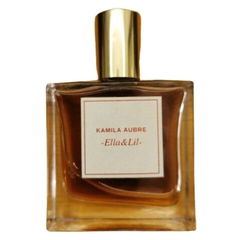
 Ella and Lil Eau de Parfum contains several ingredients that I don't particularly favor (ambrette seeds, coffee, cocoa, cardamom, and leather), but what a surprise: The fragrance quickly captivated and fascinated me with its aura. Often, the whole is indeed more than the sum of its parts.
How is that? An attempt at deconstruction:
Starting from the result, one first notices powdery dry accents, a less warm than elevated sound of sweet-spicy nuances: Coffee and cocoa are plausible but not decipherable individually, cardamom is clearly recognizable, as is the clove that is perceptible until the end. I understand the leather note here in the traditional sense (it smells rather minimally ambered or subtly resinous, definitely not like the penetrating postmodern suede notes that would be as far from a brand like Kamila Aubre as the moon).
Originally, I was interested in the fragrance because of the idiosyncratic porcini note, which appears multiple times in Kamila Aubre's creations, such as in Soliloquy Eau de Parfum or
  Gloire de Dijon Eau de Parfum, and which gives Kamila's fragrances a delicately earthy and animalistic, yet distinctly exquisite note. I have emphasized several times that mushroom notes in fragrances do not smell like a mushroom pan, but are rather comparable to the earthy and bodily notes of patchouli, even if they don't actually smell similar. They do not dominate fragrances but always remain in the background, leaving a fine aroma reminiscent of forest soil: more unconsciously dreamed than consciously noticed.
Reading: Ludwig Tieck: "Der blonde Eckbert" or "Der Runenberg"
Music: The Cure: "A Forest" or Antonin Dvořák: "From the Bohemian Forest"
Indulgence: Chocolate with dried porcini mushrooms
I kindly ask to refrain from comments that mushrooms belong only in the pan and not in fragrances, as long as this scent has not been tested.
Ella and Lil Eau de Parfum contains several ingredients that I don't particularly favor (ambrette seeds, coffee, cocoa, cardamom, and leather), but what a surprise: The fragrance quickly captivated and fascinated me with its aura. Often, the whole is indeed more than the sum of its parts. How is that? An attempt at deconstruction:
Starting from the result, one first notices powdery dry accents, a less warm than elevated sound of sweet-spicy nuances: Coffee and cocoa are plausible but not decipherable individually, cardamom is clearly recognizable, as is the clove that is perceptible until the end. I understand the leather note here in the traditional sense (it smells rather minimally ambered or subtly resinous, definitely not like the penetrating postmodern suede notes that would be as far from a brand like Kamila Aubre as the moon).
Originally, I was interested in the fragrance because of the idiosyncratic porcini note, which appears multiple times in Kamila Aubre's creations, such as in
Soliloquy Eau de Parfum or Gloire de Dijon Eau de Parfum, and which gives Kamila's fragrances a delicately earthy and animalistic, yet distinctly exquisite note. I have emphasized several times that mushroom notes in fragrances do not smell like a mushroom pan, but are rather comparable to the earthy and bodily notes of patchouli, even if they don't actually smell similar. They do not dominate fragrances but always remain in the background, leaving a fine aroma reminiscent of forest soil: more unconsciously dreamed than consciously noticed. Reading: Ludwig Tieck: "Der blonde Eckbert" or "Der Runenberg"
Music: The Cure: "A Forest" or Antonin Dvořák: "From the Bohemian Forest"
Indulgence: Chocolate with dried porcini mushrooms
I kindly ask to refrain from comments that mushrooms belong only in the pan and not in fragrances, as long as this scent has not been tested.
64 Comments
Translated · Show original
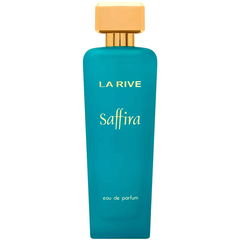
Why You Should Wear This Fragrance on New Year's Eve!
Caution: Contains a bit of irony!
Are you currently planning your New Year's Eve party and want to make it a real blast? Then I’m afraid I can’t give you any advice, as I’m not planning to do that myself, but I do have a good tip for you:
You should wear Saffira on New Year's Eve because...
... this fragrance smells like "Erba Pura | XerJoff," which almost all your nouveau riche friends will wear on New Year's Eve, and with Saffira, you won’t stand out at all because it smells almost just as synthetic.
... this fragrance is a whopping 170 euros cheaper than Erba Pura, allowing you to buy another 20 to 25 La Rive fragrances - and they’re really not that bad, often even better than the originals, as they’re not so overpoweringly long-lasting, not so intense, and not so garish.
... this fragrance has been held up by nearly every influencer in front of the camera for about 11 years, so you really can’t go wrong even in its 12th year.
... this fragrance already has more than 300 reviews on Parfumo and several new ones are added daily, which clearly indicates that not everything has been said about this fragrance yet. So many users can’t be wrong, as they always say!
... there are currently almost 70 offers in the souk, which can only speak to the quality of the fragrance: Many users want to selflessly let you participate in this fragrance challenge! So go ahead and buy!
Jokes aside: Erba Pura isn’t that bad either, rather average, I think, but no one is asking me. I rated La Rive'sSaffira with 6 points (average) because I can tolerate it quite well on others (the so-called annoyance factor), and that’s a measure of a certain quality: it doesn’t bother. And that could really be a good tip for New Year's Eve: Who wants 30 guests at their party, each one smelling more overpowering than the other?
I wish you a lovely, perhaps even quiet New Year's Eve and a good and healthy year 2025!
My motto: Read more and party less!
Yatagan
Are you currently planning your New Year's Eve party and want to make it a real blast? Then I’m afraid I can’t give you any advice, as I’m not planning to do that myself, but I do have a good tip for you:
You should wear
Saffira on New Year's Eve because...... this fragrance smells like "Erba Pura | XerJoff," which almost all your nouveau riche friends will wear on New Year's Eve, and with Saffira, you won’t stand out at all because it smells almost just as synthetic.
... this fragrance is a whopping 170 euros cheaper than Erba Pura, allowing you to buy another 20 to 25 La Rive fragrances - and they’re really not that bad, often even better than the originals, as they’re not so overpoweringly long-lasting, not so intense, and not so garish.
... this fragrance has been held up by nearly every influencer in front of the camera for about 11 years, so you really can’t go wrong even in its 12th year.
... this fragrance already has more than 300 reviews on Parfumo and several new ones are added daily, which clearly indicates that not everything has been said about this fragrance yet. So many users can’t be wrong, as they always say!
... there are currently almost 70 offers in the souk, which can only speak to the quality of the fragrance: Many users want to selflessly let you participate in this fragrance challenge! So go ahead and buy!
Jokes aside: Erba Pura isn’t that bad either, rather average, I think, but no one is asking me. I rated La Rive's
Saffira with 6 points (average) because I can tolerate it quite well on others (the so-called annoyance factor), and that’s a measure of a certain quality: it doesn’t bother. And that could really be a good tip for New Year's Eve: Who wants 30 guests at their party, each one smelling more overpowering than the other?I wish you a lovely, perhaps even quiet New Year's Eve and a good and healthy year 2025!
My motto: Read more and party less!
Yatagan
72 Comments