

 Musk
Musk Patchouli
 Sandalwood
 Tobacco
 Vetiver
MonsieurTest
39 Reviews
Translated · Show original

MonsieurTest
Top Review
45
The Soft Scent of Dictatorships
1933 was a good year. Such an insane sentence can only be thought, written, and published by a Parfumo. And it can only mean this, if it is morally sane, from a perfume historical perspective. In 1933, not only did this wonderfully soft, mildly spicy leather scent appear. In the year when the Nazis seized power in Germany in January, Guerlain's 'Sous le Vent' and 'Vol de Nuit', Caron's 'Fleur de Rocaille', Houbigant's 'Présence', Lanvin's 'Scandal', as well as 'Divine Folie' by Patou and 'Secret de Venus' by Weil saw the light of day or rather: the noses of the world; in Spain, Myrurgia's 'Embrujo de Sevilla' and the still available, wonderfully refreshing, gentle budget cologne 'Gotas de Ora' also emerged.
In Germany, the year in which the Weimar Republic died and Nazi terror took power, 'Mousons Lavendel' and Sir Cologne by 4711 were released. And in all the aforementioned countries, there were also some lesser-known, earlier extinct fragrances, as our excellent Parfumo database of historically conscious perfumes reveals with just a few clicks. Thus, the year of historical terror was the birth hour of numerous fragrance classics, a large part of which - from Guerlain's 'Sous le Vent' to the Borsari leather fine scent worthy of recognition here - has unfortunately become extinct.
What else happened back then, and what was far more important than the appearance of this extraordinary multitude of great scents that could last long, is chronicled in Uwe Wittstock's recently published book 'February 1933', especially regarding the biographies of significant writers during those weeks of massive upheaval and political terror.
In Italy, however, Mussolini's fascists had been in power since 1922, first as part of a center-right coalition, then from 1925 onward through the continuous suspension of parliamentary rules with dictatorial powers. Life for many people, especially for the Jewish population of Italy, became increasingly worse and unbearable during the 1930s, also fueled by the fascist takeovers in Germany, and later in Franco's Spain.
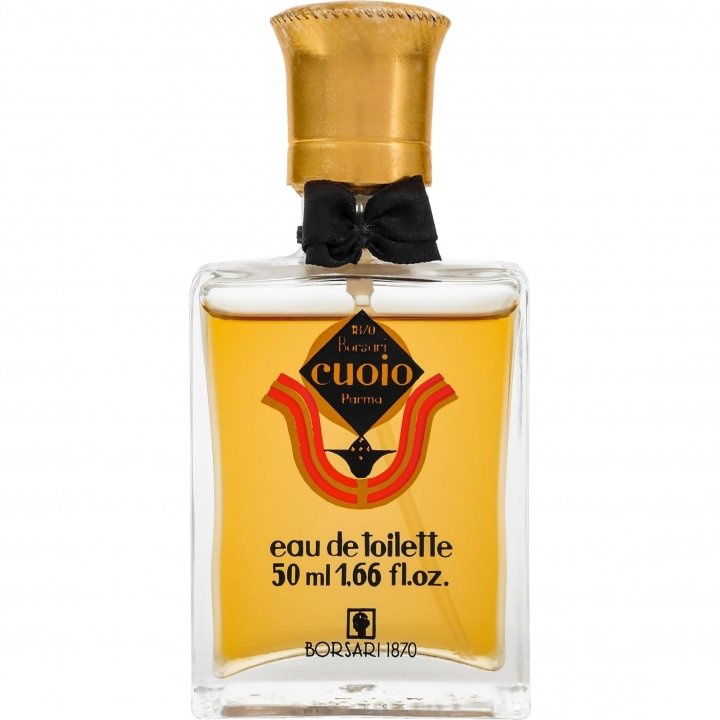
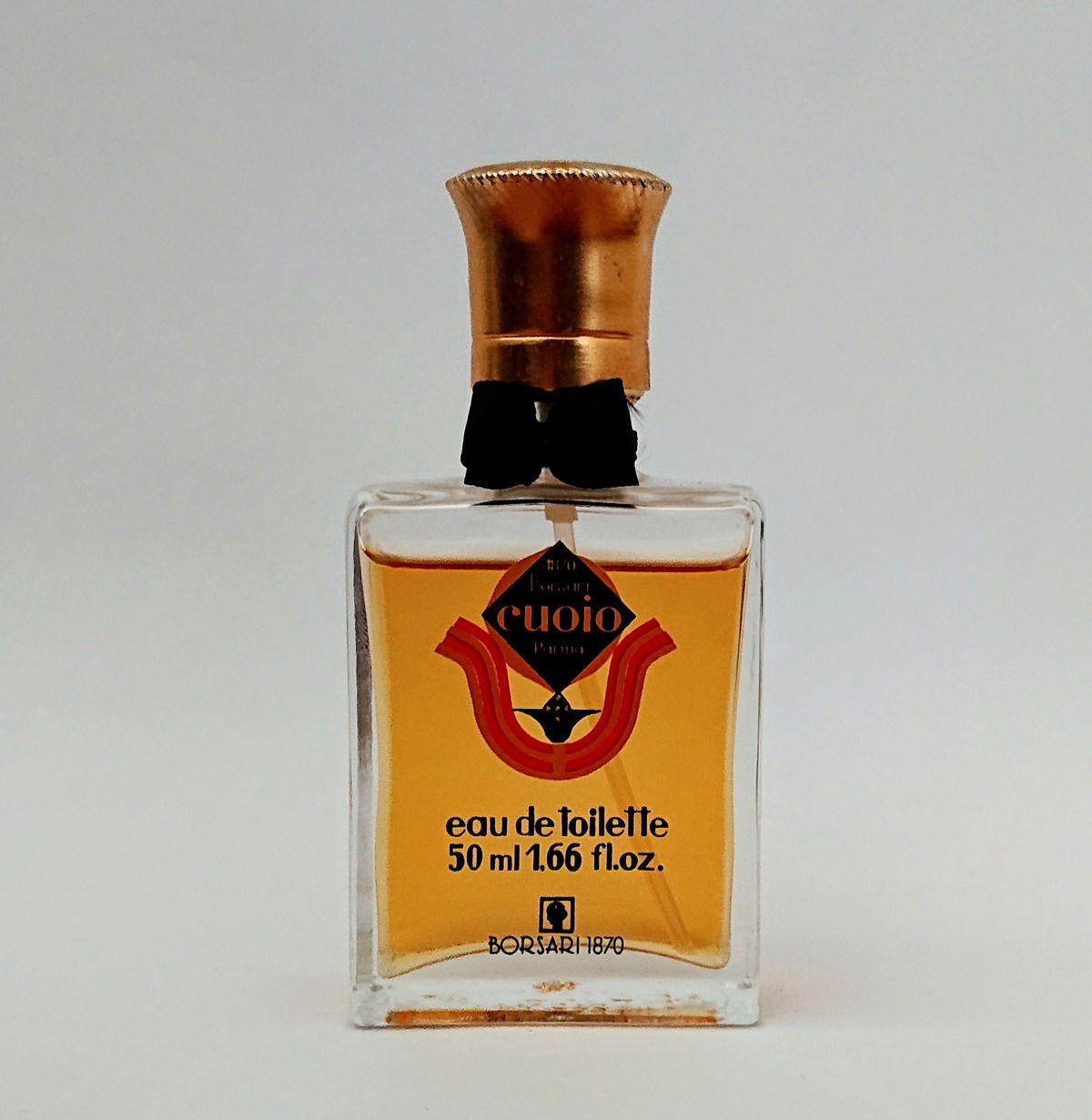
Amidst these ugly and for many affected people dreadful times, some luxury goods also thrived. As mentioned, some of the most beautiful classic modern fragrances were created across Europe at that time. And among them, 'Cuio' by Borsari can certainly be counted. It is truly impressive how here, based on vetiver and sandalwood, an accord of soft, slightly human-smelling leather is recreated, which is warmly enveloped by a heart of sandalwood. A kinship to the 8 years older Knize Ten is undeniable; although the Borsari leather comes across as softer and finer.
Presumably, birch tar aroma is also processed here as a classic leather note. And the whole composition is rounded off with the traditionally masculine notes of tobacco, patchouli, and minimal animalic musk. Despite the usual weight of almost all the involved fragrance components, the concert of these heavyweights here feels rather light and floating, more buttery than aggressively radiating.
Yes, indeed, this perfume smells a bit old-fashioned; but in the best sense, that is: elegant, noble, natural. And: completely rounded. One would rather not imagine how it was worn with brown or black uniforms and leather boots by higher-ranking officials during the criminal attacks and state actions of 1933 and the following years.
Today, this exquisite 'Cuio' is apparently no longer available. This certainly means a loss for friends of well-composed fragrances made from entirely classic ingredients. 'Cuio' by Borsari allows one to drift through time. It evokes leaps of thought and memorial journeys into the past.
Its origin was in the most fatal and darkest times of this country - as well as its country of origin, Italy. Yet even in such adverse, vile times, beauty could miraculously flourish.
My heartfelt thanks go to dear Parfumo colleague Mörderbiene for his decanting of this and many other classic fragrances!
In Germany, the year in which the Weimar Republic died and Nazi terror took power, 'Mousons Lavendel' and Sir Cologne by 4711 were released. And in all the aforementioned countries, there were also some lesser-known, earlier extinct fragrances, as our excellent Parfumo database of historically conscious perfumes reveals with just a few clicks. Thus, the year of historical terror was the birth hour of numerous fragrance classics, a large part of which - from Guerlain's 'Sous le Vent' to the Borsari leather fine scent worthy of recognition here - has unfortunately become extinct.
What else happened back then, and what was far more important than the appearance of this extraordinary multitude of great scents that could last long, is chronicled in Uwe Wittstock's recently published book 'February 1933', especially regarding the biographies of significant writers during those weeks of massive upheaval and political terror.
In Italy, however, Mussolini's fascists had been in power since 1922, first as part of a center-right coalition, then from 1925 onward through the continuous suspension of parliamentary rules with dictatorial powers. Life for many people, especially for the Jewish population of Italy, became increasingly worse and unbearable during the 1930s, also fueled by the fascist takeovers in Germany, and later in Franco's Spain.
Amidst these ugly and for many affected people dreadful times, some luxury goods also thrived. As mentioned, some of the most beautiful classic modern fragrances were created across Europe at that time. And among them, 'Cuio' by Borsari can certainly be counted. It is truly impressive how here, based on vetiver and sandalwood, an accord of soft, slightly human-smelling leather is recreated, which is warmly enveloped by a heart of sandalwood. A kinship to the 8 years older Knize Ten is undeniable; although the Borsari leather comes across as softer and finer.
Presumably, birch tar aroma is also processed here as a classic leather note. And the whole composition is rounded off with the traditionally masculine notes of tobacco, patchouli, and minimal animalic musk. Despite the usual weight of almost all the involved fragrance components, the concert of these heavyweights here feels rather light and floating, more buttery than aggressively radiating.
Yes, indeed, this perfume smells a bit old-fashioned; but in the best sense, that is: elegant, noble, natural. And: completely rounded. One would rather not imagine how it was worn with brown or black uniforms and leather boots by higher-ranking officials during the criminal attacks and state actions of 1933 and the following years.
Today, this exquisite 'Cuio' is apparently no longer available. This certainly means a loss for friends of well-composed fragrances made from entirely classic ingredients. 'Cuio' by Borsari allows one to drift through time. It evokes leaps of thought and memorial journeys into the past.
Its origin was in the most fatal and darkest times of this country - as well as its country of origin, Italy. Yet even in such adverse, vile times, beauty could miraculously flourish.
My heartfelt thanks go to dear Parfumo colleague Mörderbiene for his decanting of this and many other classic fragrances!
33 Comments
 Bastian
 Susan
Susan Gold
Gold Merteuil