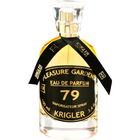
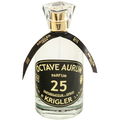
Prologue: Uncommented Fragrances No. 9
Act 1: The Look Ahead
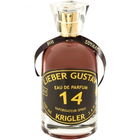
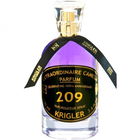
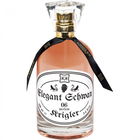
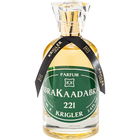
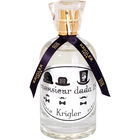
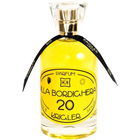
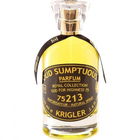
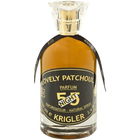
That the brand Krigler has not yet sparked any desires on this side may be a bit surprising. Actually, all the prerequisites are in place:
“The brand has a long tradition of over 100 years, which has been continued by the current owners after a few years of interruption since 2008; various fragrances from past decades have been reissued; the bottles stand out; the fragrances are extremely expensive, exclusive, and positioned far from the mainstream.
Why the fragrances are still relatively rare may perhaps be explained by the fact that Krigler's compositions can essentially only be ordered through the company's own website in the United States, and the fragrances are indeed composed in such a way that they are not very mass-compatible, which likely means that only a small group of enthusiasts could be excited about them,” says Yatagan.
Act 2: The Look Back
To place the brand in the course of time, we let the company founder Alfred Krigler speak for himself (freely based on information from the manufacturer's website):
“The story of my brand began with my decision to move from Berlin to Moscow in 1870 to work in the cosmetics and chemical industry. That was a bold decision at the time. Shortly thereafter, however, I already knew that I had acted correctly: in 1879, I created my first perfume, ‘Pleasure Gardenia,’ which still belongs to the fragrance collection of my brand today. In 1904, I opened a perfume shop in St. Petersburg, but shortly thereafter left Russia and spent some time back in Berlin, my hometown, before finally moving to southern France in 1910. There, I opened a perfume laboratory in the Mecca of perfume production. In 1931, my granddaughter moved to the USA, where she began selling the fragrances of my brand; the company headquarters shifted to America. Due to the turmoil of World War II, we lost many of our long-standing customers from Germany, Austria, and other European countries. After my death in the 1950s, production even came to a complete standstill for several years. In the 1960s, my great-granddaughter found the formulas for more than 200 fragrances in the family archives, many of which I had created myself, and decided to make these accessible to interested customers again. She initially opened a small, private studio. Finally, in 2008, my brand was reestablished in the Plaza Hotel in New York. The story of Alfred Krigler could continue.”
Act 3: The Look to the Center
Chorus of Wise Spirits: “The brand Krigler has had a tumultuous past and may have once been one of the more well-known fragrance manufacturers. Clearly, it is time to take a closer look at one or another of Krigler's fragrances that has not yet been commented on.”
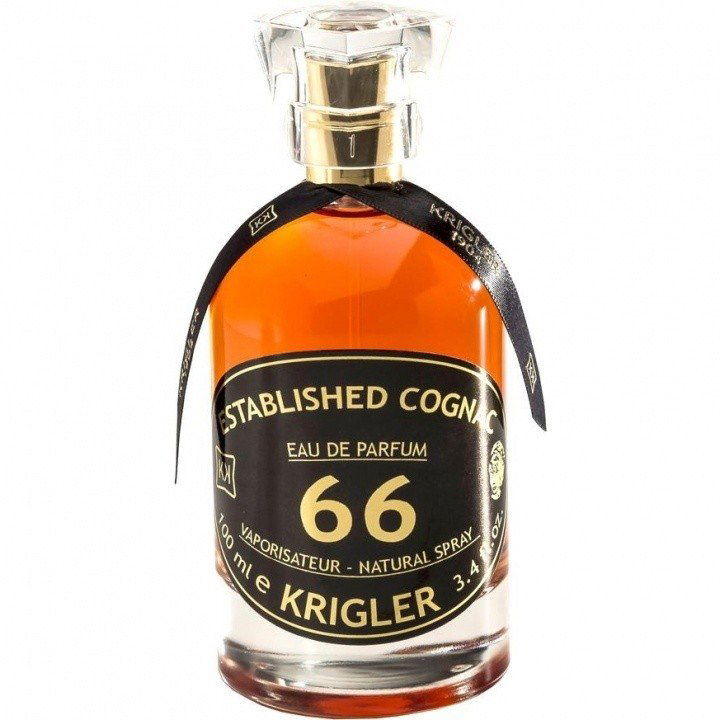
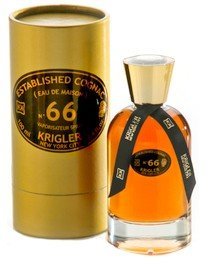
Yatagan (nodding in agreement) - Monologue: “Among the traditional colognes of Krigler is a fragrance with the quirky name Established Cognac 66. The number behind the fragrance name always refers to the year of launch at Krigler, in this case, 1966. Thus, we are dealing with a relatively young Krigler fragrance. After all, some of the fragrances go back to formulas from the 19th or early 20th century. Of course, the central question arises again as to whether these are indeed original formulas from the manufacturer - or rather reformulations in the spirit of the original. It is conceivable that the fragrances are based on historical formulas, as their character is partly very foreign, very unusual, yet also original. It is not entirely unlikely that they could be older compositions.
Nevertheless, the attentive perfume lover will be intrigued by the reading of the fragrance pyramid. In my opinion, apple is not one of the traditional components in fragrances and may have been added later. The cognac and wood notes, on the other hand, could be of historical origin and may have been included in the original fragrance from 1966; the same may apply to the marigold note, less so for the caramel note. However, Established Cognac 66 is not a gourmand fragrance, but rather a traditional men’s fragrance with a slightly feminine touch. The fragrance fits quite well with the vibe of the 60s and 70s, during which a number of heavy, sometimes sweet men’s fragrances were created, thus fitting well into the context of that time, despite all skepticism regarding the original formula.
The apple note in the top note is good, almost strikingly noticeable, but disappears unusually quickly, in my opinion. This may be due to the warm, strong tones that characterize the fragrance in the heart note. Of course, there is primarily the cognac, which gave the fragrance its name. A sweet alcoholic note dominates the fragrance for quite a while. The oak note, which is said to be included in the fragrance according to the manufacturer, seems extraordinary at first glance, but is also found in well-known fragrances such as Tabac Original, Aramis Havana, CK Free, or Burberry London Men. As I lack comparisons, I can only speculate about the scent: according to my research, it should smell strong, almost penetrating (in the best case like the scent of oak barrels), and can certainly only be used in subtle doses. The marigold also has a strong, almost pungent scent as a flower, which is not to everyone’s taste. All components contribute to the fragrance smelling very distinctive, having edges and corners, but also exhibiting a slightly feminine note due to the sweet note in the dry down, described in the manufacturer’s fragrance pyramid as a caramel note. Nevertheless, I can imagine the fragrance much better on a man. It is certainly not excluded that it can also be worn by women.”
Epilogue: An unusual fragrance, a distinctive fragrance, a fragrance that falls a bit out of time, a very expensive fragrance. Certainly, despite the highly interesting conditions regarding the brand and tradition, not good prerequisites for the “next big thing.”



 Cognac
 Oak
Oak Apple
Apple Caramel
 Indian tagetes


 Gandix
 Misca
Misca FragFreak666
 Mörderbiene
 Caligari
 Serge
Serge Gold
Gold Achilles