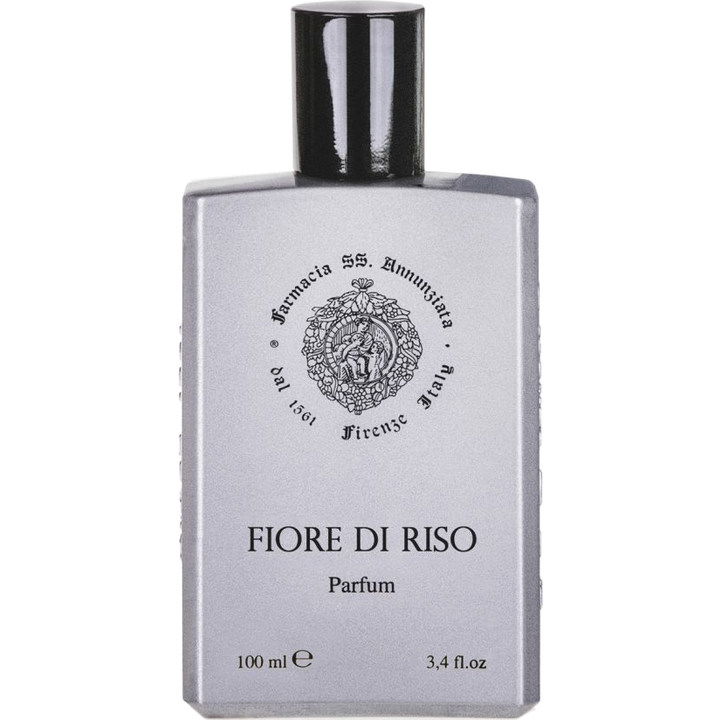


 Top Notes
  Mandarin orange
 Peach
Peach Heart Notes
  White blossoms
 Neroli
 Base Notes
  Benzoin
 Vanilla

Seerose
775 Reviews
Translated · Show original

Seerose
Top Review
What should and can this fragrance tell us?
The rice plant belongs to the grasses, and I suspect that the flowers do not have a strong scent. Much is written about cherry and other blossoms throughout Asia; they are sung about, celebrated, and revered as sacred. I am not aware of anything similar regarding the flowers of rice grasses. Although rice has been and remains the most important food source in this region of the world.
During the test run of "Fiore di Riso," I got the impression that it could refer to rice powder. It was used as face powder in the past, even here.
In India and Southeast Asia, there are also customs in some cultures and regions to sprinkle artistic patterns like flowers in front of doorways with rice powder every morning anew. This art is called Kolam, and you can read about it on Wikipedia:
https://de.wikipedia.org/wiki/Kolam
That would also be a imaginative name idea for a perfume that actually smells like powder.
"Fiore di Riso" starts off lightly with Tonka/Heliotrope and a powdery scent. Then I smell, let's say: approximately tuberose. Following that is a initially transparent green, oddly sharp scent that is underlaid by the powderiness. The sharpness is presumably meant to sketch ginger, as I see after looking it up in the pyramid. Just as the sharpness of ginger quickly fades, so does the slight sharpness in "Fiore di Riso" very quickly.
Then Tagetes is listed. Tagetes smells like pyrethrum. All chrysanthemums and asters also smell like pyrethrum, but Tagetes, also known as marigold, is particularly unpleasant. Tagetes is placed against root nematodes between potatoes and other crops and ornamental plants threatened by nematodes. It is also said to work well if you don't have slugs in the garden. They are totally keen on Tagetes. Garden enthusiasts can recite ballads about how phalanxes of slugs have devoured newly planted Tagetes overnight, leaving nothing but slime trails by morning. I have experienced that too. Is some of such plants mixed into perfumes? At least that is claimed. What should that tell us, I ask somewhat mockingly?
Because it continues with the fragrance component that is also found in Tagetes:
Pyrethrum is used as a remedy against head lice and other lice, even today, which can sometimes plague people and animals.
However, I find that neither Tagetes nor pyrethrum is captured as a scent in "Fiore di Riso." "Fiore di Riso" should at least smell a bit like chrysanthemums. It does not.
Davana is a plant from the Artemisia family, so it belongs to plants like mugwort and wormwood, which I do not perceive as particularly fragrant either. However, I have read such contradictory information about the scent of Davana that I will leave speculations about it at this point.
"Fiore di Riso" smells oddly indeterminate sharp and over some intervals like musty old powder. This is sometimes intensified in a dull way. "Fiore di Riso" also becomes sweeter and more powdery, milder, and drier. The grassy green also becomes more hay-like. Presumably, sandalwood makes the scent a bit creamier, thus more cohesive.
Fortunately for me, only a homeopathic dose of oak moss has been used; I generally do not like to smell it in fragrances, to put it mildly.
How should I judge "Fiore di Riso"? I am torn. On one hand, "Fiore di Riso" has something beautiful and delicate at a distance and in the room, and at the same time, something repulsive, slightly unpleasant close to the skin. The longevity is good for me, the sillage is delicate and yet evenly perceivable in strength.
I have searched long in my scent memory and come to the realization that "Fiore di Riso" is a nude scent, a parfum de peau. Is "Fiore di Riso" a fragrance that is supposed to smell like skin powdered with rice powder? If that was the intention of the perfumers, I find the scent "Fiore di Riso" successful and very well made, regardless of the ingredients that are very sparingly disclosed here. Unfortunately, it is just not a scent I would want to wear.
During the test run of "Fiore di Riso," I got the impression that it could refer to rice powder. It was used as face powder in the past, even here.
In India and Southeast Asia, there are also customs in some cultures and regions to sprinkle artistic patterns like flowers in front of doorways with rice powder every morning anew. This art is called Kolam, and you can read about it on Wikipedia:
https://de.wikipedia.org/wiki/Kolam
That would also be a imaginative name idea for a perfume that actually smells like powder.
"Fiore di Riso" starts off lightly with Tonka/Heliotrope and a powdery scent. Then I smell, let's say: approximately tuberose. Following that is a initially transparent green, oddly sharp scent that is underlaid by the powderiness. The sharpness is presumably meant to sketch ginger, as I see after looking it up in the pyramid. Just as the sharpness of ginger quickly fades, so does the slight sharpness in "Fiore di Riso" very quickly.
Then Tagetes is listed. Tagetes smells like pyrethrum. All chrysanthemums and asters also smell like pyrethrum, but Tagetes, also known as marigold, is particularly unpleasant. Tagetes is placed against root nematodes between potatoes and other crops and ornamental plants threatened by nematodes. It is also said to work well if you don't have slugs in the garden. They are totally keen on Tagetes. Garden enthusiasts can recite ballads about how phalanxes of slugs have devoured newly planted Tagetes overnight, leaving nothing but slime trails by morning. I have experienced that too. Is some of such plants mixed into perfumes? At least that is claimed. What should that tell us, I ask somewhat mockingly?
Because it continues with the fragrance component that is also found in Tagetes:
Pyrethrum is used as a remedy against head lice and other lice, even today, which can sometimes plague people and animals.
However, I find that neither Tagetes nor pyrethrum is captured as a scent in "Fiore di Riso." "Fiore di Riso" should at least smell a bit like chrysanthemums. It does not.
Davana is a plant from the Artemisia family, so it belongs to plants like mugwort and wormwood, which I do not perceive as particularly fragrant either. However, I have read such contradictory information about the scent of Davana that I will leave speculations about it at this point.
"Fiore di Riso" smells oddly indeterminate sharp and over some intervals like musty old powder. This is sometimes intensified in a dull way. "Fiore di Riso" also becomes sweeter and more powdery, milder, and drier. The grassy green also becomes more hay-like. Presumably, sandalwood makes the scent a bit creamier, thus more cohesive.
Fortunately for me, only a homeopathic dose of oak moss has been used; I generally do not like to smell it in fragrances, to put it mildly.
How should I judge "Fiore di Riso"? I am torn. On one hand, "Fiore di Riso" has something beautiful and delicate at a distance and in the room, and at the same time, something repulsive, slightly unpleasant close to the skin. The longevity is good for me, the sillage is delicate and yet evenly perceivable in strength.
I have searched long in my scent memory and come to the realization that "Fiore di Riso" is a nude scent, a parfum de peau. Is "Fiore di Riso" a fragrance that is supposed to smell like skin powdered with rice powder? If that was the intention of the perfumers, I find the scent "Fiore di Riso" successful and very well made, regardless of the ingredients that are very sparingly disclosed here. Unfortunately, it is just not a scent I would want to wear.
4 Comments




 Scarlett
 Blauemaus
 Gandix
 Seerose