I must admit: unusually, it was not the fragrance itself that piqued my interest. I was drawn in by its shadow.
Tell me: why?
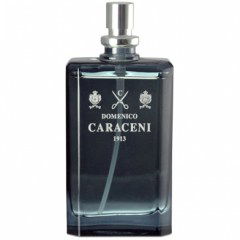
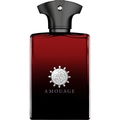
I read about a tailor of the Italian royal house, saw a bottle made of dark glass with a tailor's scissors crossed like swords in the center and two crests on either side, heard about the tradition of the house since 1913. In my mind, an image of an extraordinary fragrance formed, further fueled by the comments about Caraceni's 1913. An expectation so great that it could only be shattered, that one would have to crash down, from the very top to the very bottom, into the darkness of the dark glass of this apparently strangely unique fragrance, - shattering the expectation.
Just before I got to know the fragrance, I had to think of the English Gothic novels of the 17th and 18th centuries, of Percy Bysshe Shelley's and Mary Shelley's horror literature, of a dark mirror that only reflects the shadowy facets of light, the dark side of life, and my expectations rose once more.
I read about a perfume that could incorporate the morbid side of the rose into a men's fragrance with incense, tobacco, and styrax, that indeed emphasizes the dark side of romance, the shudder: wilted roses before a dark mirror? Romance on the surface - or really a glimpse into black water?
Then the fragrance arrived with me, long sought, hard to obtain, perhaps no longer produced by the traditional house Caraceni, likely only to be found used, hidden: really another reason to be fascinated by this fragrance?
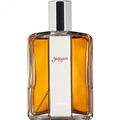
The first impression: A déjà vu! A scent experience that I had recently had in a similar way, indeed unusual, as the rose rarely dominates in a men's fragrance. And then I actually saw in the dark mirror the fragrance that reminded me of Caraceni's 1913, which, although not a twin, could well be the brighter, lighter brother, the brother on this side of the mirror: Touaregh by Il Profvmo, a fragrance that had fascinated me just a few days ago like rarely in the past years, a fragrance about which I had yet to write anything because I was still searching for the words, for descriptions, for the question of whether I really like the fragrance, whether I truly love it or simply find it interesting, different, somehow new.
And now again this experience: Once more a fragrance that is different and yes: new, that truly requires interest, which apparently seems to please me, as I can no longer let go of it, one that I could love, perhaps soon, certainly by tomorrow, but which is not an easy friend, be warned, but one that must be sought behind the black mirror, among the leaves of the wilted, unsightly rose, no romance in the true sense, one that is hard to approach directly because it contains too many seemingly conflicting components that elude, as they build distance to the wearer.
Tell me: what do you want to tell me?
What do bitter orange, neroli, and petitgrain do with incense, how does tobacco bind to rose? Apparently, someone has made a bold attempt, taken a risk that often leads to a dead end with fragrances, but here resulted in a strong and simultaneously morbid outcome, a fragrance for some, then. For some.
Tell me: for whom?
A fragrance for men, a fragrance also for women who want to smell different, not just original, but who dare to engage in an experiment with the rose, which nevertheless does not smell feminine here, which acquires a morbid-dark note through the incense, a fragrance for some who are looking for something that allows for new thinking, that leaves familiar spaces behind.
For me, the fragrance is like a whirlpool that pulls me into dark water, draws me to the dark side of the dark mirror, the fascination of the dark, the opaque, and the unpredictable: Styrax, for example, is a resin that smells heavily sweet and is said to have a relaxing and calming effect, even having healing properties. Is that what makes this fragrance so fascinating in its alchemical marriage with the rose? Perhaps: I at least need fragrances that promise me wholeness, healing, and unity with myself, that perhaps even keep that promise, who knows. Styrax and rose can do it. Incense can do it. Just as styrax is the promise of healing, incense is the promise of the sacred, of devotion, of coming to oneself, of focusing on the numinous. Orange and neroli can do it. The orange is the promise of vitality, the promise of return, the promise of being able to return from the dark side of the door: Orpheus.
And so, in this fragrance, contradictory and seemingly belonging aspects of the first and last come together into a fragrance that promises wholeness, which thus promises something that we probably all seek in fragrances: unity with oneself, perhaps even with creation: in the ideal fragrance, - the longing to finally find what heals us, makes us whole and absolutely satisfied, leaving us behind, the search for the ultimate fragrance that may render every further search unnecessary.
Tell me: is this the ideal fragrance?
Who knows what an ideal fragrance is. I never promised you that. I only say that this fragrance promises "something." But promises are always broken, if not today, then tomorrow or sometime. And then: the disappointment is all the greater.
So if you should search for this fragrance - and I tell you: you will search for a long time -, then be disappointed, for then you will find something behind the dark mirror: a shard of healing, a small piece of you. No more.
(Comment 100 from Yatagan)



 Top Notes
  Bourbon geranium
 Petitgrain
 Styrax
 Heart Notes
  Rose absolute
 Tobacco
 Neroli
 Xenophobic Thermostat
 Base Notes
  Frankincense
 Cypress






 Yatagan
 Taurus
 Troemmer
 Prokion
 Dan93
Dan93 Parfusion
 Cappellusman
 Globomanni