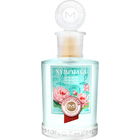
Commentless Fragrances No. 65
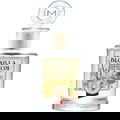
I’ll be honest: I only noticed this fragrance on a second glance, and that was thanks to the beautiful advertisement (seen above under the bottle image in various versions), which I stumbled upon in an old magazine in my mother's cabinet. It’s not just a stunning "Nude at the beach" (a phenotype of advertising from the early 70s, here masterfully painted in flat colors and shapes; by the way, if you imagine the bottle in the foreground gone, it could also be a perfectly successful movie poster), but also an embodiment of irritation - very much in the spirit of good advertising.
Because: Who is actually being addressed here? Men (the fragrance is classified as a men's scent here on Parfumo and in older Harmann & Reimer fragrance atlases), who are supposed to succumb to the charm of the beautiful naked woman? Women (the bottle clearly indicates "Roger & Gallet Madame," which could generally refer to the gender focus of the brand), who might see themselves in the image of beauty and the longing for beach and sea and sand on bare skin? Both genders, since the aforementioned image works in both ways and triggered something at the beginning of the 70s that promised, in the context of growing prosperity since the late 60s, vacations, summer, sun, beach, foreign countries, adventure, and perhaps also freer love? A promise that was later taken up in advertising (see above) by the naked couple in a more explicit manner. Whether that is the better version, because more obviously erotic, is debatable. Personally, I would always choose the older variant (in my opinion, the first of the images above is also the oldest).
It’s also exciting how the representation shifts between the mentalities of the 60s and 70s; stylistically still anchored in the Sixties, thematically already in the Seventies, particularly through the subtle, bourgeois-acceptable hint of hippie chic (thanks to DOCBE for this note).
The question of whether it is actually a women's or men's fragrance is not so difficult to answer upon unbiased consideration. Despite being classified as a men's fragrance here and elsewhere (mind you: not even as a unisex fragrance), Shendy must be considered a women's chypre with floral undertones in the context of the perception of the early 70s (citrus bergamot opening, woody note, typically even with patchouli, which cannot be missing in an early Seventies scent, finishing with oak moss and musk, also a must in this decade, but then also floral components: white floral elements: jasmine, although less intrusive, rather subtly floral; - so to speak, chypre in the foreground, bouquet in the background).
You can tell from the hypotactic nesting of my sentences how difficult it is for me to quickly categorize this: the fragrance indeed has something androgynous about it.
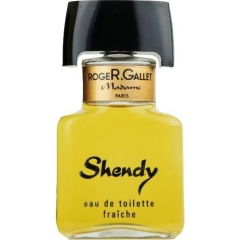
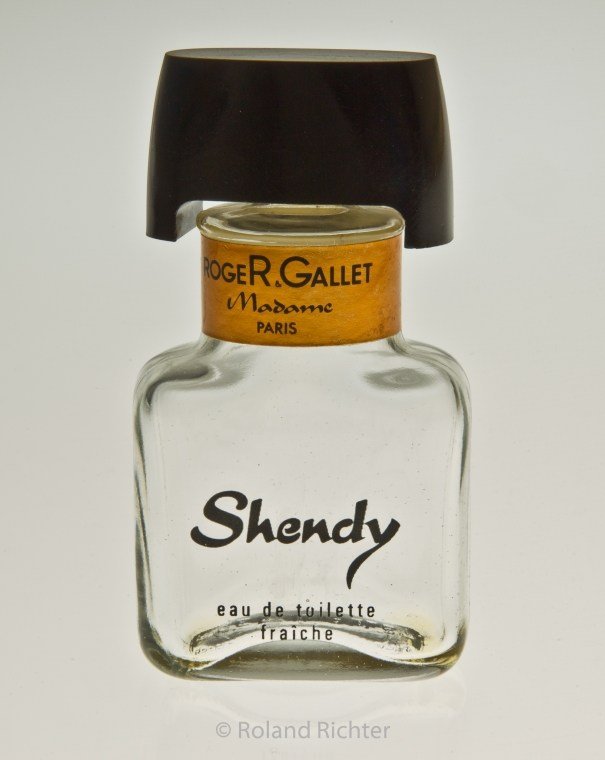
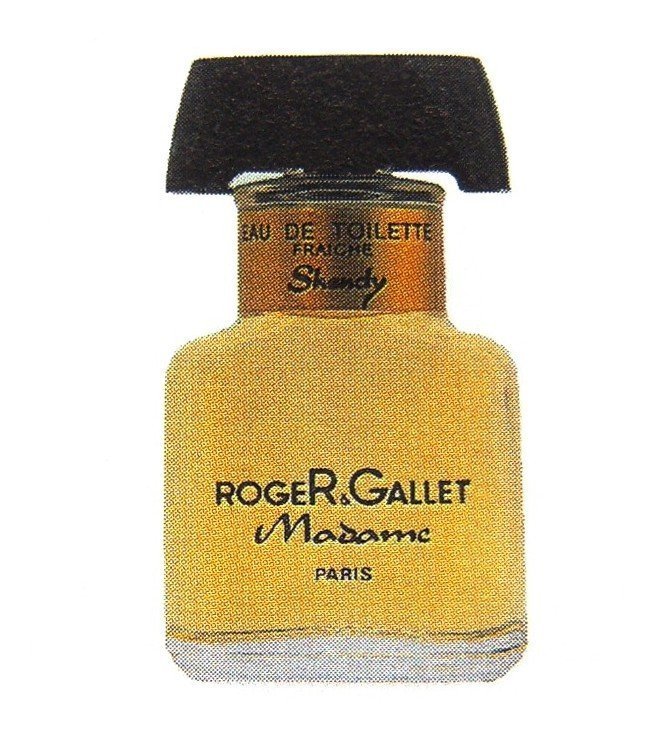
Whether the fragrance might have been advertised later with a different bottle, where the "Madame" would have been missing (see the miniature in the photo of gold below), as a men's AND women's fragrance, I do not know, but I suspect this precisely because of the already mentioned and visible black-and-white advertisement with the two naked beauties. If you think of a similar classic representative, namely Jicky, it also shows that the classification as a men's or women's fragrance can indeed fluctuate with the taste of the times over the decades.
Please no comments about how men or women can wear whatever they want... Of course, that is fundamentally true, but it was not understood this way in the perfume production of past decades and centuries. Fragrances served more as a reinforcement of contemporary gender images, even if these could indeed vary.
Back to the fragrance itself: Shendy is, to say it again, a charming chypre with somewhat more pronounced floral notes, but it also has its masculine accents in the stable woody and mossy base and the fresh opening, which in my miniature, which of course has been around for a few years, is no longer very perceptible. Only a lemony-bitter hint lingers before the other, already mentioned tones begin to resonate.
Masculine or androgynous are also some herbal notes that gently emerge after prolonged wear, but never lead the fragrance in a green fougère direction.
All in all, the classification as a men's fragrance is acceptable from today’s perspective, but due to the early advertising posters, the printing on the bottle, and the classification as a floral chypre in the early 70s, it is hardly tenable from my point of view. Therefore, I would advocate for a compromise to shift it to the category of unisex fragrances, even if H & R and Parfumo are rarely wrong.
The simultaneous promotion of the R & G men's fragrance "Monsieur" with a very similar image would also support a unisex or men's classification. This time, however, with a naked man in front of the aforementioned backdrop...
Would I have tested the fragrance if the beautiful naked woman hadn’t caught my eye? Maybe I would have - due to my fondness for older men's classics, but ultimately, Shendy remains just a time-bound episode in the narrower sense, an attempt to establish another chypre in the market, which apparently succeeded for a while, but not permanently. In my opinion, Shendy has been off the market for quite some time. It no longer appears in newer H & R fragrance anthologies, last noted in my knowledge at the end of the 80s. Whether it was produced afterward, perhaps still for the French market, is beyond my knowledge.
A bottle or a miniature is not a must-have, but if someone can acquire one cheaply, they might want to try this little fragrance. Everyone else is recommended to consider the image above.







 Gold
Gold