The Gorilla Perfumes from Lush see themselves as storytellers. And so, the new Vol. 4 is a series of different episodes, all revolving around a single question: What is home and where do I belong?
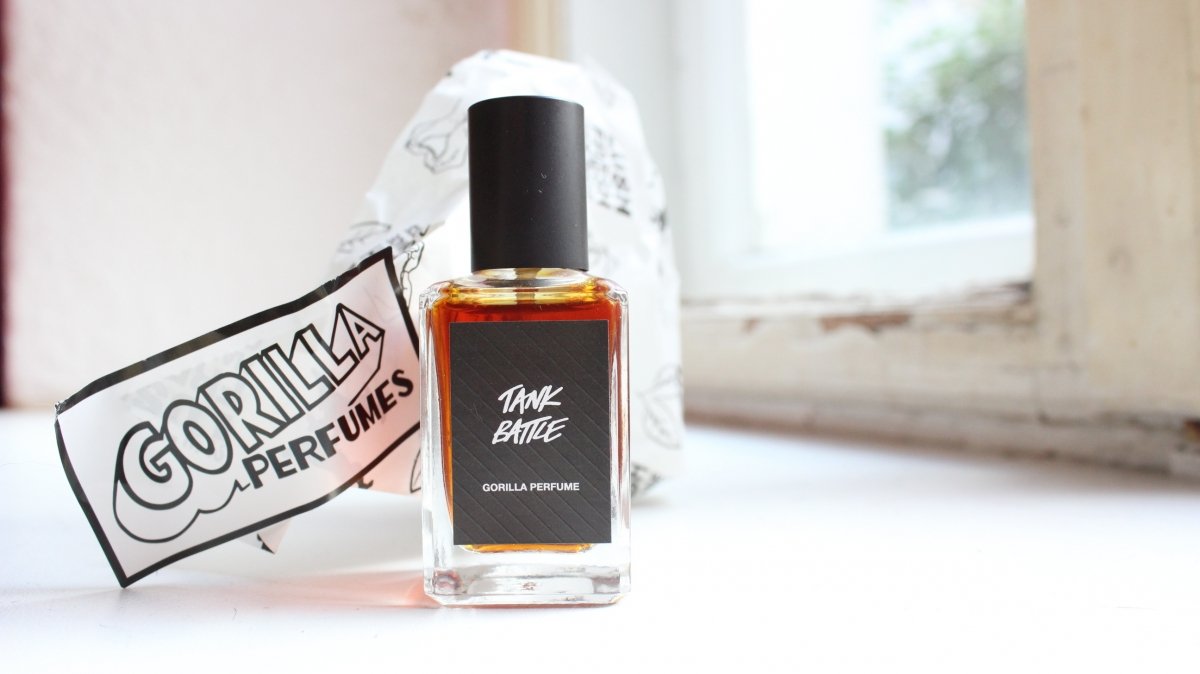
The inspiration for most of the fragrances from Vol. 4 came from photographer, video artist, and gallery owner Hal Samples, and in some perfumes, episodes from his life or the lives of those around him are recounted. Tank Battle deals with one of these encounters, and the story will be briefly retold here before we discuss the actual scent.
Hal was processing the loss of many of his friends (he was working on a video project about the homeless) and was on vacation with one of his friends. The goal was to unwind, relax, and recharge. It was then that he encountered the homeless Tachowa Covington, who approached him with the words: “I had a dream about you. You’re going to make a movie about me.” In fact, Tachowa led Hal to a water tank on the outskirts of Los Angeles, which he had made his home. From the outside, it was a completely normal-looking steel water tank, but inside, Tachowa had created his own little world from the trash of a prosperous society - his home, his sanctuary. Through upcycling and new contextualization, what was discarded became a new world. Hal actually decided to make a film about Tachowa and spent a lot of time with him in that water tank. They sang, drank, ate, and Hal documented the changes in the tank. Everything changed, however, in 2011 when the British street artist Banksy also discovered the water tank, but only the outer shell. He adorned the tank with the inscription “This looks a bit like an elephant” and transformed, through this “artistic act,” the water tank into a true art object - even though this had already happened inside thanks to Tachowa. To make matters worse, 60 days prior, Tachowa had received a sort of eviction notice, and now, through Banksy, the public's attention was drawn to his battle for the tank (so it is actually not, as noted in the Parfumo translation above, a tank battle).
So, what was the actual art? Inside the water tank, where a homeless or rentless person collects and arranges the waste of prosperity into an installation, or outside, when a renowned artist leaves an ironic comment due to the color and size?
The battle for the tank will ultimately be lost for Tachowa, as the tank was indeed sold as an art object of Banksy. But Tachowa's story does not end here - in 2013, this struggle became a theater piece at the Edinburgh Fringe Festival, for which Hal flew Tachowa in. And it was here that Tachowa met the perfumer Simon Constantine. By now, the formerly homeless man lives in an apartment thanks to the efforts of his friends... and he continues to collect the discarded items of our prosperity and integrates them into his new cave.
That was a very long digression (it’s nice if you’ve held on this long!), but I find it important to at least convey the story in some way. Because this perfume does not aim to be a pleasant scent and is not intended to turn heads of the opposite sex, but rather it wants to tell a story - the story of a homeless man who does not consider himself as such: “I've never been a homeless man. I’ve only ever been a rentless man.” - a sentence that would inspire another perfume.
What you immediately smell upon the first spray is a kind of raspberry chewing gum that, after a long chew, is carelessly spat out and shows no signs of ever coming loose from the street surface again. So we find ourselves olfactorily at ground level, alongside the rentless man sitting on the street. Beneath it, you can also smell the dirt and asphalt, as well as something chemical, namely the spray paint with which the inscription was applied to the outside of the water tank. Or is there even a metallic undertone? This may not sound very wearable, but surprisingly, it is. The main player in Tank Battle is earthy patchouli, well blended with labdanum and clove oil, which gives the scent a certain spiciness. However, the three elements listed above on Parfumo cannot tell the whole story, even if they are always present. Perhaps it is the farnesol that evokes the sweet character and the chewing gum associations?
Regardless, I do not want to overanalyze the scent here but rather engage with the story. And here, Simon Constantine has achieved a great feat. The fragrance manages to evoke these associations without knowing the actual story. Moreover, the sillage is by no means overwhelming, and the balance between sweetness and spiciness is perfectly struck, so that the scent does not overwhelm or cause headaches, yet always skims the edge of being annoying in the most positive sense. The Austrian conductor Harnoncourt once - loosely quoted - said about performances and concerts that great art always exists on the edge of catastrophe ("Quality arises only on the edge of a catastrophe"). For me, Tank Battle is a good example of this. It is a consistently fascinating scent, away from the beaten paths of aquatic, gourmand, and rose-oud fragrances, that manages to take the wearer on a journey.
I am reminded of a passage from Wolf Haas’ novel - or was it the film? - “Komm süßer Tod,” in which it is discussed that in Austrian German, the term “homeless” is not a correct designation, as a homeless person does not want a home. Rather, in Austria, they speak of “Sandler,” as this type of person likes to spend time sitting in the sand, and “Umanadasandeln” is a rather fitting expression for standard German “Herumgammeln” or “indulging in idleness.” So, Tank Battle is likely about an asphalt dweller who creates great things in his world, is satisfied with it, and fights in vain. Perhaps we also lack this perspective in our fast-paced, hectic world: idleness and the view from below on our society? Yet, on the other hand, I wouldn’t want to trade places for a second with those who have been forced by their fate to spend their lives on that edge of society. Tachowa has created his own little world at that edge. Tank Battle allows me to partake in it for the duration of wearing.
I would like to conclude this commentary with Tachowa's own words: “Art is what you see. You can look around and see it. Art speaks for itself. It can come in a lot of different forms and fashions, so you can’t really put a certain gateway on it.”
Updated on 11/19/2017





 Labdanum
 Clove
Clove Patchouli
 Forgotten Frankincense










 Stnicholas
 Rurality
 rosebay
 onvx
onvx mono22
 GrengeyGirl
 Lootgroot
 Schalkerin
 Danny264
 Ergoproxy